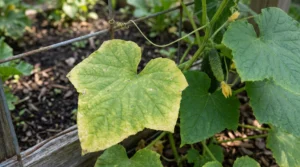
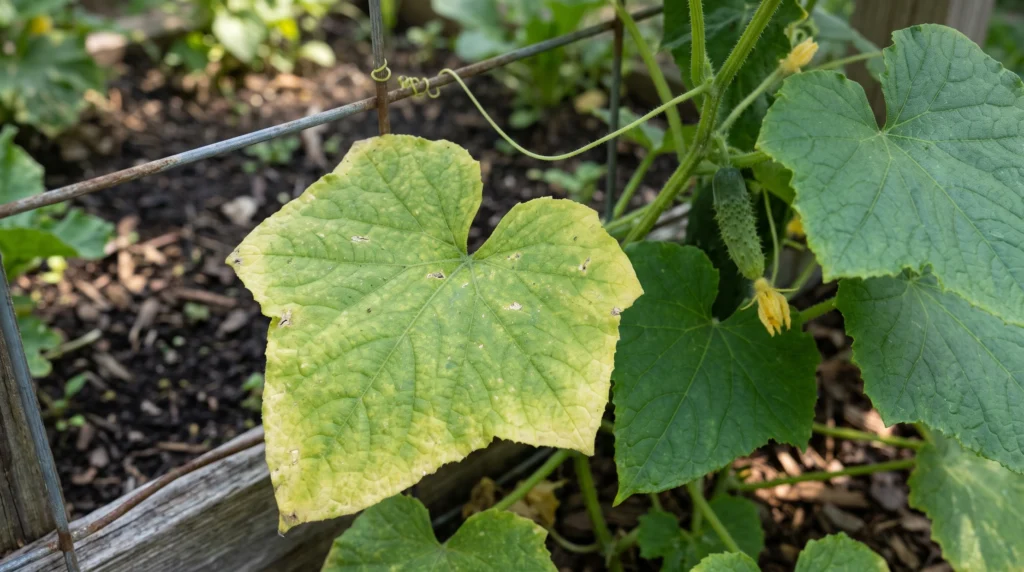
Seeing your cucumber leaves turning yellow can be worrying, especially when the vine was growing well just a few days ago.
But yellowing doesn’t always mean your plant is dying. Sometimes it’s caused by something as simple as an older leaf reaching the end of its life.
Other times, the problem may involve watering, nutrients, pests, disease, or damaged roots.
The first thing to check is where the yellowing appears. Are the bottom leaves affected, or is the newest growth turning pale? Are the leaves evenly yellow, covered in spots, or wilting?
These clues can help you narrow down nine possible causes and decide what to do before applying fertilizer, spraying pesticides, or adding more water.
What Does It Mean When Cucumber Leaves Turn Yellow?
Yellowing is called chlorosis. It happens when a leaf loses chlorophyll, the green pigment plants use to capture sunlight.
Chlorosis is a symptom, not a diagnosis. Several unrelated problems can produce similar-looking yellow leaves, so a single yellow leaf rarely tells you the cause.
The table below is a starting point, not a verdict.
What Yellow Cucumber Leaves May Be Telling You
| Leaf appearance or symptom | Possible cause | What to check first |
|---|---|---|
| A few older, bottom leaves turning yellow | Natural aging or stress | Whether new growth looks healthy |
| Several leaves uniformly pale yellow | Watering problem or nutrient shortage | Soil moisture below the surface and your feeding history |
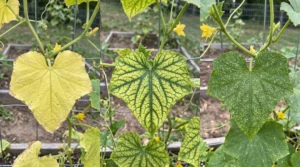
| Yellow tissue between green veins | Possible nutrient imbalance | Whether older or newer leaves are affected, plus soil conditions |
| Tiny pale-yellow speckles | Possible spider mites | Leaf undersides, with a hand lens if you have one |
| Angular yellow patches bounded by veins | Possible downy mildew | Lesion shape and the undersides of the leaves |
| Yellow and green mosaic patterns | Possible viral infection | Leaf distortion and stunted growth |
| Yellowing along with wilting | Root stress, water problems, or disease | Soil moisture and drainage |
9 Possible Causes of Yellow Cucumber Leaves
1. Overwatering and Poor Drainage
Cucumber roots need oxygen as well as moisture. When soil stays saturated, the air spaces fill with water and the roots can’t function well.
Damaged roots can’t supply the plant properly, so leaves may yellow and growth may slow, even though the soil is wet.
A cucumber plant that is drooping even though the soil is wet may be experiencing root stress rather than a shortage of water.
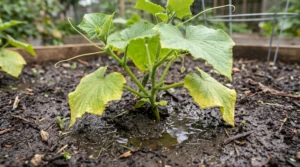
Clues: soil that stays wet for days, yellowing on lower leaves, slow growth, and drooping despite wet soil.
What to do:
- Push a finger or trowel a few inches into the soil and check moisture below the surface.
- Hold off on watering until the root zone has drained and begun to dry slightly.
- Make sure container pots have open drainage holes.
- For future plantings, improve drainage with compost-amended soil or raised beds.
- Avoid digging around the roots, which can add more damage.
Don’t add water just because the plant looks limp.
2. Underwatering and Inconsistent Soil Moisture
Cucumbers are mostly water, and they lose it quickly in hot, sunny, or windy weather.
Dry spells followed by heavy watering stress the plant, and leaves may yellow and growth may stall.
Containers dry out faster than garden beds, so they need closer attention.
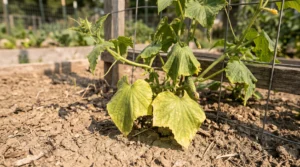
Clues: dry soil a few inches down, leaves that lose firmness, slow growth, and hot or windy weather.
What to do:
- Check moisture in the root zone, not just the surface.
- Water slowly and deeply when the soil is dry.
- Keep moisture reasonably even from week to week.
- Add a layer of organic mulch, such as straw or shredded leaves, to slow evaporation.
- Adjust for rainfall, soil type, container size, and temperature.
Daytime wilting alone doesn’t prove the plant is thirsty. Cucumber leaves can wilt during the day and recover at night when daytime water loss temporarily exceeds what the roots can replace.
Check the soil before you reach for the hose.
3. Nutrient Deficiencies
When cucumber leaves turn yellow, it’s tempting to reach for fertilizer.
But yellow leaves don’t automatically mean the plant needs feeding.
Too much water, damaged roots, and unsuitable soil conditions can also prevent cucumbers from getting the nutrients they need.
One useful clue is which leaves turn yellow first.
According to University of Missouri Extension’s nutrient deficiency guidance, shortages of mobile nutrients such as nitrogen and magnesium often appear on older leaves.
Iron deficiency, by contrast, usually affects newer growth.
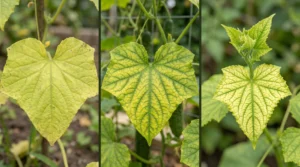
- Nitrogen: Older leaves turn evenly pale green to yellow, growth slows, and leaves may be smaller.
- Magnesium: Older leaves yellow between the veins while the veins stay greener. Other problems can look similar.
- Iron: New leaves show yellowing between the veins. Soil pH matters here, because high soil pH is a common cause of iron deficiency, and uneven watering can contribute too.
What to do:
- Think back over your fertilizer history. Has the plant been fed recently, or never?
- Consider a soil test, which can show pH and nutrient levels.
- Check drainage and root health, since damaged roots can’t take up nutrients even when the soil has plenty.
- If you fertilize, follow the label.
Don’t add Epsom salt or extra nitrogen based on color alone. Without evidence of a real deficiency, extra nutrients won’t fix the yellowing and can cause new problems.
4. Natural Aging of Older Leaves
As cucumber vines grow, some of their oldest leaves may gradually turn yellow and decline.
Older leaves can also receive less sunlight as newer foliage develops, which may contribute to yellowing.
When only a few lower leaves are affected and the rest of the plant remains healthy, this may be part of normal aging rather than a serious problem.
Signs it may be harmless:
- Only a few older leaves are affected.
- New leaves look healthy.
- Growth, flowering, and fruiting continue normally.
- The yellowing isn’t spreading quickly.
In that case, watch the plant before doing anything. You don’t need fertilizer or pesticides for ordinary aging.
Remove leaves only once they’re fully dead, and don’t prune heavily.
If yellowing keeps moving up the vine or hits many leaves at once, it’s more than aging, and you should look at the other causes.
5. Downy Mildew
Cucumber downy mildew is caused by a fungus-like organism and can spread fast.
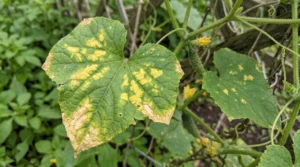
Its signature symptom, according to Purdue Extension, is angular yellow lesions on the leaves.
On cucumbers the spots are often bounded by veins, so they look blocky rather than round.
Lesions can merge and turn brown. After a rain or heavy dew, the undersides of the lesions may show a dark, fuzzy growth.
University of Maryland Extension also notes that foliar diseases usually start as small spots on a few leaves and grow from there.
Cool, humid conditions and prolonged leaf wetness can favor downy mildew development.
The pathogen produces spores that can travel on air currents, allowing the disease to spread between cucumber plants and across growing areas.
What to do:
- Check both sides of the leaf.
- Improve airflow with spacing, and keep foliage as dry as you reasonably can.
- Remove dead or severely damaged foliage when appropriate, but avoid stripping away large amounts of healthy leaf tissue. Leaf removal alone will not stop downy mildew from spreading.
- Contact your local Cooperative Extension office to confirm the diagnosis and ask about management.
Fungicides aren’t interchangeable. Products work against specific diseases and must be labeled for the problem and the crop, so don’t spray until you know what you’re treating.
6. Other Leaf Diseases
Not every yellow spot on a cucumber leaf is caused by downy mildew. Other diseases can produce similar symptoms, so it’s worth looking closely at the color, shape, and texture of the affected areas before deciding what to do.
- Powdery mildew: white, powdery growth on leaf surfaces, followed by yellowing and decline as the infection worsens.
- Bacterial or fungal leaf spots: yellow, tan, or brown lesions, sometimes with yellow borders. The damaged tissue may dry out or drop away.
What to do:
- Look closely at the lesion pattern and the leaf undersides.
- Try not to handle plants while the leaves are wet.
- Water at soil level when practical.
- Remove badly affected leaves and debris.
- Get a proper identification before applying anything.
Fungicides won’t cure bacterial or viral problems, and they shouldn’t be used to guess at unidentified symptoms.
7. Spider Mites and Other Pests
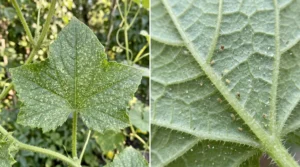
If your cucumber leaves are covered in tiny yellow or whitish speckles, take a closer look underneath them.
Spider mites are one possible cause. These tiny pests feed on leaf cells, leaving pale spots where the green pigment has been damaged.
University of Maryland Extension identifies this type of stippling as a common sign of spider mite feeding.
As the infestation gets worse, the speckles may spread, leaves can turn brown, and fine webbing may appear.
Spider mites often build up quickly during hot, dry weather. Because they’re so small, a hand lens can make them easier to spot.
Other pests can cause yellow spotting too. Squash bugs leave small yellow-green or white stippling and can leave leaves tattered, and aphids can weaken plants and spread viruses.
Not all pest damage looks the same, so don’t assume yellow spots mean mites.
What to do:
- Turn leaves over and inspect the undersides, using a hand lens if you can.
- Identify the pest before you treat.
- Start with appropriate nonchemical methods once you’ve identified the pest. For some small pests, a directed spray of water can help dislodge them, especially from leaf undersides. Avoid damaging the foliage, removing too many leaves, or using the same treatment for every pest.
- Protect beneficial insects, such as lady beetles and lacewings.
- If you use a pesticide, read the label first.
8. Viral Diseases
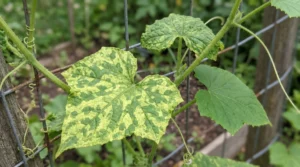
Some cucumber viruses cause yellow-and-green mosaic or mottled patterns.
Leaves may also look puckered or twisted, plants may be stunted, and fruit may be misshapen.
University of Minnesota Extension points out that many viruses cause similar symptoms, so a plant pathology lab is needed to confirm which one you have. Most of these viruses are spread by aphids.
Herbicide drift or lawn-product damage can also resemble a virus.
What to do:
- Look for several symptoms together, such as mottling, distortion, and stunting, rather than yellowing alone.
- Check for aphids and other signs of pest activity, but remember that controlling aphids after they arrive may not prevent virus transmission. Keep weeds around the garden under control, monitor nearby plants, and seek advice from your local Cooperative Extension office if you suspect a viral infection.
Plant viruses generally can’t be cured. If a viral infection is confirmed, removing the affected plant may be recommended to reduce potential sources of infection.
Seek local Extension guidance before removing a plant, because nutrient problems, herbicide injury, and other stresses can produce similar symptoms. One yellow leaf is not enough to diagnose a virus.
9. Temperature Stress and Root Damage
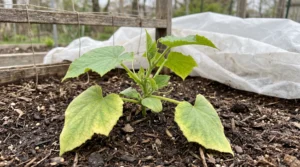
Cucumbers are warm-season plants. Cold soil, a sudden chilly spell, or the shock of transplanting can slow root growth and cause yellowing, especially on young plants.
Roots can also be harmed by compaction, digging near the plant, or too much fertilizer, which builds up salts in the soil.
What to do:
- Think back over recent weather, especially cold snaps and heavy rain.
- Ask whether the yellowing started after you transplanted or fertilized.
- Avoid cultivating close to the roots.
- Keep growing conditions as steady as you can.
- Watch for healthy new growth as a sign the plant is recovering.
If the roots were badly damaged, the plant may recover slowly or not at all.
How to Diagnose Yellow Cucumber Leaves Before Treating Them
Before trying to fix yellow cucumber leaves, take a few minutes to examine the plant and its growing conditions.
You don’t need special equipment to begin.
Checking the soil, comparing older and newer leaves, and looking underneath the foliage can help you decide what to investigate first.
Follow these six steps to narrow down the possibilities. Some diseases and nutrient problems may still require professional testing or identification.
Step 1 — Check Which Leaves Are Yellow
Note whether the yellowing is on older, lower leaves, newer growth at the tips, or spread across the whole plant. Older-leaf yellowing points toward aging, water issues, or some nutrient shortages. Yellowing on new growth points more toward iron or other less mobile nutrients, root problems, or some viruses.
Step 2 — Check Soil Moisture and Drainage
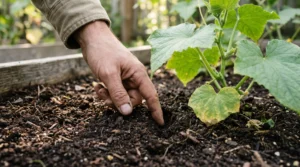
Dig down a few inches. Is the soil soggy, damp, or dry and crumbly? In containers, lift the pot to judge its weight and check that water drains out the bottom.
Step 3 — Examine the Yellowing Pattern
Is the leaf evenly pale, yellow between the veins, marked with angular patches, speckled with tiny dots, or patterned with a yellow-green mosaic? The table earlier in this article can help you match what you see.
Step 4 — Inspect Leaf Undersides
Look for mites, aphids, webbing, fuzzy growth, or lesions. This step catches several problems that aren’t visible from above.
Step 5 — Review Recent Weather and Gardening Activity
Consider heavy rain, heat waves, cold nights, recent fertilizing, transplanting, or nearby herbicide use.
Step 6 — Choose a Targeted Response
Address the most likely cause first rather than applying water, fertilizer, and pesticides all at once.
Multiple treatments can add stress and make it difficult to identify what helped. Monitor soil conditions, existing symptoms, and new growth over the following days.
If yellowing spreads rapidly or signs of serious disease appear, seek advice from your local Cooperative Extension office rather than waiting for the plant to recover on its own.
Should You Remove Yellow Leaves From Cucumber Plants?
You don’t need to remove every yellow cucumber leaf. A leaf that is still partly green may continue contributing to photosynthesis, while a completely yellow leaf may still be alive.
Remove leaves that are fully dead, dry, or severely damaged when appropriate.
Selective removal of diseased foliage may also help with certain problems, but avoid removing too many leaves at once.
Use clean, sharp tools, and clean them between plants when disease is suspected.
Can Yellow Cucumber Leaves Turn Green Again?
Sometimes. Mild yellowing may improve once the underlying problem is corrected. But dead or badly damaged tissue can’t recover, and an old leaf may stay yellow even after conditions improve.
A better sign of recovery is healthy new growth, so judge progress by new leaves rather than old ones.
How to Prevent Cucumber Leaves From Turning Yellow
- Keep soil moisture steady rather than swinging between wet and dry.
- Plant in well-drained soil, or use containers with drainage holes.
- Feed according to soil conditions and label directions, not guesswork.
- Grow cucumbers in a location that receives at least 6–8 hours of direct sunlight daily, where practical.
- Space plants so air can move through the leaves.
- Check leaf undersides regularly for pests.
- Avoid disturbing the roots.
- Choose disease-resistant varieties where disease is a recurring problem.
- Clear plant debris and keep tools clean.
FAQs
Why are the bottom leaves on my cucumber plant turning yellow?
Often it’s natural aging, especially if only a few leaves are affected and the rest of the plant looks healthy. Overwatering, underwatering, and nitrogen or magnesium shortages can also show up first on older leaves, so check soil moisture and watch whether the yellowing spreads.
Why are my cucumber leaves yellow even though I water regularly?
Watering on a schedule doesn’t guarantee the roots have the right amount of moisture. Weather, soil type, and drainage all change how much water reaches them. Check the soil a few inches down before you water.
Do yellow cucumber leaves mean the plant needs nitrogen?
Not necessarily. Nitrogen deficiency is one possibility, usually with pale older leaves and slow growth. Water problems, root damage, pests, and disease can look similar, so rule those out before adding fertilizer.
Why are my cucumber leaves turning yellow with brown spots?
It could be a leaf disease such as downy mildew or a leaf spot, pest feeding, or environmental injury. Check the lesion shape, the leaf undersides, and recent weather. If spots spread, contact your local Cooperative Extension office for identification.
Can my cucumber plant recover from yellow leaves?
Often, yes. It depends on the cause, how severe the damage is, how healthy the roots are, and how much healthy growth remains. Fix the cause and watch for fresh, green new leaves.
Conclusion
Yellow cucumber leaves are a symptom, not a diagnosis. Before choosing a treatment, check which leaves are affected, how moist the soil is, what the yellowing looks like, and whether pests or disease signs are present. Correct the most likely cause, give the plant time, and look to new growth to tell you whether it’s working.