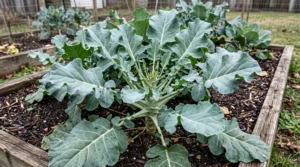
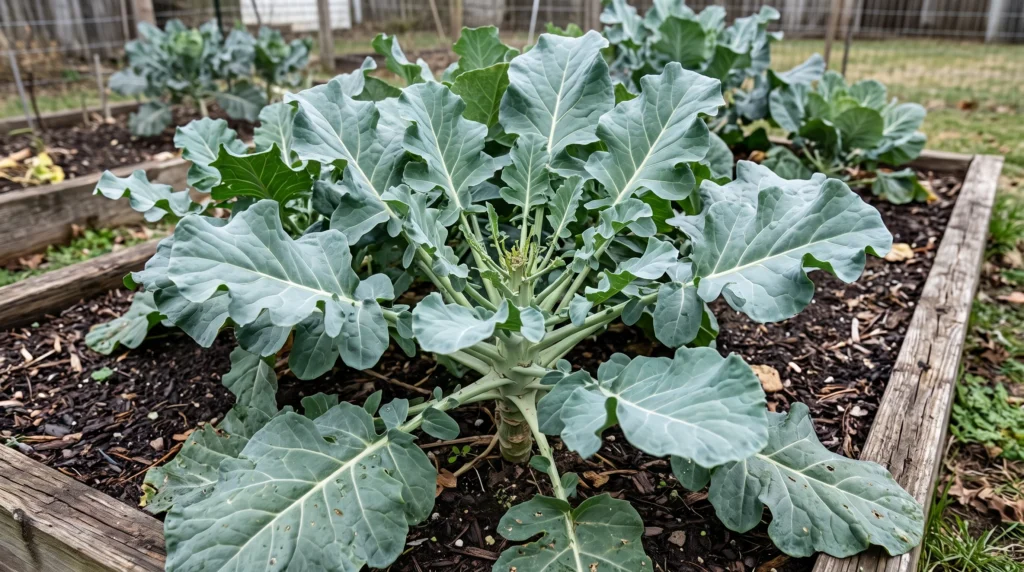
Broccoli not forming heads can be frustrating, especially when your plants have plenty of large, healthy-looking leaves.
This can happen when a plant is still too young, when heat or cold disrupts development, or when stress or damage affects the growing point.
Before adding fertilizer or changing your watering routine, look at the very center of the plant.
A healthy growing point means a head may still develop, while a severely damaged one may prevent a normal central head from forming.
Why Is Broccoli Not Forming Heads When It Has Plenty of Leaves?
The edible broccoli head is a compact cluster of immature flower buds that have not opened yet.
These buds develop at the growing point near the center of the plant.
The plant first builds a strong frame of leaves and roots.
Then, when it is big enough and the weather suits it, the center switches over and starts making buds.
That switch can be delayed or disrupted.
A plant can look lush and green while this is going on, because leaves and heads are separate jobs.
Lots of leaves tells you the plant is alive and growing. It does not tell you that a head is on its way, and it does not prove the soil is short on nutrients.
Variety also matters. Standard heading types make one large central head.
Sprouting broccoli varieties generally produce several smaller flowering shoots rather than one large, compact central head.
Their growth habit is different from standard heading broccoli, so check the variety description before deciding that something is wrong.
What Do You See in the Center of Your Broccoli Plant?
Part the top leaves gently and look straight down into the middle. What you find there points to the cause.
Healthy Leaves but No Visible Head
Check the seed packet or plant tag for the expected days to maturity.
Pay attention to whether the estimate starts from sowing or transplanting, since seed companies use different methods.
For broccoli varieties started indoors, the seed packet may give the expected days to maturity from the transplanting date rather than the sowing date.
Check the instructions carefully so you know when to start counting.
Also check the center itself. Is the growing point present and green? Is new growth coming up in a normal way? If so, and the plant is still within its expected time, waiting is reasonable.
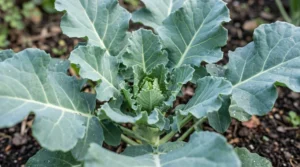
Recent weather matters too. Unusually hot or cold conditions can delay or disrupt head development, depending on the plant’s stage of growth and variety.
A Tiny Broccoli Head That Stopped Growing
A very small head on a plant that is otherwise small or average in size is called a button.
Buttoning means the plant formed a head far too early, before it had enough leaves to support a full-size one.
Stress early in life is a common reason for buttoning.
Young broccoli plants that experience prolonged cold, remain too long in cramped containers, dry out, or suffer transplant shock may form small heads before they have developed enough leaves to support normal growth.
Once a button forms, it usually remains much smaller than a normal central head. Even if conditions improve, it is unlikely to develop into a full-sized head.
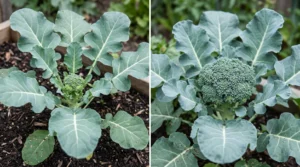
Buttoned broccoli develops a much smaller head than a normally developing plant.
You can still eat the button when it looks firm and tight.
Cut it before the buds loosen. Some plants then send up side shoots, though this is not guaranteed.
A Missing or Damaged Growing Point
The growing point is the tiny tip at the center of the stem where new leaves, and later the head, begin.
A plant with no working growing point is called blind. It keeps making leaves from the sides, but it cannot make a central head.
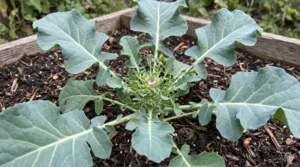
Signs of damage may include a flat or hollow-looking center, crowded or twisted new leaves, or visible injury around the central bud.
The growing point can be damaged during planting or weeding, by cold injury, or through insect feeding.
In some regions, pests such as swede midge can also interfere with normal crown development.
Look closely at the newest growth for distorted leaves, unusual swelling, discoloration, or visible insect damage.
These signs can help you decide whether the growing point has been injured, although they do not identify the exact cause on their own.
This is the case where fertilizer cannot help.
If the growing point is destroyed, you will not get a normal central head.
Side shoots from lower leaf joints may form in some plants, but treat that as a possible bonus, not a promise.
A Small, Loose, or Opening Broccoli Head
Sometimes a head does form, but it is small, uneven or loose, with buds separating or tiny yellow flowers starting to show.
That is a different problem from having no head at all. The head formed, but it developed poorly or is past its best.
Hot weather during head development is a common reason.
If you see loose buds or yellow flowers starting, harvest right away.
A head that has begun to open will not tighten up again, and waiting only lowers the quality.
Use this quick table to match what you see with the likely cause.
| What you see | Likely cause | What to do |
|---|---|---|
| Healthy leaves, tight center, no head | Plant is still young or was slowed by weather | Check days to maturity, then wait |
| Tiny head on a small plant | Buttoning from early stress | Cut the button when firm; side shoots may follow |
| Flat, chewed or dried center | Blind plant (growing point lost) | Don’t wait or feed; replace if the season allows |
| Loose head, separating buds, yellow flowers | Heat, or a head left too long | Harvest now |
| Very leafy during hot weather, no visible head | Possible heat-related delay or disruption | Check maturity and the growing point, review recent temperatures, and maintain suitable soil moisture. |
What Causes Broccoli Not to Form Heads?
Hot Weather During Head Development
Broccoli is a cool-season crop. It grows best when days are mild, and heat can disrupt how the head forms.
Heads may come out loose, uneven or with buds that separate early.
In some cases the plant rushes toward flowering without making a good head.
During extremely hot weather, broccoli can also stay leafy and not start a head at all.
The timing of heat exposure matters.
Broccoli can be particularly vulnerable during early head formation, and prolonged high temperatures can interfere with normal crown development.
How severely the plant is affected also depends on the variety, its stage of growth, and the conditions in which it is growing.
That is why spring crops that mature as summer arrives often struggle, while fall crops that mature into cooling weather often do better.
Local climate changes all of this, so check recent temperatures where you garden and compare them with your area’s planting advice.
If heat is already here, you can’t undo it.
You can ease the stress with steady soil moisture, a layer of mulch and, in strong sun, light afternoon shade. Plan an earlier or later planting for next time.
Cold Weather and Transplant Stress
Cold can cause trouble at the other end of the season.
Young plants that sit through a long cool period early in life can be pushed to form small heads too soon.
Transplants can also be set back by rough handling, damaged roots or a sudden move from a sheltered spot to open ground.
Healthy transplants help.
Older, larger transplants are more likely to button than younger, smaller ones, so a plant that already has lots of leaves is not always the better buy.
Look for compact plants with sturdy stems and good color.
Avoid seedlings that have been left in small containers until their roots are tightly wound, since root-bound plants often struggle to establish.
Preventing this stress is far easier than fixing a plant that has already buttoned.
Inconsistent Watering or Root Stress
Broccoli needs steady moisture in the root zone. Long dry spells slow growth and can stress the plant at a key time.
Soil that stays soggy is just as bad, because waterlogged roots get little oxygen and cannot work well.
Don’t judge by the surface. Push a finger or trowel several inches into the soil beside the plant. If it is dry down there, water deeply.
If it is wet and heavy, hold off and look at drainage. Sandy soil and raised beds dry faster and may need more frequent watering. Clay soil holds water longer and can stay wet after rain.
Fix what you can see, without overcorrecting.
Nutrient Problems and Excess Fertilizer
Broccoli does need enough nutrients to grow a good-sized plant. A plant that is pale, stunted or slow may be short on something, and a soil test can tell you what.
A plant with dark green, healthy leaves usually has enough to grow foliage.
Adding more nitrogen in the hope of triggering a head tends to make more leaves, not more heads.
Look back at what you have applied this season. If you suspect a real nutrient problem, test the soil first and follow the results instead of guessing from leaf size.
Broccoli Variety and Planting Time
Heading types and sprouting types behave differently, and varieties differ in maturity time and heat tolerance.
A variety bred for cool spring weather may do poorly if planted late and forced to head in warm weather.
Check the packet for days to maturity and any notes on planting season.
Your local Cooperative Extension office, which offers free regional gardening advice in many areas, can tell you the best planting windows for your climate.
Can Broccoli Still Form a Head Later?
It depends on the cause and on the growing point.
A plant that is simply young, or was slowed by a cool or dry spell, may still head if the center is healthy.
Give it time and good conditions. A plant that has a small button may give you that button and maybe a few side shoots, but not a full central head.
A plant with a destroyed growing point will not make a normal central head, though it might produce small side shoots from the leaf joints.
To decide whether it is worth keeping, ask three things. Is the center alive?
Is the plant still within its expected maturity window? Does your weather still suit broccoli? If the answers are mostly yes, wait.
If the center is dead and the season is moving against you, it is usually better to pull the plant and use the space.
What Should You Do With a Broccoli Plant That Has No Head?
Work through these checks in order, and change one thing at a time.
Step 1: Inspect the Center of the Plant
Look for a tiny head forming. Check that the central bud is present and healthy. Note whether the growth looks distorted, chewed or missing.
Step 2: Check the Variety and Planting Date
Find out whether you planted a heading or sprouting type. Compare the planting date with the expected days to maturity. Many plants are simply not done yet.
Step 3: Review Recent Weather
Think back over the past few weeks. Was there a heat wave, or a long cold stretch when the plant was small? Does the season suit this variety?
Step 4: Examine Soil Moisture and Plant Health
Check moisture several inches down. Look for signs of root stress, pest damage or poor growth. Fix clear problems, but avoid applying several treatments at once, since you will not know which one helped.
Step 5: Decide Whether to Wait, Harvest, or Replant
Wait if the growing point is healthy and the plant looks immature.
Harvest a small head if it is firm and tight.
Replant if the plant is unlikely to recover and your season still allows a new crop. A damaged center usually means no normal central head, so don’t spend weeks hoping for one.
How Can You Prevent Broccoli From Growing Only Leaves Next Season?
Choose the right variety. Pick one suited to your growing season, and know whether it gives one central head or many shoots.
The seed packet and your local Extension office are good guides.
Plant at the right time. Try to schedule head development for mild weather, not predictable heat. In many areas a fall crop works well. Use regional planting calendars, not fixed dates from elsewhere.
Cut down early stress. Start with healthy seedlings. Don’t let transplants sit in containers until they are root-bound. Harden them off first, which means exposing them gradually to outdoor conditions over several days. Handle the center of the plant gently.
Keep moisture steady. Check the root zone regularly and water based on what the soil feels like. Mulch can help hold moisture. Avoid both long dry spells and soggy soil.
Feed based on soil needs. A soil test shows what is actually missing. Skip routine extra fertilizer, and keep the soil in good shape so roots can grow freely.
Watch the developing head. Look into the center as the plants mature. Spot buttons or damage early. Cut normal heads while the buds are still tight and before any yellow flowers open.
What Should You Do Next?
A leafy broccoli plant without a head is not automatically a failure.
Start by checking the growing point, then the plant’s age, variety, recent weather and soil moisture.
Some causes can be corrected, but a head that has already been disrupted usually cannot be reversed.
Work out what actually went wrong before you add fertilizer, pull the plant or start over.