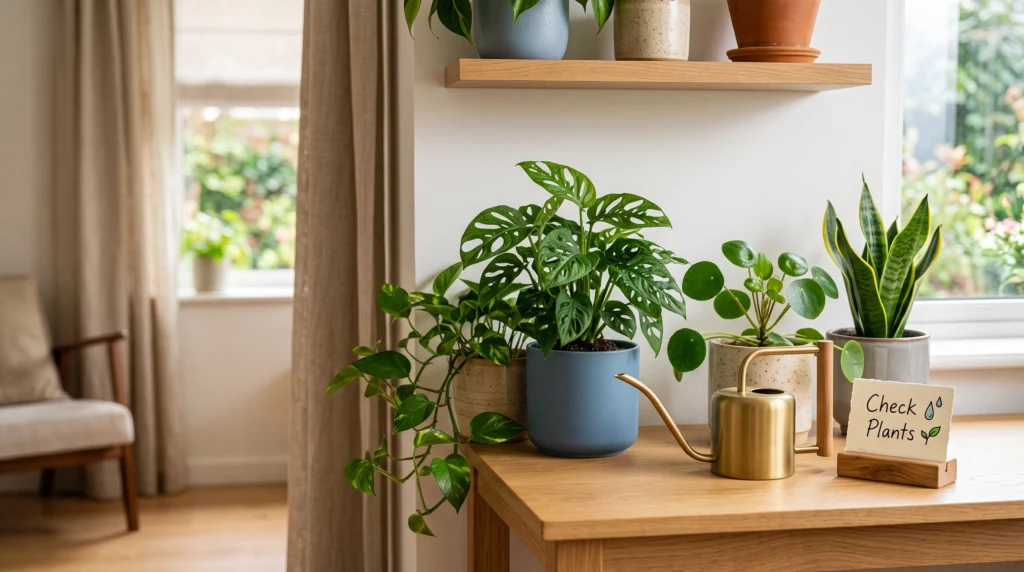
Stop trying to remember a watering day. Build an external system instead: keep your plants and tools somewhere visible, set a reminder to check them rather than to water them, and let the actual soil tell you what to do.
For plants that suit them, a self-watering container or simple drip setup can reduce how much you have to remember.
You’ve probably lived this pattern already. The plants look fine for a week or two, then suddenly they don’t, and it feels like it happened overnight even though it didn’t.
That’s not carelessness. Watering is one of the easiest tasks to lose track of because nothing bad happens the first time you skip it, or the second.
Here’s how to build a system that catches you before it becomes the fifth time.
Why Is It So Easy to Forget to Water Plants With ADHD?
Most everyday tasks have some kind of built in reminder. A dirty dish sits in the sink.
A ringing phone demands attention. Watering doesn’t work that way. Skip it once and the plant looks exactly the same. Skip it for a week and it might too, right up until it doesn’t.
That gap between action and consequence can make a task especially easy to lose track of.
NIMH’s overview of ADHD in adults points to difficulty with organization, time management, and remembering routine daily tasks as common features of adult ADHD, and a task with no immediate feedback is about as easy to forget as they come.
It also doesn’t help that watering feels like it should be simple.
There’s no complicated technique to learn, so it’s easy to assume you’ll just remember.
That assumption is where the trouble starts. The task itself isn’t complicated.
For some people with ADHD, the harder part is remembering that it needs to be done, especially when there is no immediate consequence for putting it off.
If you already have a broader system for staying consistent with garden care, our guide to building an ADHD gardening routine covers that ground.
This piece is about the one task that tends to slip through even a decent routine: watering specifically.
Stop Trying to Remember a Watering Day
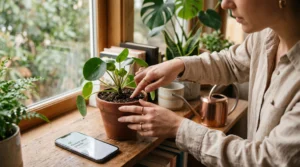
Here’s the shift that matters most: don’t set a reminder to water. Set a reminder to check.
A reminder that says “water the plants” pushes you toward watering whether the plant needs it or not, because by the time the alert goes off, the path of least resistance is just to do the thing it says.
A reminder that says “check the plants” asks you to make a quick decision instead.
That one word difference changes the whole system from a chore you either do or skip into a two minute glance that tells you what’s actually needed.
This matters because a fixed schedule doesn’t hold up well against how plants actually work.
How fast a pot dries out depends on the plant itself, the size of the container, the type of soil, how much light and heat it’s getting, and the time of year.
“Water every Sunday” might be right for one plant and completely wrong for the one sitting next to it.
It also means a routine built around a specific day can quietly fall apart the first time that day gets busy, since there’s no flexibility built in.
UConn Extension’s guidance on watering houseplants makes this point directly: instead of watering by the calendar, check plants regularly and respond to what the soil actually needs.
The same source specifically suggests a self-watering container or wick system for people who are forgetful waterers at times.
Build an ADHD-Friendly Plant Check System
Once “check” replaces “water” as the actual task, the next job is making sure you notice the check needs doing at all.
Make the plants hard to overlook. A plant tucked behind furniture or on a shelf you rarely look at will get missed no matter how many reminders you set.
Group the plants that need more frequent attention somewhere you pass daily, and keep the watering can right there with them instead of stored away.
If tools and plants are both out of sight, there’s more friction between noticing and acting, which can make the task easier to skip.
Attach the check to something you already do. After making coffee, after feeding a pet, before winding down in the evening. Something automatic works better than something you have to remember on its own.
Leicestershire Partnership NHS Trust’s guidance on ADHD strategies points to exactly this kind of external, routine-anchored cue as more reliable than depending on memory alone.
Keep the task small. Not “take care of all my plants,” which is vague enough to avoid starting. Just “check these five pots” is concrete enough to actually begin.
What Should You Actually Check Before Watering?
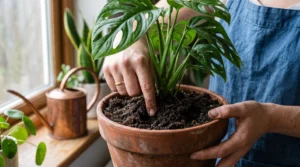
Once you’re standing in front of the plant, the decision itself is simple.
Feel the soil. Push a finger about two inches below the surface rather than judging by how the top looks, since the surface can dry out before the deeper potting mix does.
Illinois Extension’s guide to houseplant watering recommends testing the soil to this depth as a practical way to check whether a plant actually needs water.
Check the pot and drainage. Look for standing water in the saucer, confirm the pot actually has drainage holes, and keep in mind that unglazed clay containers dry out faster than plastic or glazed ones.
Two plants that look identical can dry at very different rates just because of what they’re sitting in.
Look at the plant, but don’t trust it completely. A drooping, wilted plant often does mean it’s thirsty.
But the same Illinois Extension source notes that wilting can also be a sign of overwatering and root stress, so a droopy plant isn’t automatic proof that it needs more water.
If the soil already feels damp, wilting is telling you something else is going on.
A few common symptoms and what they usually point to:
| What you notice | Likely cause | What to check |
|---|---|---|
| Soil is dry and leaves droop | Underwatering | How long since the last watering, and whether water reaches the roots |
| Soil is wet and leaves droop | Possible overwatering or root stress | How long the soil has stayed wet, and whether the pot drains |
| Leaf edges turn brown and crispy | Often underwatering, but can involve light or humidity too | Soil moisture first, then light and humidity |
| Plant wilts again shortly after watering | May be a root problem rather than thirst | Drainage and how the roots look if you can check |
| Water runs straight through and out the bottom | Mix has dried and pulled away from the pot | Whether the root ball is actually absorbing water |
None of these symptoms are proof on their own. They’re a starting point for the soil check above, not a replacement for it.
The Easiest Ways to Make Forgetting Less Consequential
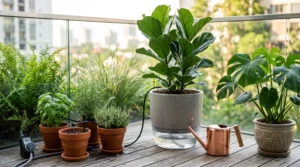
Checking helps, but the most durable fix is reducing how much depends on you remembering to check in the first place.
Think of the options below as backup layers, the same “if one cue fails, another catches you” idea that makes any ADHD friendly system hold up.
Self-watering containers. These hold a reservoir of water at the base, with a wick or basket of soil pulling moisture up as the plant needs it.
Illinois Extension’s explainer on self-watering containers walks through exactly how the reservoir and wick work.
They don’t remove care entirely, since you still need to refill the reservoir occasionally, but they stretch out how often that has to happen and remove the day-to-day guesswork.
Drip irrigation. Worth setting up if you’ve got several containers, an outdoor bed, or regular stretches of time away from home.
It’s more setup upfront, but it turns watering into something that happens automatically instead of something you have to initiate every time.
Moisture meters. A reasonable second opinion, not a replacement for your finger.
The same Illinois Extension source notes a moisture probe “can be useful, but may not always be reliable,” so treat a reading as one more data point rather than the final word.
Group plants by how they like to be watered. Instead of remembering fifteen different rules for fifteen different plants, sort them into two or three groups, such as ones that like to dry out between waterings and ones that prefer to stay consistently moist.
Fewer categories means a faster, easier decision each time you check.
What to Do When You’ve Already Forgotten to Water
If you’re reading this because a plant is already struggling, here’s what actually helps.
Start by checking how dry the root zone really is rather than assuming the worst. Push a finger well below the surface, or gently tip the pot to feel how light it’s become.
Resist the urge to panic water. Dumping a large amount of water on a severely dried-out plant isn’t automatically the best fix, especially if the potting mix has become difficult to re-wet.
Severely dried-out potting mix can actually resist absorbing water again, so a single heavy watering may just run straight through and out the drainage holes without properly rehydrating the root ball.
If the mix has become difficult to re-wet, rehydrate it gradually rather than flooding it all at once.
If a pot has pulled away from the sides of its container, that’s a visible sign the mix has shrunk from dryness and water is likely bypassing the roots entirely rather than soaking in.
After that, give the plant time to recover before changing anything else. Skip the fertilizer and hold off on repotting in the same sitting. One stress at a time is enough.
University of Missouri Extension’s guide to caring for houseplants puts the underlying principle plainly: no general schedule works for every houseplant, and soil kept either too wet or too dry is what actually damages the roots.
That’s really the whole article in one sentence. The fix was never a stricter schedule. It’s paying attention to the plant in front of you.
Which Plants Are Best If You Frequently Forget to Water?
If watering keeps slipping no matter what system you try, it’s worth choosing plants that are simply more forgiving.
Look for drought-tolerant species, thicker or fleshier leaves built to store water, and plants known to handle drying out between waterings without much drama. Containers matter too.
Container size matters too: larger pots can hold moisture longer, but oversized pots can stay too wet.
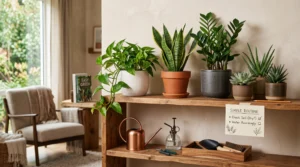
For a full list of specific plants that fit this pattern, see our guide to low maintenance plants for ADHD gardeners.
A Simple ADHD-Friendly Watering Routine You Can Copy
Here’s what the whole system looks like put together:
- Reminder: set regular check-in points to check the plants.
- Check: feel the soil an inch or two down.
- Decide: water only what’s actually dry.
- Water thoroughly, then let the excess drain rather than leaving the pot sitting in a full saucer.
- Stop.
The exact frequency can flex depending on your plants and your home’s light and humidity.
The structure matters more than the schedule: a reminder to check, a quick physical test, and a decision based on what you actually find.
The Best System Is the One You Don’t Have to Think About
None of this depends on becoming a more attentive person.
It depends on building a setup where forgetting once doesn’t cost you the plant: visible placement, a check instead of a chore, a bit of automation where it makes sense, and a few forgiving plants in the mix.
If you’re looking for the wider framework this fits into, our guide to building an ADHD gardening routine covers the rest of the system this piece is one part of.