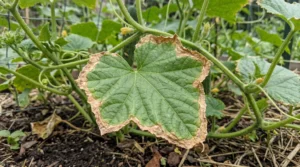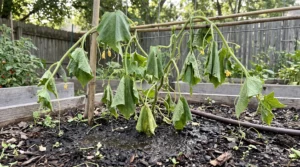
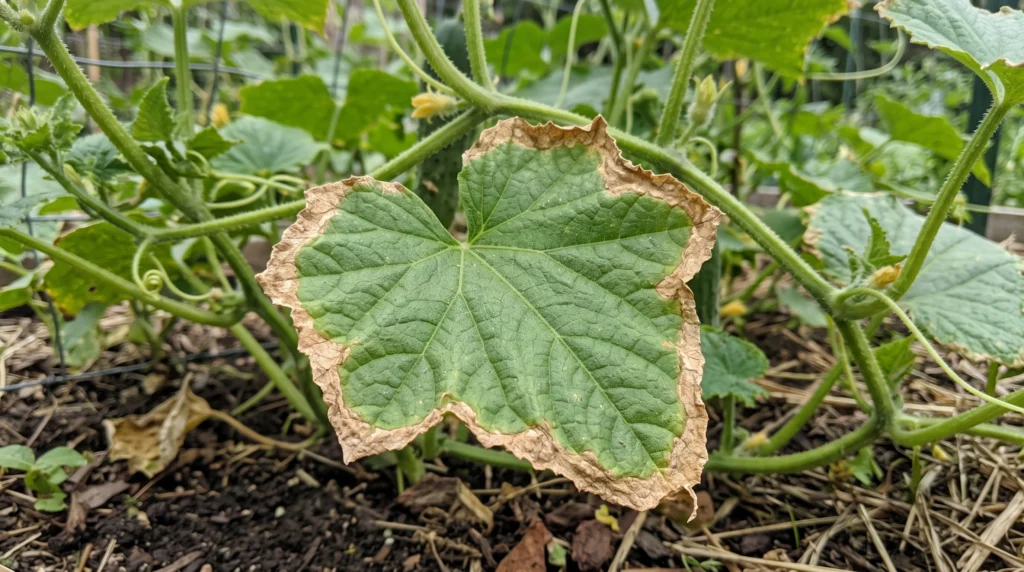
If your cucumber leaf edges are turning brown and crispy, hold off on the watering can, fertilizer, or spray for a moment.
Brown margins mean that part of the leaf has been damaged, but they do not tell you the cause by themselves.
Heat, wind, dry soil, wet soil, fertilizer salts, potassium deficiency, cold weather, and spider mites can produce similar-looking damage.
Less common look-alikes include magnesium deficiency and herbicide injury.
The useful clues are in the pattern: where the browning starts, which leaves are affected first, what the soil feels like, and what happened just before the damage appeared.
A wrong guess can make things worse.
Fertilizer burn is a good example: adding more fertilizer to a salt-stressed root zone only adds to the problem.
Spend a few minutes reading the plant first.
Your 60-Second Check
Before treating anything, check these seven things:
- Are the brown areas mainly along the leaf edges, or are they separate spots?
- Is the soil dry, moist, or soggy a few inches below the surface?
- Did the damage begin during hot, dry, or windy weather?
- Did it appear soon after you fertilized?
- Are older leaves affected before the newer leaves?
- Do you see tiny pale speckles or fine webbing underneath?
- Has the weather recently turned cold and wet?
Several cucumber problems can brown a leaf, but they do not all need the same fix.
Why Are Cucumber Leaf Edges Turning Brown?
Once a leaf margin becomes dry, brown, and brittle, that tissue is damaged or dead.
Leaf margins are often among the first areas to show scorch when water loss becomes greater than the plant can replace. But water stress is only one possibility.
Dry soil, fertilizer or salt injury, potassium deficiency, cold injury, and some pest damage can all cause brown or shriveled leaf margins.
That is all the color tells you.
The cause usually becomes clearer when you look at the pattern across the whole plant.
Brown Edges or Brown Spots? The Difference Matters
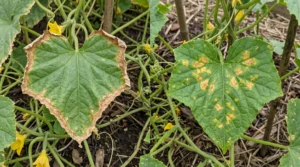
Look closely at the shape of the damage.
If the brown tissue follows the outside rim of the leaf while much of the center remains green, start by investigating stress such as:
- heat
- dry soil
- wind
- fertilizer salts
- potassium deficiency
- cold damage
Brown spots or patches inside the leaf are different.
Downy mildew, for example, can begin as pale green or yellow angular patches between the veins.
Those areas later turn brown, and dark gray to purplish growth may appear underneath when conditions favor the disease.
The University of Minnesota describes this pattern in its guide to cucumber leaf spots and downy mildew.
Is the damage following the edge of the leaf, or forming separate lesions inside it?
If you are seeing spots, lesions, or other disease-like symptoms rather than simple edge scorch, our guide to common vegetable garden diseases can help you narrow the problem further.
Which Leaves Are Browning First?
Leaf age is another useful clue.
If older, lower leaves are affected first, potassium deficiency becomes more plausible.
Yellowing mainly between the veins can also point toward a less common magnesium problem.
Older leaves can also show the effects of long-running plant stress before newer foliage does.
A few aging leaves near the base of an otherwise healthy plant may also decline naturally later in the season, so do not diagnose a nutrient problem from one leaf.
If the newest leaves are also developing brown margins, look more closely at the root zone and recent environmental stress.
If much of the plant develops edge damage at roughly the same time, think about what happened just before it appeared.
- a heat wave?
- strong drying wind?
- a missed watering?
- heavy fertilizing?
- a sudden spell of cold, wet weather?
Timing can be more useful than the color itself.
Is It Heat, Wind, or Dry Soil?
Start here because it is one of the easiest causes to check.
Cucumber leaves are large, so they can lose a lot of water during hot or windy weather.
If the roots cannot replace that water quickly enough, the margins may begin to dry and turn brown.
Check the soil below the surface.
Do not judge only by the top layer.
The surface can look dry while the root zone is still moist, or look slightly damp while the soil deeper down has become much drier.
Heat or water stress becomes more likely when:
- the soil is dry below the surface
- browning appeared during hot or windy weather
- the leaves also droop during the afternoon
- the plant is in a container that dries quickly
- exposed outer leaves show the worst damage
Wind matters too. Dry moving air can increase water loss from leaves even when temperatures are not extreme.
If your cucumber leaves wilt during the day and recover at night, that symptom deserves its own diagnosis.
Afternoon wilting does not always mean the plant needs more water.
Can Uneven Watering Cause Crispy Edges?
Yes.
One severe dry spell can damage leaf margins, but repeated swings between very dry and very wet soil can also stress a cucumber plant.
Light surface watering can be misleading. The top layer becomes damp while much of the root zone stays dry.
Containers can change fastest because there is less soil to buffer moisture swings.
Look at what happened over the previous few days, not only what the soil feels like at this moment.
A cucumber that dried badly yesterday may still show new damage today even after you watered it.
The goal is steady moisture without keeping the root zone saturated.
What If the Soil Is Wet but the Edges Are Still Crispy?
Wet soil can still leave a cucumber looking water-stressed.
Roots need air as well as moisture. When soil stays saturated, the spaces that normally contain air fill with water.
Stressed roots may then struggle to function normally.
Check for:
- soil that remains soggy for long periods
- slow growth
- persistent drooping
- yellowing lower leaves
- poor drainage
If those signs occur together with crispy edges, do not automatically add more water.
The plant may have plenty of water around its roots but still be unable to use it effectively.
If the plant is also drooping while the root zone stays wet, see our guide to why a cucumber plant droops even though the soil is wet for a deeper root-zone and drainage check.
Could Too Much Fertilizer Burn the Leaf Edges?
Yes.
Fertilizers contain soluble salts.
When those salts become too concentrated in the root zone, they can damage roots and contribute to brown or shriveled leaf margins.
Fertilizer injury becomes more likely when:
- the damage appeared soon after feeding
- you used a concentrated liquid fertilizer
- you fertilized more often than the product instructions recommend
- the cucumber is growing in a container
- a pale or white crust has formed on the soil or pot rim
If the timing strongly points toward excess fertilizer, stop feeding while you assess the plant.
For a container with good drainage, watering thoroughly can help move excess soluble salts out of the potting mix.
Avoid using a fixed flushing volume because container size, soil mix, drainage, and salt level all vary.
Potassium deficiency and too much fertilizer can both produce brown margins.
That is why adding more fertilizer is a poor way to test whether a cucumber needs nutrients.
Could It Be Potassium Deficiency?
Potassium is the “K” in the three numbers printed on a fertilizer label.
Because potassium can move from older plant tissue to younger growth, deficiency symptoms often appear on older leaves first.
In cucurbits, potassium deficiency can produce pale or yellowed margins followed by tan or scorched-looking edges. University of Florida IFAS describes marginal yellowing and scorch on older leaves as part of the deficiency pattern.
Look for several clues together:
- older leaves affected before new growth
- yellowing near the edge before browning
- damage moving inward from the margin
- several older leaves showing a similar pattern
- weaker growth or fruit development alongside the leaf symptoms
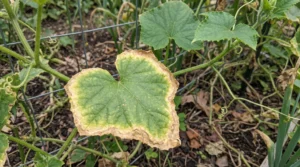
One brown leaf is not enough to confirm potassium deficiency.
If nutrient problems seem likely, a soil test can help show whether potassium levels or soil conditions may be contributing.
Adding extra potassium to a root zone already stressed by salts may make matters worse.
Our guide to fertilizer for vegetable gardens explains the fertilizer numbers and broader feeding decisions.
Could Magnesium Deficiency Look Similar?
It can, but the pattern is usually different from classic potassium-type margin scorch.
Magnesium deficiency in cucurbits usually begins as yellowing between the veins on older leaves.
As the problem progresses, the yellow tissue may turn brown and die.
The University of Kentucky guide notes that this problem is more likely in sandy, low-pH soils and is seen more often in muskmelon than in cucumber.
That makes magnesium a useful look-alike to know, but not the first explanation for a cucumber with only a crispy brown rim.
If the yellowing is mainly between green veins, check soil pH and nutrient status before adding magnesium or Epsom salts.
Can Cold, Wet Weather Cause Brown Leaf Edges?
Yes.
Cucumbers are warm-season plants, and sudden cold, wet conditions can damage the leaves.
The University of Minnesota notes that cucumber leaf edges exposed to cold injury may turn olive green and later brown.
This is easy to miss because crispy leaf edges are usually associated with hot weather.
Do not judge only by today’s conditions.
Think back over the previous few nights. A recent cold spell may explain damage that becomes more noticeable after warmer weather returns.
If more cold weather is expected, young cucumber plants may need temporary protection.
Could Spider Mites Be Making the Leaves Crispy?
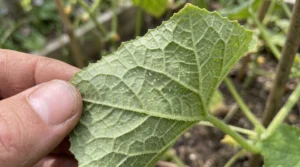
Possibly, but the brown edge alone is not enough to tell.
Turn the leaf over.
Spider mites feed from leaf tissue and often leave many tiny pale or yellow speckles.
With heavier infestations, fine webbing may appear around veins or between leaves.
They tend to become more troublesome during hot, dry weather, which means mite damage can appear at the same time as ordinary heat stress.
Look for:
- many tiny pale dots
- dull or bronzed-looking leaves
- fine webbing
- damage spreading during dry weather
A simple check is to hold a sheet of white paper under the leaf and tap it.
Tiny moving specks can be a clue that mites are present.
Minnesota Extension includes stippling and webbing among useful signs when diagnosing mites on cucumber leaves.
Do not treat for mites based only on a crispy margin.
Could Herbicide Injury Be Involved?
Keep herbicide injury lower on the list unless the newest growth looks distorted rather than simply scorched.
Herbicide injury can cause cupped or curled leaves and twisted, irregular new growth.
A useful clue is the pattern: drift or contaminated soil amendments may affect several plants, sometimes across more than one species, rather than only one cucumber leaf.
Think about recent spraying nearby and whether new compost, manure, mulch, or soil was added before the symptoms appeared.
If herbicide exposure seems possible, avoid adding more sprays or fertilizer simply to counter the damage, and contact your local Extension service for advice that fits the product and situation.
What If the Cucumber Is Growing in a Container?
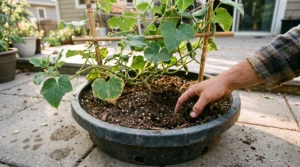
Pots change the diagnosis because both moisture and fertilizer levels can swing faster.
A container cucumber may develop brown leaf edges because the pot dries quickly during warm weather, but the opposite can also happen if the lower potting mix remains wet.
Check:
- soil moisture a few inches down
- whether drainage holes are open
- whether water leaves the pot freely
- whether a white salt crust is forming
- whether roots are growing heavily through the drainage holes
- whether the container becomes very hot in afternoon sun
A dark container exposed to strong sunlight can heat the root zone quickly.
Sometimes moving the pot away from reflected heat or protecting the sides from intense afternoon sun is more useful than changing the fertilizer.
Diagnosis Table
| What you see | May point to | Check first |
| Crispy edges after hot, dry, or windy weather | Heat or water stress | Soil moisture and recent weather |
| Wet soil, drooping, and brown edges | Root stress possible | Drainage and root zone |
| Edges brown soon after feeding | Fertilizer or salt injury possible | Recent fertilizer use |
| Older leaves yellow, then brown at margins | Potassium deficiency possible | Leaf age and soil/fertilizer history |
| Older leaves yellow between green veins, then brown | Magnesium deficiency possible | Soil pH and nutrient status |
| Olive-to-brown margins after cold, wet weather | Cold injury | Recent weather |
| Pale speckles with fine webbing | Spider mites | Leaf undersides |
| Twisted or cupped new growth on several plants | Herbicide injury possible | Recent spraying or soil amendments |
| Angular yellow patches later turning brown | Downy mildew possible | Lesion shape and leaf underside |
No single row proves the cause. Use the table to decide what to inspect next.
Should You Cut Off Brown, Crispy Cucumber Leaves?
Not automatically.
A leaf that still has plenty of healthy green tissue can continue helping the plant.
Removing every partially damaged leaf may leave the cucumber with much less useful foliage.
As a practical rule:
- leave leaves that are still mostly green
- remove leaves that are almost completely dead when necessary
- if disease is involved, follow the removal advice for that specific disease
Avoid stripping many leaves at once.
Healthy cucumber foliage also helps shade developing fruit and the soil beneath the plant.
Will the Brown Edges Turn Green Again?
No.
Once the tissue has become dry and brown, it will not turn green again.
Judge recovery by the new growth instead.
- Are new leaves opening normally?
- Has the browning stopped spreading?
- Is the plant growing again?
- Has persistent wilting or yellowing improved?
If fresh leaves remain healthy, the problem may already be under control even though the old damaged edges still look bad.
What Should You Do Right Now?
- Check soil moisture below the surface.
- Decide whether the damage is mainly along the margins or inside the leaf.
- Note which leaves were affected first.
- Think back over recent heat, wind, rain, and cold nights.
- Review what fertilizer you used and when.
- Turn over several leaves and check for stippling or webbing.
- If new growth is twisted or cupped, think about recent herbicide use nearby or new compost, manure, or mulch.
- Correct the cause that best matches the full pattern.
- Make one change at a time.
- Watch the new growth rather than expecting old brown tissue to recover.
Making several changes at once can create a second problem and also makes it harder to know what actually helped.
When Should You Be More Concerned?
Take a closer look if:
- the browning spreads quickly
- new leaves are developing the same damage
- the plant remains wilted
- angular yellow or brown lesions appear
- several cucumber plants develop the same unusual symptoms
- stippling and webbing continue to spread
- stems or roots also begin looking unhealthy
- plant growth slows sharply
Those extra symptoms suggest the problem may involve more than temporary scorch.
FAQs
Can a cucumber plant still produce fruit with brown leaf edges?
Often, yes. A plant with some damaged margins but plenty of healthy green foliage may continue flowering and producing fruit. The bigger concern is widespread leaf loss.
Why are the edges crispy even though I water often?
Frequent watering does not always mean the root zone is getting the right amount of moisture. Shallow watering can leave deeper soil dry, while poor drainage can keep roots too wet. Check below the surface before watering again.
Can too much fertilizer burn cucumber leaves?
Yes. Excess fertilizer salts can stress roots and contribute to brown or shriveled leaf margins.
Can potassium deficiency cause brown cucumber leaf edges?
Yes. Potassium deficiency can produce yellowing followed by marginal scorch, especially on older leaves. Brown edges alone, however, do not prove that potassium is lacking.
Can I tell potassium deficiency from fertilizer burn without a test?
Timing and pattern can help, but they do not prove the cause. Fertilizer injury becomes more suspicious when browning starts after feeding or salt buildup is visible, while potassium deficiency usually develops first on older leaves with yellowing near the margins. If the distinction matters, soil testing and the plant’s full symptom pattern give better evidence than adding more fertilizer as a test.
Should I remove a cucumber leaf with crispy edges?
Not if most of the leaf is still healthy and green. Remove leaves mainly when they are badly damaged, dead, or when management of a diagnosed disease calls for removal.
Treat the Cause, Not the Brown Edge
Cucumber leaf edges turning brown are a symptom, not a diagnosis.
Start with the soil, recent weather, and which leaves were affected first. Then check your fertilizer history and the undersides of the leaves.
Do not add water, fertilizer, or a spray simply because the edge looks brown.
Find the reason the tissue died, correct that problem, and use the next leaves to judge whether the plant is recovering.