You’ve probably tried this before. You buy a plant, feel excited for two weeks, then forget it exists.
Or you decide to “garden every day,” keep it up for four days, then quietly give up the first time life gets busy.
That’s not a discipline problem. It’s a task-size problem.
These ADHD gardening tips are built around one simple idea: make the task small enough that starting feels possible.
The habit that actually works for an ADHD brain isn’t a daily gardening routine.
It’s one five-minute task, done right after something you already do — after your coffee finishes brewing, after your dog’s morning walk.
Pick a plant that forgives missed days, pair it with one tiny task, and you build something that survives a hard week instead of one that collapses the first time you skip a day.
Why Typical Gardening Advice Doesn’t Work for ADHD Brains
Most gardening advice says things like “check your plants daily” or “spend fifteen minutes in the garden each morning.”
That sounds simple enough, but it quietly assumes three things: that you’ll remember to start, that you’ll know exactly what to do once you’re out there, and that you’ll have the energy for it on any given day.
For a brain that struggles with task initiation — the part of executive function responsible for actually starting something, not just wanting to — that’s three separate hurdles hiding inside one vague instruction.
This is sometimes called task paralysis: you want to do the thing, you know it matters, and you still can’t make yourself begin.
It’s not laziness.
It’s a mismatch between how the advice is written and how your brain actually starts tasks.
The fix isn’t more motivation. It’s a smaller, more specific task.
Why Small, Specific Tasks Actually Stick
Behavior researcher BJ Fogg spent two decades at Stanford’s Behavior Design Lab studying why some habits stick and others fall apart within a week.
His conclusion, boiled down: a behavior only happens when three things line up at once — motivation, ability, and a prompt.
You can’t control how motivated you feel on a random Tuesday.
You can control how easy the task is. Shrink it small enough, and you don’t need much motivation to do it anyway.
That’s the whole logic behind a five-minute garden task.
It’s small enough that even a low-motivation day can’t stop you.
There’s a second reason it works: gardening gives you fast, visible proof that something changed.
Pull a weed, and the bed looks different right away.
Water a wilting plant, and by evening it’s standing up straighter.
That kind of quick feedback tends to matter more for ADHD motivation than a reward that shows up weeks later.
Time outside may help too, separately from the task itself.
CHADD, the national ADHD support and advocacy organization, points to a growing body of research connecting green space with better attention.
A 2024 review on nature exposure and ADHD symptoms in children found a possible connection, though the evidence was limited to seven mostly observational studies in children and does not suggest nature replaces ADHD treatment.
A 2024 review looked specifically at nature exposure and ADHD symptoms in children and found a real link — though it covered only seven studies, mostly observational and mostly in kids, and its authors were careful to frame nature as something that can support treatment, not replace it.
None of this means gardening treats ADHD.
It means a small, repeated garden task gives your brain two things it tends to respond well to — a quick win and a bit of green space — without asking for willpower you might not have that day.
Pick Forgiving Plants Before You Pick a Routine
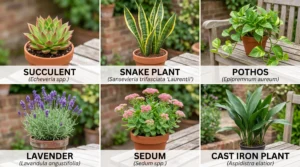
Decide what you’re growing before you decide what task you’ll do each day.
This matters more than most gardening advice admits.
If your plant needs precise, frequent care, one missed day can turn into a struggling plant, and a struggling plant becomes a reason to quit the whole habit.
Look for plants that tolerate occasional missed watering instead of punishing you for forgetting:
- Succulents and jade plants store water in their leaves, which generally makes them more forgiving of a missed watering than plants that need consistently moist soil.
- Snake plant (also sold as mother-in-law’s tongue) handles lower light and less frequent watering, which is why it’s often recommended for people who want a lower-maintenance houseplant.
- Pothos is forgiving indoors and tends to give a visible warning — drooping leaves — before it’s in real trouble.
- Lavender and rosemary are drought-tolerant herbs that generally prefer soil to dry out between waterings.
- Sedum, sometimes called stonecrop, works well outdoors in beds or containers and is known for tolerating dry conditions better than most flowering plants.
- Cast iron plant lives up to its name indoors, tolerating lower light and less frequent care better than many other houseplants.
If you’re growing in containers, a self-watering pot gives you extra buffer — a reservoir helps hold moisture, so a missed day or two is less likely to stress the roots.
Plenty of forgetful gardeners use these for exactly that reason.
None of this means a plant can be ignored forever.
It means the plant forgives the version of care you’re actually going to give it, instead of the version the plant tag assumes you will.
The 5-Minute Garden Habit: Five Tasks That Actually Fit
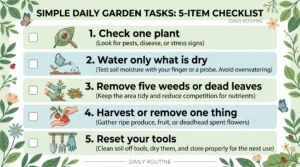
Once you’ve picked a plant that can handle some inconsistency, here’s the actual task list.
Each one takes about five minutes, whether you’re working with a windowsill pot or a backyard bed.
| Task | What You Do | Time |
|---|---|---|
| Check one plant | Look at the soil and leaves for signs of stress | 1 minute |
| Check soil moisture | Water only if the soil is actually dry | 1 minute |
| Remove five weeds or dead leaves | Create one small visible improvement | 1 minute |
| Harvest or remove one thing | Enjoy a quick result from your effort | 1 minute |
| Reset your tools | Make tomorrow’s task easier to start | 1 minute |
Check One Plant
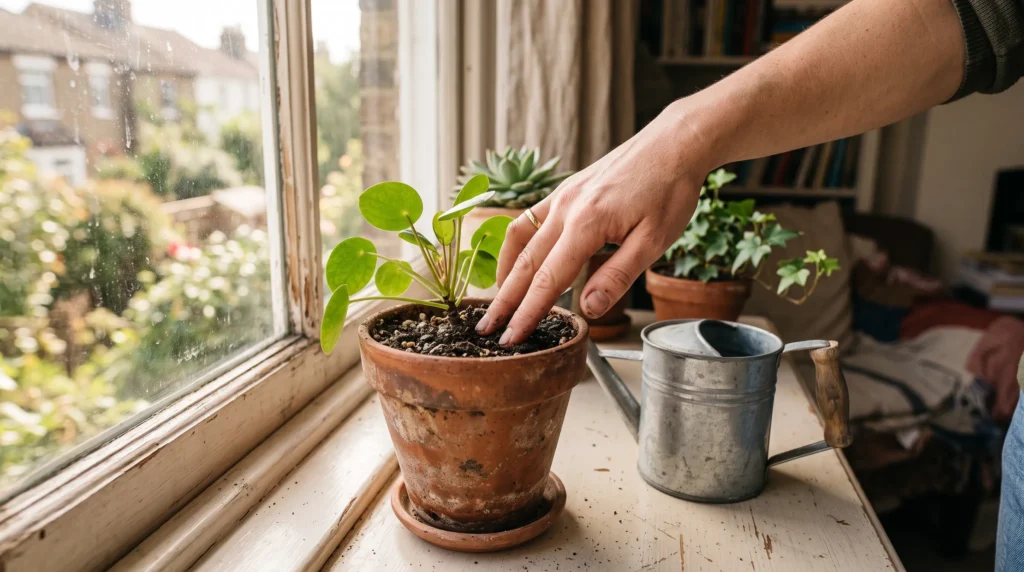
Before you do anything else, just look. Check the soil — dry an inch down, or still damp? Look at the leaves for anything unusual: yellowing, wilting, spots.
You’re not fixing anything yet. You’re gathering information, which is often the hardest part to start and the easiest part to finish.
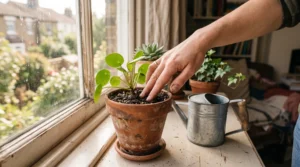
If you’re a container gardener, this can mean checking one pot on a windowsill.
If you’re working with a yard or beds, it can mean walking one section instead of the whole garden.
One plant, or one small patch, is enough — you’re not expected to cover everything in five minutes.
Water Only What’s Actually Dry
Skip watering everything on a fixed schedule.
Plant needs vary by species, season, and how much sun a spot gets, so a set schedule usually means overwatering some plants and underwatering others. Stick a finger into the soil.
If it’s dry, water. If it’s not, move to the next task instead.
Pull Five Weeds (or Five Dead Leaves)
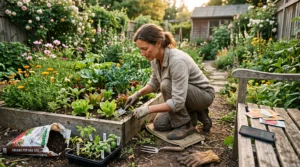
Outdoors, pull five weeds — not the whole bed, just five. Indoors or in containers, pinch off five yellow or dead leaves instead.
Picking a specific number does two things: it gives you a finish line, and it stops the task from quietly turning into an hour you didn’t plan for.
Harvest or Remove One Thing
Pick one ripe tomato, cut one flower for a vase, or pull one weed that’s about to go to seed.
This step exists for the payoff — you get to see or hold the result of the work right away, which is the fast feedback your brain is looking for.
Reset Your Tools
Put the watering can back where you’ll actually see it tomorrow. Wipe soil off your hands and the trowel.
This isn’t cleaning for its own sake — it’s clearing away the friction that makes tomorrow’s five minutes harder to start.
Attach the Task to Something You Already Do
A five-minute task only works if you remember to do it.
Instead of relying on memory, attach it to something already built into your day — what Fogg calls an anchor. Right after the coffee maker finishes.
Right after you close your laptop for the night.
Right after the dog’s morning walk.
Pick one anchor and one task from the list above.
Keep the plant, or the watering can, somewhere you’ll actually see it at that moment — on the counter by the coffee maker, by the back door you walk the dog through.
The visible object does the reminding so your memory doesn’t have to.
Set Up Your Garden So You Can’t Forget
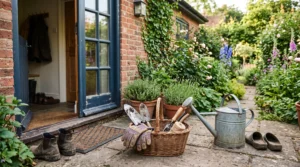
A little setup prevents a lot of forgetting. Keep your tools somewhere visible, not tucked in a shed you have to walk to and open.
A basket by the back door or a small caddy on a windowsill works better than a shelf you never see.
Label your plants, especially if you’re growing more than two or three.
A small tag with the plant’s name and roughly how often it likes water saves you from guessing later.
If you’re managing more than a few plants, split them into small zones instead of treating the whole space as one unit — the pots by the kitchen window, the raised bed out back, the hanging basket on the porch.
Checking one zone at a time feels far smaller than checking “the garden.”
What to Do When the Garden Gets Away From You
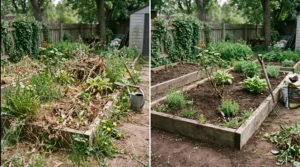
At some point, you’ll look outside and see two weeks of weeds, or a pot of soil so dry it’s pulled away from the sides.
That’s not a sign the system failed. It’s a sign you need a reset, not a restart from zero.
Give yourself three days instead of one big cleanup session:
Day one: Remove anything obviously dead. Don’t diagnose, don’t fix — just clear it out.
Day two: Water whatever looks like it needs it most. Not everything, just the plants in real trouble.
Day three: Handle weeds — five or ten minutes’ worth, not the whole bed.
You don’t need to “make up” the days you missed.
The garden isn’t keeping score. Once the three days are done, go straight back into your five-minute habit.
Low-Energy Days Still Count
Some days, five minutes still feels like too much.
That’s a different problem from the garden being a mess — this is about how much you have to give that day, not how much work is sitting there.
On those days, lower the bar again.
Looking at your plant from across the room counts.
Checking the soil with one finger counts.
You’re not trying to accomplish anything on a low day — you’re trying to keep the habit alive so it’s still there once your energy comes back. A missed day doesn’t erase the habit.
A string of missed days you never restart is what actually ends it.
Keeping It Going Long-Term
Once the five-minute habit feels automatic, a few small additions keep the garden healthy without turning it back into a big project.
Notice patterns instead of memorizing rules.
If a plant keeps wilting by Thursday, that says something about your week, not just about the plant.
Expect the routine to shift with the seasons.
A plant that needs daily water in July might need none for weeks in winter.
Adjust the task, not your sense of whether you’re doing it right.
Deal with small problems while they’re still small — a few weeds, one yellowing leaf, dry soil in one corner.
Catching these early is what keeps the three-day reset a rare event instead of a monthly one.
Frequently Asked Questions
Can gardening help with ADHD symptoms?
Gardening may support wellbeing, focus, and a sense of calm, but it is not a treatment or cure for ADHD.
The value of an ADHD-friendly garden routine is that it creates a small, rewarding activity with clear results.
A five-minute task can provide structure, movement, and time connected with nature without requiring a large amount of energy or planning.
What if I don’t have a garden or outdoor space?
You don’t need a backyard to use this approach.
A windowsill herb, a houseplant, or a small container garden can work just as well.
The goal is not the size of the garden — it is creating a small habit that feels easy enough to return to.
How many minutes a day should someone with ADHD spend gardening?
There is no perfect number of minutes that works for everyone.
The five-minute approach is simply a starting point.
Some days you may do less, and some days you may naturally continue longer.
The important part is creating a task small enough that starting does not feel overwhelming.
The goal was never a perfect garden.
It was a habit small enough to survive your actual life, on your actual bad days, with the actual amount of attention you have to give it.
You do not need to become someone who spends an hour gardening every morning.
Start with one plant.
Five minutes.
One small action.
That is enough to begin.
A garden does not need your perfect attention. It just needs you to come back.