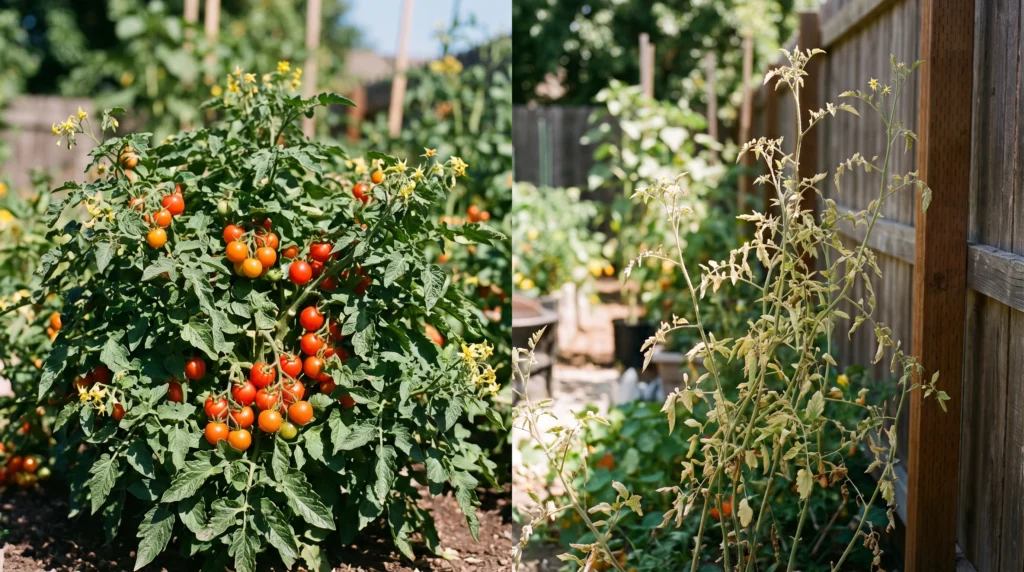
If your tomato plant isn’t getting enough direct sunlight, it may grow tall and thin, produce fewer flowers, set less fruit, and develop fruit more slowly.
The plant probably won’t die from low light alone, but it won’t perform the way a full-sun tomato does either.
That’s the short version. The more useful question is how to tell whether sunlight is actually your problem, since several other issues can look almost identical.
Here’s what’s really going on, and how to figure out what to do next.
Why Sunlight Matters So Much to Tomatoes
Tomatoes use sunlight to power photosynthesis, the process that turns light into the sugars a plant uses to grow, flower, and ripen fruit.
Think of sunlight as the plant’s fuel supply. A tomato plant growing in full sun has a steady, generous supply of that fuel to spend on new stems, leaves, flowers, and fruit.
A plant growing in partial shade receives less light for photosynthesis, which means less energy is available to support growth and reproduction.
It may respond by producing more elongated growth as it reaches toward available light, while flowering and fruit production can decline.
That’s why a shaded tomato plant can look reasonably green and alive while still giving you a disappointing harvest.
Tomatoes need enough light to support healthy growth, flowering, fruit development, and ripening.
What Happens If Tomato Plants Don’t Get Enough Sun?
When light is limited, that energy shortage shows up in a few predictable ways.
The plant becomes tall and leggy
A tomato plant that isn’t getting enough light will often stretch upward, reaching toward whatever brightness it can find.
The stems grow thin and tall, and the gaps between leaves (called internodes) get noticeably longer than normal.
This stretching, sometimes called legginess, is the plant’s attempt to find more light rather than a sign of strong, healthy growth.
Flower production can drop
Producing flowers takes energy. When a tomato plant is running on a limited light budget, it often produces fewer blossoms than it would in full sun.
Fewer flowers means fewer chances for fruit to form later on, since every tomato starts as a pollinated flower.
You may get fewer tomatoes
Less flowering usually leads to less fruit, but light also affects fruit development directly.
A shaded plant may also produce fewer tomatoes overall, because inadequate light can limit the plant’s ability to support productive growth and fruit development.
Fruit may ripen more slowly
Tomatoes that form on a shaded plant may develop more slowly because the plant has less light available to support growth and fruit production.
However, sunlight is not the only factor involved in ripening. Temperature, variety, fruit maturity, and overall plant health can have a major effect on how quickly a tomato changes color.
Can a Tomato Plant Grow Without Much Sun?
Yes. A tomato plant can survive and even keep growing in a spot that doesn’t get much direct sun.
But surviving and producing well are two different things.
It’s entirely possible to have a tomato plant that looks green, puts out new leaves, and seems generally healthy, while producing only a handful of tomatoes all season.
The plant isn’t struggling to stay alive; it simply doesn’t have enough light energy to put toward fruit.
This is one of the more confusing parts of growing tomatoes in a shady spot, because the plant doesn’t necessarily look sick. It just underperforms.
If your goal is a good harvest, low light can become a significant limitation.
How Do You Know If Lack of Sun Is the Problem?
This is the part most tomato-growing advice skips, and it’s often the most useful question a gardener can ask.
Several tomato problems share overlapping symptoms, so before you assume sunlight is to blame, it helps to look at the whole picture.
| What you’re seeing | Could low light explain it? | What else to check |
|---|---|---|
| Tall, thin stems | Yes | Seedling stage, plant spacing |
| Long gaps between leaves | Yes | Direction the plant is leaning toward light |
| Few flowers | Yes | Heat or cold stress, excess nitrogen |
| Flowers but little fruit | Possible | Pollination, temperature, plant stress |
| Slow-ripening fruit | Yes | Temperature, variety, overall plant health |
| Yellow leaves | Possible, but not enough to diagnose a light problem | Watering, nutrients, pests, disease |
A few questions can help you narrow things down:
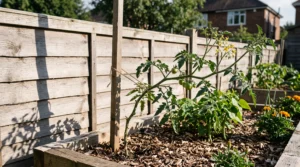
- Is the plant leaning or stretching noticeably toward one direction? That’s a strong sign it’s reaching for light.
- How many hours of actual, direct sun hit the leaves, not just bright daylight or reflected light?
- Are trees, fences, a roofline, or a neighboring building blocking part of the day’s sun?
- Has anything changed recently, like a tree filling in with leaves or a new structure casting shade?
- Is the plant otherwise green and free of spots, curling, or wilting?
If the plant is stretched, sparsely flowered, and getting only a few hours of weak or filtered light, sunlight is a reasonable suspect.
If the leaves are yellowing, spotted, curling, or the plant is wilting despite adequate soil moisture, look for other possible causes before assuming sunlight is the problem.
Yellow leaves have many possible causes, including watering problems, nutrient issues, pests, disease, and sometimes unfavorable light conditions.
Yellowing by itself is not enough to show that sunlight is the problem.
It also helps to consider the plant’s age and setting.
A young seedling that hasn’t been outside long will naturally look a little thin and tall before it fills out, so don’t mistake normal early growth for a light problem.
Plants growing close together can also stretch and compete for light even in an otherwise sunny bed, which looks similar to a true low-light problem but has a different fix: better spacing rather than a new location.
And container plants deserve a second look at their surroundings, since a pot that sits in full sun in spring can end up shaded for part of the day once nearby plants, fences, or a neighbor’s tree fill in with summer growth.
A quick way to narrow it down
Look at the combination of symptoms rather than relying on one symptom alone:
- Tall, stretchy growth + few flowers + only a few hours of direct sun: Low light is a strong possibility.
- Healthy, compact growth + lots of flowers + little or no fruit: Check temperature and pollination conditions.
- Yellowing leaves + wilting or leaf spots: Look more closely at watering, nutrition, pests, and disease.
- Plenty of sun + lots of leafy growth + few flowers: Check for excessive nitrogen and temperature stress.
- Fruit developing but ripening slowly: Consider sunlight, temperature, plant health, and how long the fruit has been developing.
No single symptom proves that sunlight is the cause. The goal is to look at the whole pattern.
How Much Sun Is Too Little for Tomatoes?
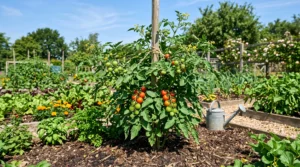
Most reputable growing guides recommend around six to eight hours of direct sunlight a day for productive tomato plants.
That range is not a strict cutoff where the plant switches from “fine” to “failing” the moment it drops below six hours.
Light intensity, the time of day the sun hits the plant, the season, and the plant’s overall health all factor into how well it performs at any given light level.
As a general pattern:
- Under six hours often means reduced flowering and fruiting, even if the plant still grows.
- Around four hours is well below the amount generally recommended for productive tomato growing, so harvests are likely to be reduced, although the plant may survive and produce some fruit.
- Very low light, such as deep shade for most of the day, is unlikely to produce a meaningful harvest no matter how well you care for the plant otherwise.
If you want the full breakdown of sunlight requirements, including the difference between morning and afternoon sun, our guide on how much sun tomato plants need covers that in more detail.
What Should You Do If Your Tomato Plants Don’t Get Enough Sun?
The most effective fix is almost always improving the plant’s light exposure rather than adding more fertilizer, water, or other inputs to compensate.
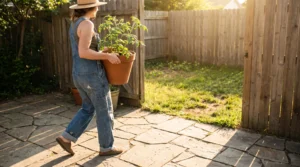
Move container plants. If your tomato is growing in a pot, this is your biggest advantage. Track the sunniest spot in your yard, patio, or balcony over the course of a day, and relocate the container to a location that receives substantially more direct sunlight.
Choose the sunniest realistic location for in-ground plants. If you’re planning next season’s garden, walk the space at different times of day before you plant. A spot that looks bright at noon can be shaded for hours in the morning or evening.
For an established tomato planted in the ground, avoid unnecessary transplanting simply to chase more sunlight. Look for practical ways to reduce nearby shade when possible, or choose a sunnier planting location next season.
Watch for changing shadows. Shade patterns shift throughout the growing season as the sun’s angle changes and nearby trees fill out or drop their leaves. A bed that got full sun in May can end up partly shaded by July.
Don’t over-fertilize to compensate. Extra nitrogen won’t replace lost sunlight, and too much of it can actually push the plant toward more leafy growth and fewer flowers, making a legginess problem worse.
Adjust watering for shaded conditions. Plants in lower light typically use less water than those in full sun, so keep an eye on soil moisture rather than sticking to a fixed watering schedule. Overwatering a shaded plant can invite root problems on top of the light issue.
If relocating the plant isn’t possible, it’s reasonable to accept a smaller harvest rather than fighting the space you have.
A partly shaded tomato plant that gives you a modest handful of fruit is still a success, even if it’s not the abundant harvest a full-sun plant would produce.
What If the Plant Gets Plenty of Sun but Still Isn’t Producing?
Not every unproductive tomato plant is a sunlight problem. If your plant is getting a solid six-plus hours of direct light and still isn’t flowering or fruiting well, it’s worth ruling out these other common causes:
- Temperature extremes. Tomatoes often struggle to set fruit when nighttime temperatures stay too warm or daytime temperatures spike too high, regardless of how much sun they get.
- Watering inconsistency. Both drought stress and waterlogged soil can interfere with flowering and fruit set.
- Too much nitrogen. Excess nitrogen fertilizer can push a plant to grow lush, leafy foliage at the expense of flowers.
- Pollination conditions. Tomato flowers are self-pollinating, but fruit set can still be affected by unsuitable temperatures and conditions that interfere with pollen movement.
- Variety and plant stress. Some varieties are simply less prolific, and general stress from transplanting, root damage, or crowding can delay production.
- Pests and disease. Sap-sucking pests or early disease can sap a plant’s energy in ways that mimic a light shortage.
If sunlight checks out but the harvest still isn’t coming, one of these factors is a more likely explanation.
What If Your Tomatoes Get Too Much Sun?
More sun isn’t automatically better, especially in hot climates.
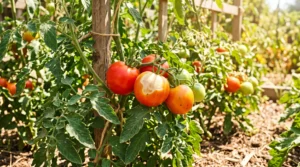
The issue in very sunny, very hot conditions usually is not the light itself, but the heat that comes with it.
Intense afternoon sun combined with high temperatures can contribute to blossom drop, where flowers fall off before they are pollinated, and sunscald, where exposed fruit develops pale, papery patches from too much direct heat.
If you garden somewhere with intense summer heat, a little afternoon shade during the hottest part of the day can protect your plants without meaningfully cutting into their overall light needs.
This isn’t a reason to seek out shade in a moderate climate, where cutting light exposure will simply reduce production. It’s a targeted fix for extreme heat, not a general rule.
FAQs
Do tomato plants need direct sunlight, or is bright daylight enough?
Direct sunlight matters more than general brightness. A spot that feels bright because it’s open to the sky, but only receives filtered or reflected light, won’t give a tomato plant the same energy as a spot where direct sun actually lands on the leaves for several hours.
Can lack of sunlight stop tomatoes from ripening completely?
Low light can affect the plant’s ability to support fruit development, but it is not usually the main reason a mature tomato stays green. Temperature, fruit maturity, variety, and the number of fruit developing at once can all affect how quickly tomatoes change color. If green tomatoes are lingering well past their expected ripening window, look at temperature and plant load alongside light.
Can Tomato Plants Grow With Only 4 Hours of Sun?
Yes, a tomato plant can grow and produce some fruit with only about four hours of direct sun, but the harvest will usually be smaller than it would be with six to eight hours of sunlight. Four hours is below the amount generally recommended for productive tomato growing, so expect less flowering and fruit production. If possible, move container tomatoes to a sunnier location or choose a sunnier spot for future plantings.
Is Morning Sun Enough for Tomato Plants?
Morning sun can help tomato plants grow, but a few hours of morning sun alone may not provide enough light for the best flowering and fruit production. Tomatoes generally perform best when they receive around six to eight hours of sunlight each day. If your plant gets only a short period of morning sun and then spends most of the day in shade, expect a smaller harvest than a plant growing in a sunnier location.
Conclusion
Too little sun usually means a less productive tomato plant, not a dead one.
Expect legginess, fewer flowers, a smaller harvest, and slower fruit development or ripening rather than outright failure.
Before you change anything, spend a day tracking how many hours of direct, unobstructed sun actually reach your plant.
If it’s receiving substantially less light than recommended and you have a better location available, improving its light exposure may help.
For container plants, moving the pot is usually the simplest option.
For established in-ground plants, avoid unnecessary transplanting and instead reduce nearby shade when practical or choose a sunnier location next season.
If the plant is already getting plenty of light and still isn’t producing, the answer may have more to do with heat, water, pollination, nutrients, pests, disease, or another growing condition than with sunlight.