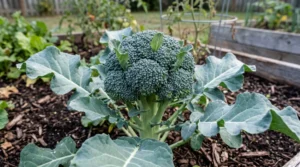
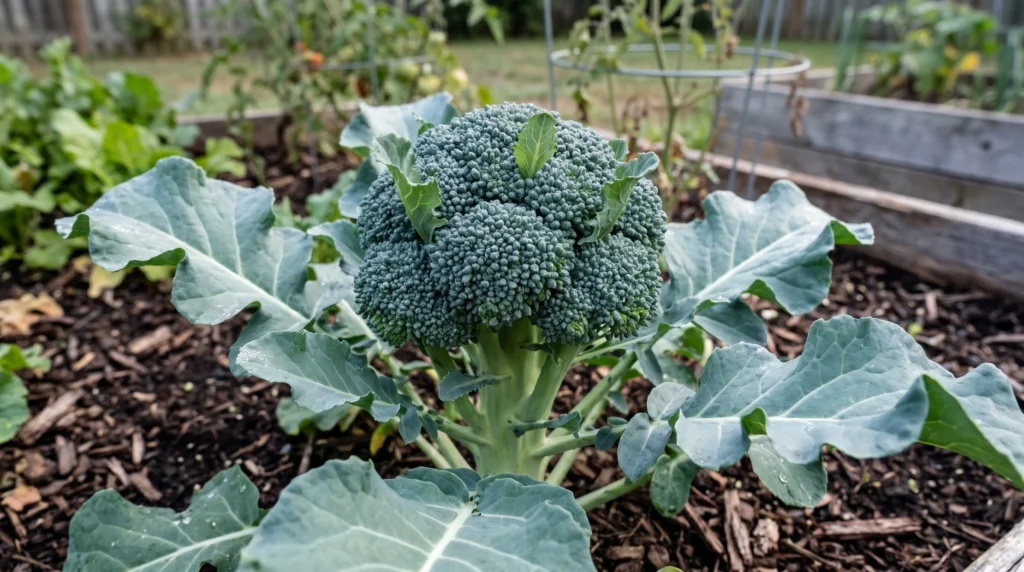
Leaves growing inside your broccoli head? Those small green leaves between the florets are called bracts.
They commonly develop when heat or low soil moisture stresses broccoli during early head formation.
Bracts are a growing problem, not a disease.
If the flower buds are still firm, tight, and green, the head is usually fine to harvest and eat.
What matters now is the condition of the buds.
A leafy head with tight buds is ready to cut.
A head with loosening buds, yellow flowers, or soft, rotting spots is a different problem.
What Are the Small Leaves Growing Inside a Broccoli Head?
Bracts are small, leaf-like growths that pop up between the clusters of flower buds.
A broccoli head is really a mass of unopened flower buds.
When the plant is stressed, it can push out little green leaves among them instead of forming one smooth, tight dome.
They look quite different from the big outer leaves.
The large leaves grow on the stem below the head and wrap around it.
Bracts are small, often only a few inches long at most, and they stick up from inside the head itself.
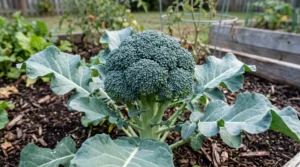
You may spot them while the head is still forming, or only after it has grown larger.
They can be a surprise, and a few small leaves do not mean the head is ruined.
The leaves are green plant tissue, much like the rest of the plant. Broccoli leaves are also edible, so they are not a worry on the plate.
Why Does Broccoli Develop Leaves Between the Florets?
Broccoli grows best in cool weather. When conditions swing too far from that, the plant can’t build a clean, compact head.
High temperatures and low soil moisture during early head formation can lead to leaves growing within the heads of broccoli and cauliflower.
The key words are “early head formation.” The stress seems to matter most at the stage when the head is being laid down, long before you see a full crown.
High Temperatures During Head Formation
A hot stretch at the wrong time can disturb how the head develops.
Instead of a tight cluster of buds, you may get a looser head with little leaves poking through.
Timing is the part gardeners often miss. Heat while the plant is growing its leaves is much less of a concern.
The trouble starts when a hot spell hits as the head begins to form.
That is why a spring crop that matures just as summer arrives, or a fall crop planted too early, can end up leafy.
Ordinary maturity looks different.
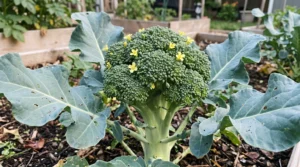
A head that is simply past its prime has buds that loosen and open into small yellow flowers.
Bracts show up while the buds are still closed and green.
There is no single “too hot” number.
It varies with the variety, the crop stage, and how long the heat lasts. Watch the forecast during early head development, and treat a long hot spell as a warning.
Inconsistent Soil Moisture
Broccoli needs steady water to build a good head.
Plants that don’t get consistent rainfall or irrigation may form small heads with an off flavor.
Dry spells, then big soaks, then more dry spells make the plant work harder than it should.
You can check this without guessing.
Push a trowel into the soil near the plant and see how deep the moisture goes.
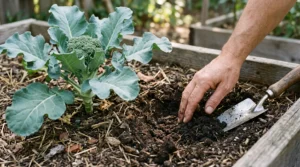
If only the top inch or two is moist while the soil below remains dry, the water may not be reaching enough of the root zone.
Water thoroughly enough to moisten the soil where the roots are growing, without leaving it waterlogged.
Soil should feel evenly moist, like a wrung-out sponge, not powdery dry and not muddy.
More water is not always the answer.
Waterlogged soil stresses roots too.
The goal is steady moisture, not a bigger dose.
Sandy soil dries out faster than clay, so it usually needs more frequent watering, and rainy or windy weeks change the need.
Variety and Growing Conditions
Not all broccoli handles heat the same way.
Choosing heat-tolerant varieties can help reduce bract formation.
Some varieties are bred to cope better when temperatures climb.
Your season and location matter just as much.
Spring broccoli has to finish before summer heat arrives.
A fall crop has the opposite problem: it must be planted early enough to grow, but late enough that the heads form in cooler weather.
The same variety can do well in one season and badly in another.
Seed packets and local nurseries are the best guide to varieties that suit your area.
Your state Extension office can also tell you the usual planting windows for your region.
Are Leaves Growing Inside Broccoli Heads a Sign of Disease?
Usually not. Fresh, green bracts between otherwise healthy buds point to a growing condition, not an infection.
Disease looks different. Watch for these signs:
- Soft, mushy, or decaying tissue
- Slime on the head
- A bad smell
- Large patches of brown or dark discoloration
- Fuzzy mold or other unusual growth
Here is a quick way to tell the three common situations apart.
| What you see | What it likely means | What to do |
| Small green leaves between tight, firm buds | Bracts from heat or moisture stress | Harvest if the buds are tight |
| Buds loosening, yellow flowers showing | Head is past its best | Cut it right away |
| Soft spots, slime, odor, or heavy browning | Rot or other damage | Discard the head if it shows signs of rot or spoilage. Do not rely on trimming away visibly rotten areas. |
Some broccoli diseases can damage leaves and developing heads, but unusual growth or discoloration alone is not enough to identify a specific disease.
Looks alone can’t name every problem, though.
If a head is rotting and you’re not sure why, a photo sent to your local Extension office can help.
Can You Still Eat Broccoli With Leaves Inside the Head?
In most cases, yes. Bracts alone don’t make a head unsafe to eat. The question is whether the head is in good shape.
Check the buds first. Firm, tight, green buds are a good sign.
Then smell and feel the head. Anything slimy, sour-smelling, or mushy should go in the compost, not on the dinner plate.
A few other points:
- The leaves themselves: You can leave them on or trim them off. Small scissors or a paring knife work well if you prefer a cleaner look.
- Texture and taste: A loose, leafy head may not be as dense or sweet as a tight one. Water-stressed plants can also make off-flavored heads.
- Insects: Bracts and loose florets can give small bugs a place to hide. Rinse the head well and check between the florets before cooking.
Should You Harvest Broccoli When Leaves Start Growing Through the Head?
If the buds are still tight and green, cutting is usually the better call.
Broccoli is a flower crop, so the longer it stays on the plant, the closer it gets to blooming.
The standard rule is to harvest while heads are tight and before the flower buds open.
If flowers are already opening, cut right away.
Waiting for a leafy head to turn tight and smooth rarely works.
The bracts that have formed will stay.
Hot weather can speed up bud loosening, so a head that looks fine today can start to open within days.
A quick way to decide:
- Buds tight and green, head a decent size: Harvest now.
- Buds tight, head still small, weather mild: You can give it a few more days, but check it daily.
- Buds loosening or yellow flowers showing: Cut it today.
After you cut the main head, some broccoli varieties will produce smaller side shoots.
Harvest timing for different vegetables also depends on the stage at which each crop develops its best flavor and texture.
Can You Fix a Broccoli Head That Has Already Turned Leafy?
Not really. Bracts that have already formed are part of the head, and they won’t go away. Trimming them off improves the look, but it doesn’t change the cause.
What you can do is protect what comes next.
Even out the watering, and add mulch if the soil is drying fast.
Those steps may help side shoots and later heads develop more normally.
No one can promise how much a plant will bounce back, and a hot summer may still bring leafy shoots.
If the current head is firm and green, harvesting it is smarter than waiting for it to improve.
A leafy head that sits too long often gets worse, not better.
How Can You Prevent Leafy Broccoli Heads Next Season?
No method guarantees a perfect head in a heat wave. These steps can improve your odds.
- Time the crop for cool weather. Plan the planting so heads form before summer heat, or in the cooler part of fall. Check the planting dates your local Extension office suggests.
- Choose varieties with care. Look for heat-tolerant varieties for spring crops. For fall, longer-maturing types can be a good fit, since the heads form as the weather cools.
- Water evenly. Broccoli generally needs about 1–2 inches of water per week from rainfall and irrigation combined, depending on growing conditions. Check moisture below the soil surface and adjust for temperature, rainfall, soil type, and drainage. Avoid repeated drying and waterlogging.
- Mulch the soil. A layer of straw or other organic mulch slows drying and smooths out swings in soil moisture.
- Watch the forecast during early head formation. If a heat wave is coming, make sure the soil is moist, and consider a light shade cloth over the plants.
- Harvest on time. Cut as soon as the head is a good size and the buds are still tight.
What Should You Do Next?
Look closely at the buds. If they are tight, firm, and green, cut the head and enjoy it.
Leaves between the florets are most often a sign of heat or moisture stress, and that stress can’t be undone once the head has formed.
The most useful move is to even out your watering now, and to time your next crop so the heads form in cooler weather.