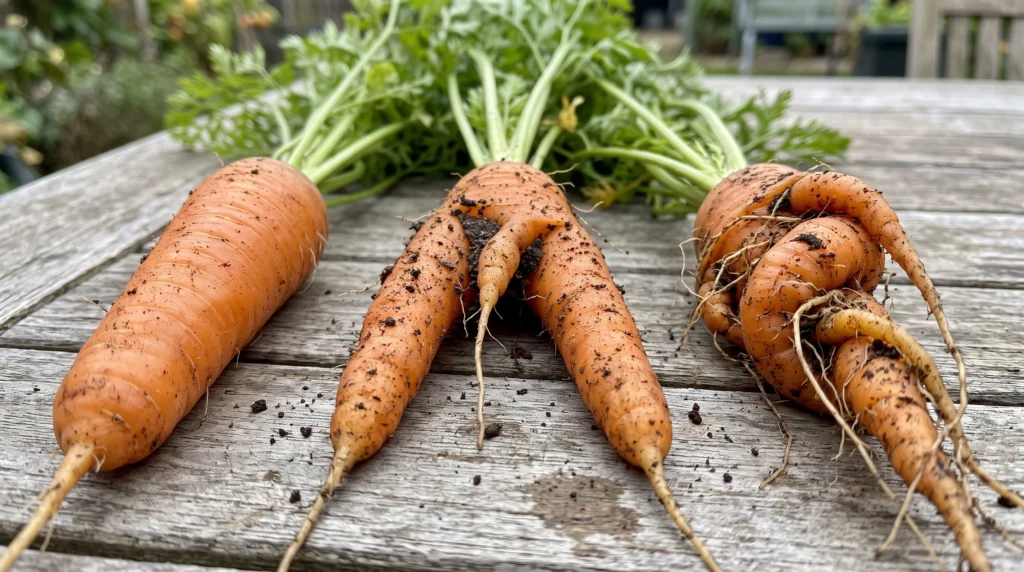
You pull a carrot from the ground and find two legs. Or three. Maybe a neighbor is wound around it like rope. Or the root is short and blunt, or covered in thin hairs.
It looks strange, but an odd shape rarely means the whole bed is ruined. It does mean something happened underground, and the shape gives you clues about what.
So, why are my carrots forked? Most often, the young taproot (the main root that becomes the carrot) hit something solid, got crowded, or was hurt while it grew.
Stones, hard soil, thick sowing and rough handling are the usual suspects.
If the roots also have lumps, masses of fine roots, dark marks or sickly tops, look for a root pest or disease before blaming the soil.
Why Do Carrots Grow Forked or Twisted?
A carrot grows from one main root that pushes straight down. The tip leads the way, and everything behind it swells into the part you eat.
If that tip meets a stone, a hard clod or a pocket of tight clay, it has to bend or split to get around the obstacle.
Damage works the same way.
A tip that gets bruised, chewed or killed early often answers by sending out several roots instead of one.
Timing matters here. Nematodes are tiny soil worms that feed on roots, and injury to the growing tip usually happens in the first few weeks after the seed sprouts.
Pythium, a soil-borne disease, can kill young taproots just as early.
So when you hunt for the cause, think back to the first month of growth, not the weeks before harvest.
Many different problems leave the same mark, so a fork on its own doesn’t name the culprit. The next two steps help narrow it down.
Step 1: What Shape Is Your Carrot?
Sort your odd carrots into these groups:
- Forked: one main root divides into two or more branches.
- Twisted: neighboring carrots wrap around each other.
- Short and blunt: the root stopped growing downward early.
- Hairy: many thin side roots grow from the main root.
- Knobby: firm lumps show up, especially on the fine roots.
- Marked: dark or horizontal lesions cross the skin.
- Cracked: the root has opened along its length instead of branching.
You will probably find one or two of these. Each points to a different part of this article.
Step 2: Where in the Bed Do the Odd Carrots Grow?
Don’t judge from a single carrot. Pull a few from different spots.
A few scattered oddballs usually mean isolated trouble, such as a buried stone, a hard clod or a bit of root damage.
If you are asking why are my carrots forked in just one corner, start digging there.
When most of a row or bed is affected, think bigger.
Poor bed preparation, thick sowing, late thinning, coarse debris in the soil, deep hoeing and heavy feeding can all affect a whole bed.
Patches of weak or deformed plants, especially patches that grow larger each season, push soil pests higher on the list.
Random plants with hairy roots and odd-looking tops point toward a plant disease rather than a soil problem.
Diagnosis Table
Use this to decide what to check first. It is a guide, not a final answer.
| What you see | Likely direction | Check first |
| One root splits in two or three, skin clean | Stone, clod or compaction | Dig for hard spots and stones |
| Carrots wrapped around each other | Crowding | Sowing thickness, thinning |
| Forked roots across most of one bed | Bed prep, hoeing damage, coarse debris | Soil structure, hoeing depth |
| Forks, knots and many fine roots | Root-knot nematodes | Wash roots, look for galls |
| Short, forked roots with dark marks | Pythium | Drainage, marks on skin |
| Hairy roots, lush tops | Too much nitrogen or soggy soil | Feeding and watering history |
| Hairy roots, yellow or purple bunchy tops | Aster yellows | Leaf symptoms |
| Crack along the root | Uneven watering | Watering pattern |
Is the Soil Rocky, Hard or Compacted?
Start here, because it is the most common cause.
Heavy or compacted soil produces stunted, forked or twisted roots, and stony ground is a classic reason for forks.
The blocker isn’t always easy to see. A bed can look loose on top and hide a hard layer a few inches down.
Carrots sail through the top, then hit a wall. Small stones hide in fresh-looking soil, and clay dries into clods.
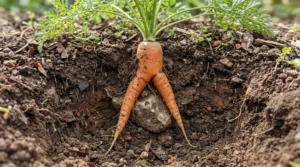
To test, dig a hole as deep as your carrots should grow, in several parts of the bed.
Feel for the depth where the spade suddenly meets resistance, and sift a handful from each layer for stones.
If the odd carrots cluster where the soil is hard or stony, you have a strong lead.
A fork caused by a stone or clod usually has clean, smooth skin, and you can often find the culprit in the hole where the carrot bent.
A fork with knots, masses of fine roots or dark marks tells a different story, and later sections cover those.
Root length matters too.
Very long types such as Imperator suit only deep, sandy ground, so a long variety in shallow soil is asking for trouble.
Before the next sowing:
- Loosen the soil to the full length of the variety.
- Pick out stones and break up clods.
- Stay off the bed so it doesn’t pack down again.
- Skip digging when the soil is wet.
- Keep coarse chunks out of the root zone.
Our guide to preparing soil for a vegetable garden covers the basics.
Were the Carrots Too Close Together?
Crowding mostly explains twisting.
Twisting and tangling come from sowing too thickly and thinning too little, as roots bend around their neighbors while competing for the same space.
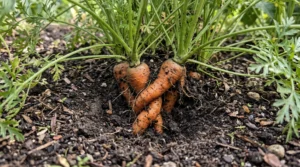
Crowding doesn’t always make a classic fork. Packed carrots often end up thin, with plenty of leaf and little root.
Spacing depends on the type of carrot and the size you want, so follow your seed packet.
Thin early, once the tops are a few inches tall, rather than waiting until the roots are already tangled.
Was the Taproot Disturbed?
Anything that bruises or breaks the growing tip can lead to branching:
- Deep or close hoeing. Hoe shallowly near the row.
- Pulling weeds right beside young carrots.
- Tugging seedlings out during thinning. Snipping extras at soil level disturbs the neighbors less, and this is a common practice.
- Transplanting.
Transplanting deserves a closer look. Carrots are normally sown where they will grow, because a bent or cramped young taproot tends to fork.
It isn’t an absolute rule, though.
Some commercial growers raise carrot plugs in trays and plant them out before the taproot reaches the bottom of the cell. Once the root touches the bottom, the carrot forks.
For most home gardeners, direct sowing is simpler and safer. Replanted thinnings and root-bound seedlings from cells are the likeliest to fork. Pots are a harder fit, since most don’t give a long taproot enough room.
Can Compost, Manure or Fertilizer Cause Forking?
Sometimes, but it isn’t as simple as “fertilizer makes carrots fork.” Three different things can happen.
Too much nitrogen can lead to multiple roots and a hairy look, usually with lots of leaf growth.
Fresh manure or fertilizer pellets touching the roots is another risk. If you use manure-rich compost, put it on in fall and let it sit over winter before carrots go in.
Coarse, half-rotted material can simply block the way. Wood chips mixed in just before planting are a good example.
In practice, use well-rotted compost, add it well ahead of sowing and keep chunks out of the carrot row.
More compost is not automatically better. A soil test shows what the bed really needs.
Could Root-Knot Nematodes Be the Cause?
Root-knot nematodes are microscopic worms that feed inside roots and cause swellings called galls.
In carrots they can cause a forked or stunted main root, many fine roots, and small lumps on both the main and fine roots.
Forking alone doesn’t prove nematodes. Only the galls are a dependable sign, because other problems can look similar.
To check:

- Lift a whole plant instead of just pulling the carrot.
- Wash the soil off the roots.
- Look along the thin roots for firm knots. Healthy fine roots are smooth, thin and pale.
The tops can mislead you. Root vegetables can carry heavy nematode numbers with no sign above ground.
Look for circular patches of poor plants that grow larger each season. No galls doesn’t clear every nematode, since other types can injure the tip without them, but they usually cause fewer problems in vegetable gardens.
If you find galls, a local Extension office or diagnostic lab can confirm them from a soil sample.
The damage can’t be undone, because nothing restores a damaged taproot.
If nematodes are confirmed, rotate carrots out of that bed and use a non-host crop recommended for the nematode species in your area.
Your local Extension service or diagnostic lab can help you choose an appropriate rotation.
Throw heavily galled roots out instead of composting them.
Could a Root Disease Be Involved?
Pythium root dieback is a less common look-alike. Watch for short, stunted roots that may be forked, sometimes with horizontal marks on the skin, and yellow or wilting tops when damage is severe.
It thrives in very wet soil.
So if the bed stays soggy and the roots show marks or the plants look unwell, don’t blame stones by default. Improve drainage, ease off the watering, and get a local diagnosis if the damage is severe.
What About Hairy Carrots?
Hairy roots can show up alongside misshapen carrots, but they point to different stresses:
- Too much nitrogen or fresh manure, covered above.
- Soggy soil. Roots turn hairy in waterlogged ground, and overwatering is a known cause.
- A second year of growth. Carrots are biennials, meaning two-year plants. A carrot left in the ground puts out pale secondary roots, then a flower stem.
- Aster yellows, a plant disease. Look for hairy roots in lines, older leaves turning yellow then purplish, short pale bunchy tops and a bitter taste, on plants scattered at random through the bed.
Treat aster yellows as a possibility only when the leaves look wrong too.
Forked Carrot or Split Carrot?
These are different problems. A forked carrot has branched or changed direction. A split carrot has opened along its length.

Uneven moisture is tied to splitting and cracking, while compacted or heavy soil goes with stunted, forked or twisted roots.
Splits call for steadier watering. Forks call for a look at soil, spacing and disturbance.
Can You Fix a Carrot That Has Already Forked?
No. A branched root won’t turn back into one straight taproot.
Keep healthy plants growing, harvest as usual, and use what you saw to correct the bed before the next sowing.
Are Forked Carrots Safe to Eat?
An unusual shape by itself does not automatically mean the carrot is unsafe to eat.
If the root is firm and shows no signs of rot or spoilage, prepare it as you normally would.
Throw out roots that are soft, slimy, foul-smelling or badly rotted.
Skip bitter roots from plants that showed aster yellow signs.
If you are unsure when to dig, see when to harvest vegetables.
How to Grow Straighter Carrots Next Time
- Prepare a loose root zone that suits the variety’s length.
- Remove stones and break up large clods.
- Sow seed where the carrots will grow.
- Sow thinly, then thin early.
- Hoe and weed shallowly.
- Skip fresh manure and heavy nitrogen feeding before sowing.
- Use only well-rotted compost, added well ahead of planting.
- Keep the soil evenly moist, never soggy.
- Move carrots to a new bed if you found galls.
- Match the carrot type to your soil depth.
What If Your Soil Is Heavy or Rocky?
You don’t need perfect soil to grow carrots, but you need to match the carrot to the ground.
A raised bed gives you a loose, stone-free root zone from day one.
A deep container works for short types, though pots rarely suit long ones. Short, stout types such as Chantenay handle shallow or heavy ground better than very long carrots.
For heavy clay, improve structure gradually with organic matter. Don’t reach for sand.
A small amount of sand mixed into clay can create a concrete-like mix instead of loosening it.
What to Check Before the Next Sowing?
Work through it in order. Look at the shape of the roots. Dig the bed and feel for hard layers and stones.
Think about spacing, thinning and hoeing. Wash a few roots and look for galls or dark marks.
Then prepare the next root zone to fit what you found. The most common mistake is adding more compost or manure without finding the cause first.
A strange carrot is a clue. The shape, the rest of the root and the pattern across the bed tell you where to look.