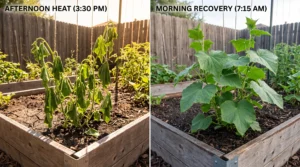
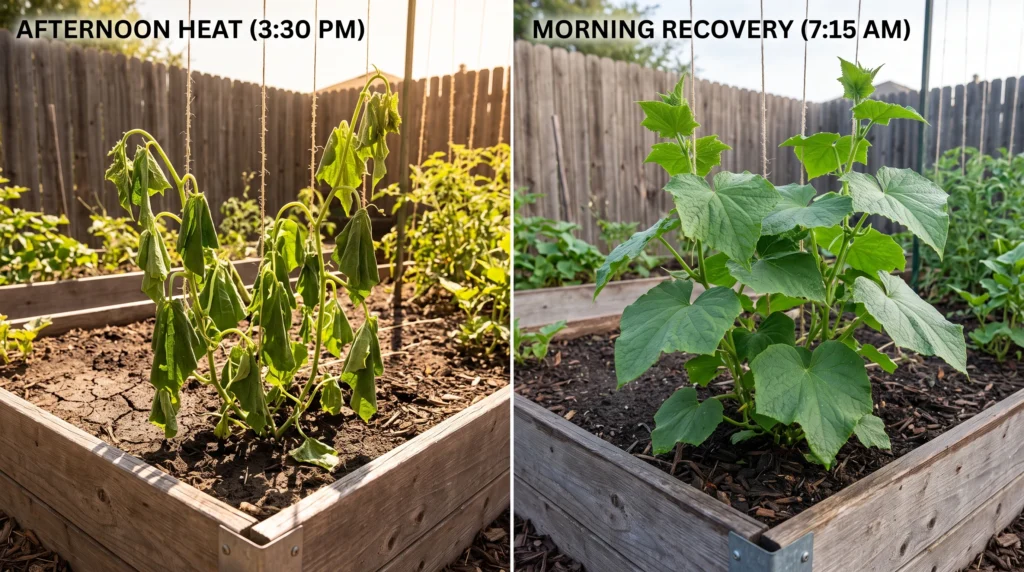
Cucumber leaves wilt during the day for several reasons, including heat, dry soil and bacterial wilt.
If they bounce back at night, temporary stress may be the cause, but the same pattern can also appear in the early stages of bacterial wilt.
One droopy afternoon can’t tell you which one you have. Bouncing back overnight is encouraging, but it isn’t proof that the plant is healthy.
What matters is the pattern over a few days, plus what you find in the soil, on the leaves and on the vine.
Your 60-Second Check
- Push a finger or trowel 2 to 4 inches into the soil near the plant. Is it dry or soggy?
- Look for striped or spotted cucumber beetles on the leaves, stems, and flowers.
- Look at the same plant again early tomorrow morning, before the sun hits it.
The rest of this guide shows you how to read what you find.
Why Do Healthy Cucumber Leaves Wilt on Hot Afternoons?
Cucumbers have big, thin leaves. They release water through tiny pores in a process called transpiration.
On a hot, sunny, or windy day, leaves can lose water faster than the roots can pull it from the soil.
The leaves go limp. When the air cools in the evening, the roots catch up and the leaves stand up again, as long as the soil holds enough moisture.
Heat isn’t the only trigger. Drying wind pulls moisture from leaves, and a few dry days can leave the root zone short on water.
Many plants with large leaves wilt at the hottest time of day and look fine again by morning.
Still, a plant that perks up overnight hasn’t passed a health test. Some diseases look exactly like this in the beginning.
Can Bacterial Wilt Cause the Same Day-and-Night Pattern?

Yes.
Bacterial wilt is a disease caused by a bacterium called Erwinia tracheiphila, and cucumber beetles spread it.
The bacteria multiply inside the tubes that carry water up through the plant.
They clog those tubes, so water can’t reach the leaves even when the soil is wet.
Early on, the leaves look dull green. They wilt in the day and recover at night. That is why the two problems get mixed up.
The disease often starts small. Single leaves wilt first, especially ones with beetle damage.
Then the wilt moves along the vine. Infected plants may also bounce back on cloudy days, so a good recovery on a cool day isn’t reassuring either.
Over time, the pattern changes. Overnight recovery slows, and the leaves stay limp longer each day. Infected vines may die within 7 to 14 days.
The disease isn’t a problem everywhere every year. Minnesota’s Extension service, for example, says it doesn’t occur every year there. Your local beetle numbers matter.
So neither shortcut works. Night recovery doesn’t mean it’s bacterial wilt. It doesn’t mean it’s only heat, either.
Heat Stress or Bacterial Wilt? Five Clues to Check
1. Check the Soil Before You Water
Check moisture 2 to 4 inches deep, where the active roots are. The surface can look dry while the soil below is damp.
If the soil is dry, water stress is likely. If it is already soggy, more water won’t help. Waterlogged roots can’t get enough air, and that alone can make a plant wilt.
Don’t water just because the leaves look limp.
2. See What Is Wilting
If the whole plant droops during the hottest hours, heat or dry soil is the more likely cause.
If one leaf, one section, or one vine wilts first, think about a local problem.
That could be bacterial wilt, stem damage, root damage, or a problem at the base of the plant.
In larger plantings, bacterial wilt may appear first near the edges where cucumber beetles arrive, although this is less useful as a clue in a small home garden.
Also notice where the wilting is.
If the affected plant sits in a low, persistently wet patch, investigate waterlogging and root problems before adding more water.
3. Look for Cucumber Beetles
Striped cucumber beetles are yellow with black stripes. Spotted ones are yellow-green with black spots.
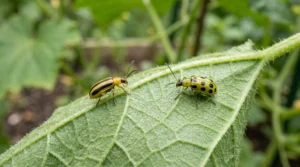
Check the leaves, stems, and flowers, and look for chewed spots.
Both kinds can carry the bacteria. Seeing a beetle doesn’t prove your plant is sick. But beetles plus wilting that keeps getting worse should raise your concern.
4. Compare the Plant Today With Tomorrow
Check the same plant for several days. Ask yourself:
- Is the wilting starting earlier in the day?
- Is a bigger part of the plant affected?
- Is recovery slower?
- Are more vines wilting?
Heat-related wilting usually tracks hot, demanding weather. With bacterial wilt, the overall trend is progressive: wilting tends to affect more of the vine, and recovery becomes less complete over time.
5. Check the Plant Early the Next Morning
Go out before the sun hits the bed. If the plant looks fully recovered, heat or water stress is still a good bet.
If it is still limp, take it seriously. But a full recovery isn’t an all-clear. Infected vines may recover at night but wilt again the next day.
What Your Cucumber Pattern Might Mean
| What you see | More likely cause | What to check next |
|---|---|---|
| Whole plant droops on hot afternoons, soil is dry, plant recovers | Heat or water stress | Soil moisture, watering |
| Soil stays soggy and the plant still wilts | Root or drainage problem | Drainage, roots, base of the plant |
| One leaf or vine wilts and gets worse each day | Bacterial wilt or a stem or root problem | Beetles, stem test, daily changes |
| Beetles present and wilting keeps worsening | Bacterial wilt is more likely | Stem test, local Extension |
| Small hole and sawdust-like waste at the base of the vine | Squash vine borer is likely | Base of the stem |
| Water-soaked spots on the stem or crown | Root or crown disease | Disease identification |
| Cold, wet weather, cold soil, leaf edges turning olive to brown | Cold injury | Recent weather |
| Plant is still limp the next morning | More serious than normal afternoon wilt | Disease, roots, stem |
Could It Be Squash Vine Borer?
It’s less likely, but it’s worth a quick look. Squash and pumpkins are the main targets, and cucumbers are less susceptible.
Even so, borers can occur on cucumbers, and the first sign is often wilting that clears up at night.
The larvae tunnel inside the vine.
Check the base of the wilting vine for small entry holes and a clump of orange or green, sawdust-like waste called frass.
Finding both strongly points toward squash vine borer.
If you split the affected stem and find tunneling or a larva, that confirms borer damage. One vine wilting on an otherwise healthy plant is another clue.
How Do You Do the Bacterial Wilt Stem Test?
This test can support your suspicion, but it can’t clear your plant.
- Cut a wilted vine near the base of the plant. Pick one that is wilted but not dead.
- Press the two cut ends together.
- Pull them slowly apart.
- Look for thin, sticky threads stretching between the cut ends.
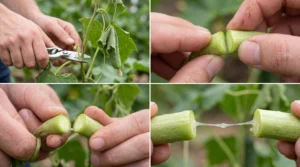
Threads suggest bacterial wilt. You can also try the water version. Put a piece of the wilted stem in a glass of clean water and look for milky cloudiness.
A negative stem test does not reliably rule bacterial wilt out.
If you need a sure answer, send a sample to a plant disease clinic, which your local Extension office can point you to.
What to Do If It Looks Like Heat or Water Stress
Start with the soil, not the leaves. If the root zone is dry, water deeply at the base of the plant. If it’s already damp, leave it alone and check again tomorrow morning.
Water in the morning when practical. Then keep going with a few other habits:
- Keep soil moisture fairly even. Cycles of bone-dry and soaking wet stress the roots.
- Add mulch to bare soil. It keeps soil cooler and holds moisture.
- Check cucumbers in containers more often. Many gardeners find pots dry out much faster than garden beds.
- In extreme heat, some gardeners drape shade cloth over plants for the afternoon. It can help, but you don’t need it for every wilting episode.
Needs change with weather, soil, plant size, pot size, sun, wind, and rain, so there is no one schedule that fits every garden. Look at the plant again the next morning to see if it helped.
What to Do If You Suspect Bacterial Wilt
Once a plant is infected, there is no way to cure it.
Beetle control helps protect healthy plants, but it can’t undo an infection that is already inside the vine.
No home remedy changes that.
Here is what you can do:
- Check the plant and nearby cucurbits for beetles.
- Compare your symptoms with your local Extension’s description of bacterial wilt.
- Use the stem test as one clue, not the final word.
- Pull plants that are clearly declining or confirmed. Leaving them gives beetles a place to pick up the bacteria and carry it to healthy plants.
- Check nearby cucumbers, melons, and squash for the same symptoms.
- Reduce cucumber beetle pressure around healthy plants.
Advice on getting rid of infected plants differs from source to source and place to place.
Ask your local Extension office before you compost them.
How to Lower the Risk Next Season
Most of the work is keeping beetles off young plants. Plants are most at risk between seedling emergence and bloom.
- Start checking for beetles as soon as seedlings come up, and keep checking.
- Cover young plants with floating row covers, and remove them when flowers appear so pollinators can reach the blooms.
- Where available, consider a bacterial-wilt-resistant cultivar such as ‘County Fair’.
- Pull badly affected plants right away.
Row covers and resistant varieties lower the odds. They don’t guarantee a clean season.
Check current labels and local advice before using any spray.
When Should You Stop Waiting and Act?
Watching a plant for a few days is fine. Move faster if you see any of these:
- The plant is still limp the next morning.
- The wilting is worse every day.
- One vine is heading toward collapse.
- Cucumber beetles are active on the plants.
- Leaves are turning yellow or brown.
- More of the plant is affected.
- Nearby cucumbers show the same symptoms.
If several of these signs appear together, investigate disease or another serious root or stem problem rather than assuming the plant only needs water.
If you only see afternoon droop that clears by morning, with moist soil, no beetles and a whole plant that looks normal otherwise, heat is the better guess.
Our overview of common vegetable garden diseases can help if you’re still unsure.
Can cucumber leaves wilt when the soil is moist?
Yes. In very hot weather, leaves can lose water faster than even moist soil can supply it.
Waterlogged or damaged roots, stem damage, and bacterial wilt can also stop water from reaching the leaves.
If the soil is wet and the plant is still limp the next morning, look at the roots and stem.
Why is only one cucumber vine wilting?
One wilting vine points to a local problem. Stem damage, root injury, squash vine borer, and bacterial wilt can all cause it.
Look at that vine on its own instead of assuming the whole bed needs water.
What to Remember
Afternoon wilting followed by overnight recovery can be temporary and harmless, but recovery alone doesn’t tell you what’s causing it.
Check the soil, look for cucumber beetles, and watch the same plant over the next few days.
If wilting progressively worsens, spreads along the vine, or stops resolving by morning, investigate bacterial wilt or another root or stem problem.