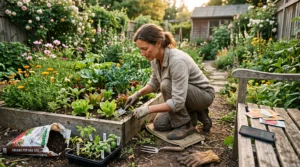
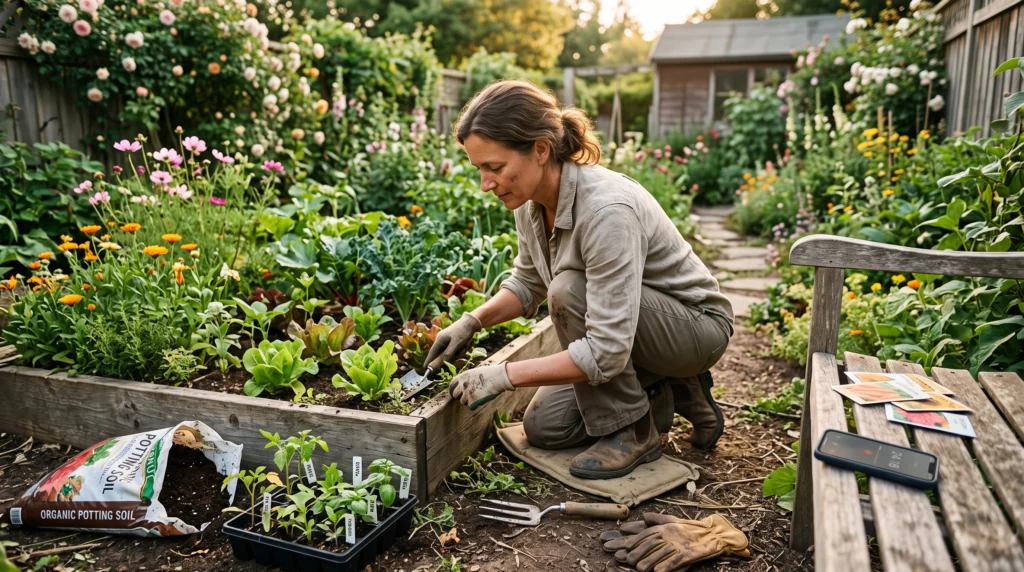
You went outside to pull a few weeds.
Three hours later, you’ve reorganized the greenhouse shelving, researched four tomato varieties, ordered seeds you didn’t plan to buy, and completely forgotten about the appointment you had at two.
Nobody called you inside.
You just disappeared into it.
If you garden with ADHD, this kind of intense focus may feel familiar. A small task can become deeply absorbing, and hours can pass before you realize how long you’ve been outside.
The goal isn’t to love gardening less.
It’s to give that intensity some boundaries so your gardening session ends because you decided it should — not because the sun went down, you missed dinner, or your body finally forced you to stop.
What ADHD Hyperfocus Actually Is
Hyperfocus describes a state of unusually intense concentration on a particular task, activity, or subject.
When it happens, you may lose track of time, become less aware of what’s happening around you, overlook things like hunger or thirst, and find it surprisingly difficult to stop or switch to something else.
There are a few important things to understand.
Not everyone with ADHD experiences hyperfocus.
Hyperfocus is also not part of the official diagnostic criteria for ADHD, according to information from the National Institute of Mental Health.
Experiencing intense focus on something you enjoy does not automatically mean you have ADHD.
An ADHD diagnosis depends on a broader and persistent pattern of symptoms, how long they have been present, whether they appear in different areas of life, and whether they interfere with everyday functioning.
Researchers are still working to understand exactly why hyperfocus happens.
A 2019 study examining hyperfocus in adults found that people reporting higher levels of ADHD symptoms also reported more frequent hyperfocus in several areas, including hobbies, school activities, and screen time.
In 2024, researchers from the same group validated a shorter 12-item version of the Adult Hyperfocus Questionnaire, known as the AHQ-D, giving researchers another way to study dispositional hyperfocus in adults.
So while hyperfocus is commonly discussed in connection with ADHD, scientists are still learning more about how it works and why some people experience it more strongly than others.
Why Gardening Can Feel So Absorbing
Gardening has several qualities that may help explain why some people find it especially absorbing.
It’s hands-on.
Something is always happening as a result of what you’re doing.
Pull weeds and the bed immediately looks clearer.
Repot a plant and you’ve completed something visible.
Prune an overgrown section and you can see the difference straight away.
Gardening also has something else working in its favor — or against it, depending on the day:
There is almost always one more thing to do.
One weed becomes an entire bed.
The empty space in the bed reminds you about the seedlings.
The seedlings remind you that one tray needs repotting.
While repotting, you notice you’re almost out of compost.
Five minutes later, you’re comparing compost online.
Gardening doesn’t just give you an absorbing task.
It gives you an endless supply of next tasks.
Gardener and author Anya Lautenbach has described a similar experience, explaining how her interest in a particular plant can lead her into extensive reading, experimentation, and a desire to understand everything about it.
That kind of curiosity can be a wonderful part of gardening.
It can also make it difficult to notice when a small gardening job has quietly turned into an all-day project.
Is Your Gardening Hyperfocus Helping or Hurting?
Hyperfocus isn’t automatically a bad thing.
Sometimes an extended period of concentration can help you finish something meaningful, solve a problem you’ve been avoiding, or make real progress on a gardening project.
Instead of asking only:
“How long was I gardening?”
ask:
“What did that gardening session leave behind?”
| Helping | Hurting |
|---|---|
| You finish a meaningful project | You repeatedly abandon projects halfway |
| You feel satisfied or energized afterward | You finish completely exhausted |
| You still make it to meals and commitments | You regularly miss meals or appointments |
| Your garden becomes easier to manage | You keep creating more maintenance |
| You can recognize when you’re finished | You struggle to stop even when you want to |
If your gardening sessions regularly leave you exhausted, late, overwhelmed, or surrounded by unfinished projects, the answer doesn’t necessarily have to be suppressing your enthusiasm.
A better goal may be giving that intensity somewhere useful to go — and a reliable way to stop.
Give Your Focus a Specific Job
Advice like “channel your energy productively” sounds nice until you’re standing in front of six plants wondering where to begin.
Try something more concrete.
Before you start gardening, choose the kind of session you’re actually capable of having that day.
Short session: 15–30 minutes
You might:
- deadhead spent flowers
- harvest what’s ready
- water containers
- check one bed for pests or problems
- tidy one small area
Medium session: 30–90 minutes
You might:
- repot a few plants
- prepare one bed
- prune one section
- sow one tray of seeds
- complete one clearly defined maintenance task
Deep-focus project
This might include:
- redesigning part of the garden
- building a structure
- propagating a large batch of cuttings
- planning your seasonal planting
- tackling a major cleanup
The important part isn’t choosing the “right” category.
It’s knowing which one you’re entering before you begin.
It also helps to recognize the gardening activities that can consume enormous amounts of time without moving your actual garden forward.
For example:
Researching the same plant across dozens of websites.
Comparing seed suppliers long after you’ve found a perfectly acceptable option.
Watching one gardening video that turns into twelve.
Buying another tool instead of using the ones already sitting in the shed.
None of these necessarily feel wasteful while you’re doing them.
That’s why identifying your personal rabbit holes in advance can make them easier to recognize when they appear.
Decide What “Finished” Means Before You Start
One of the easiest ways for gardening to expand indefinitely is to begin with a goal that has no obvious ending.
For example:
“Work on the garden.”
When exactly have you finished “working on the garden”?
Probably never.
Try giving yourself a finish line you can actually see.
Instead:
“Clear this bed, put the weeds in the compost, clean the tools, and stop.”
Now the session has an ending.
A vague goal gives your brain very little indication that you’ve reached the finish line.
A specific goal gives the session somewhere to end.
Build the Off-Ramp Before You Need It
A timer can be useful, but a single alarm isn’t always enough when you’re deeply absorbed in something.
The problem is often not knowing that time has passed.
The harder part can be switching away from what you’re doing.
So instead of deciding how you’ll stop once you’re already absorbed, build the stopping process before you begin.
A simple off-ramp can include four things:
- Start cue: Decide exactly which project you’re working on.
- Warning alarm: Set an alarm five or ten minutes before your real stopping time.
- Stop condition: Decide what “done enough” looks like.
- Next-step note: Write down where you’ll restart next time.

That last step matters more than it might seem.
Sometimes stopping feels uncomfortable because your brain is already thinking:
“But if I leave this now, I’ll have to figure everything out again later.”
A one-line note removes that problem.
For example:
“Next time: finish the last three containers and water the new seedlings.”
Now you don’t have to keep working just because you’re afraid of losing your place.
Don’t Forget the Physical Basics
Before you start, put water somewhere you can see and reach it.
If you’re gardening outside in hot or sunny weather, use appropriate sun protection before you become absorbed in the task.
Intense concentration can make it easy to overlook thirst, hunger, fatigue, discomfort, or how long you’ve been outside.
Preparing for those needs before you start means you don’t have to depend entirely on noticing them at exactly the right moment.
What If the Alarm Goes Off Mid-Task?
You don’t necessarily need to drop everything the second your warning alarm sounds.
Instead, finish the smallest safe unit of work you’re currently doing.
If you’re repotting a plant, finish that one plant.
Get it settled.
Water it.
Then stop.
Don’t start the next one.
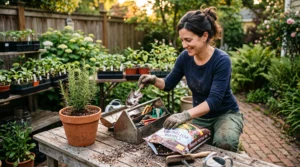
Move directly into cleanup.
Close the compost bag.
Put the soil away.
Rinse the trowel.
Return the tools to their place.
The aim is to leave the garden in a stable condition without allowing:
“I’ll just finish this…”
to turn into another hour.
The same idea works for a research rabbit hole.
Write down the useful thing you learned.
Save the one or two resources you genuinely need.
Close the tabs.
Walk away.
You don’t have to finish everything you’ve opened before you’re allowed to stop.
Watch for the Hyperfocus-to-Overwhelm Cycle
Some people with ADHD may recognize a pattern like this in hobbies and personal projects:
A new idea feels exciting.
The excitement becomes a big project.
The project becomes an even bigger project.
Eventually, the amount of work becomes exhausting.
Exhaustion turns into avoidance.
Avoidance creates guilt.
Then another exciting idea appears, and the cycle begins again.
Gardening makes this particularly easy because there is always another possibility waiting for you.
Another bed to redesign.
Another plant to buy.
Another technique to try.
Another problem to solve.
Another corner of the garden that could “just use a little work.”
One way to make that enthusiasm easier to live with is to keep individual projects small enough to finish and avoid creating more maintenance than your normal-energy self can realistically handle.
Don’t Make Hyperfocus Responsible for Everyday Plant Care
The other version of overdoing gardening isn’t spending six hours outside.
It’s committing to six months of work during one highly motivated afternoon.
You buy more plants than you realistically have time to maintain.
You start three beds at once.
You create elaborate watering requirements.
Today’s enthusiasm becomes next month’s obligation.
That’s why hyperfocus probably shouldn’t be the foundation of routine plant care.
Watering, weeding, pruning, feeding, and checking plants usually work better when they’re connected to a simple, repeatable routine.
Your garden needs to work on ordinary days too — not only on days when you’re intensely motivated.
If you know you tend to overcommit during exciting gardening phases, choosing lower-maintenance plants outside your favorite projects can also help.
A Simple ADHD Gardening System to Screenshot
Before
Choose one project.
Decide what “finished” looks like.
Set your warning alarm.
Put water somewhere visible.
During
Stick to the target you chose.
Notice thirst, heat, hunger, or fatigue.
Don’t begin an entirely new project simply because you noticed it.
When the Warning Goes Off
Finish your current safe micro-step.
Do not begin another one.
Start putting things away.
Before You Leave
Take a quick photo of where you stopped.
Write one sentence explaining what comes next.
Then leave the project for your next gardening session.
When It’s Bigger Than a Gardening System
Sometimes the issue extends beyond gardening.
If intense focus is regularly contributing to missed obligations, major sleep disruption, skipped meals, difficulties at work or school, or strain in your relationships, changing your gardening routine may not be enough on its own.
Consider discussing what you’re experiencing with a qualified healthcare or mental health professional, especially if similar difficulties are affecting several areas of your life.
Gardening strategies can make an afternoon easier to manage.
They aren’t a replacement for professional assessment or treatment when broader ADHD symptoms are creating significant problems.
Give Your Focus a Job, a Boundary, and a Way Out
The next time you feel that pull to disappear into the garden for an afternoon, you don’t necessarily need to fight the focus itself.
Give it a job.
Give it a boundary.
Give it a way out.
Know what you’re working on before you begin.
Know what “finished” looks like.
Give yourself a warning before your stopping time.
Leave yourself a clear note explaining where to begin next time.
A good gardening session isn’t necessarily the one where you accomplished the most.
It’s the one that leaves both the garden and you in a state that makes it easy to come back.
The goal isn’t to make every gardening session shorter.
It’s to make sure the session ends because you chose to end it — while leaving enough time, energy, and enthusiasm to enjoy gardening again tomorrow.
This article is for general educational purposes and is not intended to diagnose or treat ADHD or any other health condition. If ADHD symptoms are significantly affecting your daily life, consider speaking with an appropriately qualified healthcare professional.