A good ADHD gardening routine is small, flexible, and built so it doesn’t depend on you remembering everything.
It should have a minimum-care version for rough days, keep important tools visible, break tasks into single actions, and include a plan for when the routine gets disrupted.
You’ve probably lived the cycle already: you buy plants full of excitement, spend a hyperfocused weekend setting everything up, and then two weeks later you can’t remember the last time you watered anything.
That’s not a lack of discipline.
It’s a mismatch between how most gardening advice is written and how your attention actually works. Here’s how to build a routine that survives the mismatch instead of fighting it.
Why Gardening Routines Are So Hard to Stick With
Most gardening advice assumes you’ll remember to check your plants, that you will notice when something needs attention, and that a task once started will get finished in one sitting.
For many people with ADHD, some of those assumptions don’t hold up well.
Starting a task — even one you genuinely want to do — can be harder than doing it.
Remembering a plan you made yesterday competes with everything else pulling at your attention today.
And an open-ended job like “tend the garden” has no clear finish line, which makes it easy to either avoid entirely or fall into for three hours straight.
The NIMH’s overview of ADHD in adults and the CDC’s summary of adult ADHD describe difficulties with organization, time management, and following through on longer or less structured tasks.
There’s also a timing problem with gardening: the gap between an action and its result.
Water a plant today and the result may not be obvious immediately. Likewise, the consequences of missing a task may take time to show.
That delay makes it easy for the task to slip out of mind before it matters, in a way that more immediate tasks don’t.
For example, “take care of the garden” sounds like one task, but it can actually mean checking the soil, watering, pulling weeds, checking for pests, harvesting, cleaning tools, and deciding what needs attention next.
When all of those decisions arrive at once, getting started can become harder than the gardening itself.
None of this means every person with ADHD experiences gardening the same way, and it isn’t a reason to give up on the hobby.
It just means a routine that depends heavily on memory may not hold up when remembering is already difficult. You need something sturdier than good intentions.
Make the Routine Smaller Than You Think You Need
The instinct is to build a routine around everything your garden could use — watering, deadheading, weeding, checking for pests, tidying edges.
That’s a recipe for a routine that collapses the first time you’re tired or busy.
Instead, split garden care into two tiers.
Essential care means the things that are time-sensitive or where delaying them is likely to cause meaningful harm.
Depending on your garden, that might include watering when the soil is genuinely dry, dealing with an urgent plant problem, harvesting something that’s ready, or checking plants during unusually hot or dry weather.
Optional care can wait. That might include deadheading, tidying paths, reorganizing tools, pulling every visible weed, or making the garden look finished.
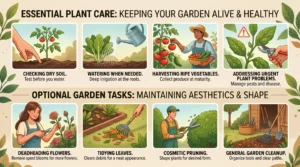
On a good day, you can do both. On a rough day, protect the plants first and let the rest wait.
This one distinction removes the all-or-nothing trap where “I don’t have time to do it properly” turns into doing nothing at all.
Attach Gardening to Something You Already Do
Waiting for motivation to strike is unreliable. A better anchor is a habit you already perform without thinking — making coffee, letting the dog out, coming home from work.
Tie a small garden task to that moment and it stops depending on memory.
“Water the herbs while the kettle boils” survives on days when “remember to check the garden at some point today” doesn’t.
The strategies outlined by Leicestershire Partnership NHS Trust point to the same idea: external cues tend to work better than internal ones when planning and memory are the bottleneck.
The cue should also match the garden. If your plants are outside by the back door, “after I let the dog out” may work better than a reminder that simply says “garden.”
The more specific the cue, the less thinking is required before the task begins.
Give Yourself One Task, Not “The Garden”

“Take care of the garden” is not a task — it’s a category, and categories are hard to start. Narrow it down to something specific enough to picture. Instead of:
“I’m going to tend the garden,”
try:
- “I’ll check the tomato containers.”
- “I’ll water the two pots that need it.”
- “I’ll harvest anything that’s ready.”
- “I’ll pull weeds from one raised bed.”
- “I’ll spend five minutes checking for pests.”
The goal isn’t to make gardening rigid. It’s to remove the vague starting point that makes the task harder to begin.
Thrive’s guidance on gardening with ADHD makes the same point — when a job feels too big to approach, shrinking its scope is often what gets it done, rather than trying to power through the whole thing at once.
Set Up Your Garden So You Don’t Have to Remember Everything
A routine that depends entirely on memory is fragile, not because you’re careless, but because memory is an unreliable thing to build a system around. Build in backups instead.
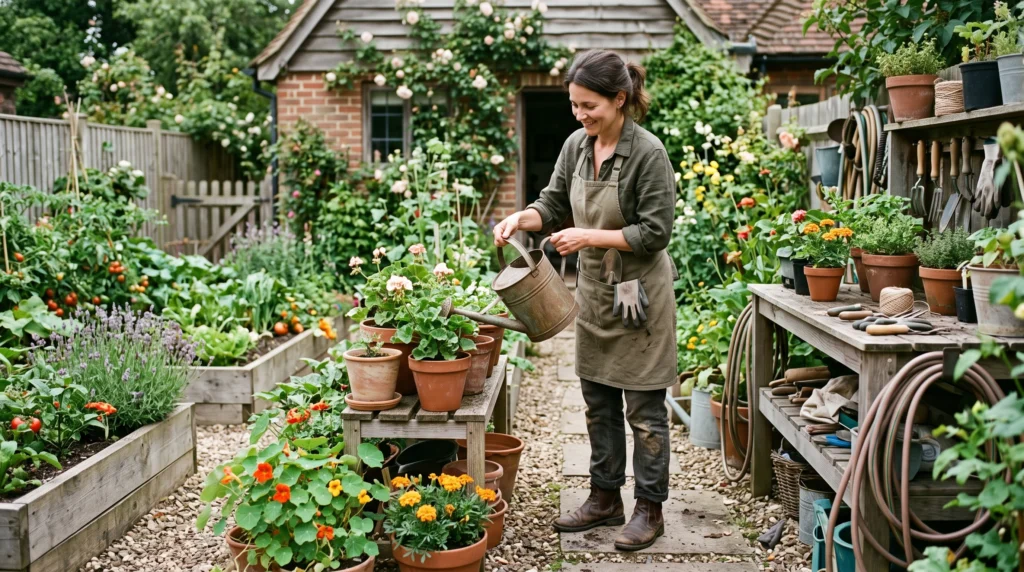
Keep your basic tools — gloves, a trowel, a watering can — together in one spot near where you actually garden, not tucked away “properly” in a shed you never visit.
A set of ADHD-friendly gardening tools kept in a visible, easy-to-reach place can make it easier to start than tools you have to go looking for.
Layer in a few different reminder types: a phone alert, a note by the door, a plant tag that flags when something was last watered.
If one fails, another may catch you. For plants that are especially easy to forget, a self-watering pot or basic drip line can act as a safety net — not a replacement for checking on them, but a buffer for the days you don’t check.
If you’re setting up a new growing space, building it around low effort from the start — a raised bed designed with ADHD in mind, for instance — makes the whole system easier to maintain later.
The goal is to reduce the number of decisions between thinking “I should garden” and actually starting.
Think of this as a gardening system rather than a storage system: the tools you use most often should be visible, together, and easy to reach.
It helps to think of every extra step as another chance to stop.
If watering means finding gloves, then the can, then remembering where the fertilizer went, then deciding what actually needs attention — that’s four decision points before you’ve done anything.
Cut the chain down to “walk outside, watering can is right there, water what’s dry,” and there’s almost nothing left to derail you.
Know How You’re Going to Stop, Not Just How You’ll Start
Forgetting is not the only failure mode.
For some people with ADHD, the opposite problem can happen: once they are in the garden, three hours disappear and they miss meals, hydration, or other responsibilities.
Treat stopping as its own skill, not something that happens automatically once you’re “done.” Set a timer before you start.
Keep water nearby so you’re not tempted to push through thirst.
Pick a stopping point in advance — “I’ll finish this bed” rather than “I’ll see how it goes” — and set a second alarm for five minutes before it, so the end doesn’t arrive as a surprise.
Thrive’s advice covers this directly, noting that it’s easy to lose track of time while absorbed in gardening and recommending scheduled breaks as the fix.
The aim isn’t to stop enjoying a productive gardening session.
It’s to give yourself an exit point before “I will just do one more thing” turns into an exhausted afternoon.
A planned stopping point can be part of the routine too.
Match the Routine to Your Energy, Not Your Intentions
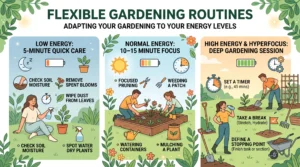
A single fixed routine — the same 20 minutes every day, rain or shine, energy or none — sets you up to “fail” on the days you’re running low. Build three versions instead.
Low-energy day
Pick one genuinely useful task and stop after about five minutes if that’s all you have.
Examples:
- Check whether containers need water
- Harvest something that’s ready
- Water one priority plant
- Remove one obvious problem
Normal-energy day
Give yourself 10–15 minutes and choose one or two jobs.
Examples:
- Check several containers
- Harvest and water
- Weed one small area
- Check plants for pests or damage
High-energy or hyperfocused day
Use the extra energy, but give the session a stopping point.
You might garden for longer, tackle a larger job, or work on something you’ve been putting off.
Set a timer, plan a break, and leave yourself an easy next step for another day.
All three versions count as following the routine.
That reframes a low-energy day from “I failed at gardening” to “I did the low-energy version,” which is a very different story to tell yourself.
A Simple ADHD-Friendly Gardening Routine
Here’s what the system can look like when you put the pieces together:
- Cue: After your morning coffee, step outside.
- First task: Check the plants that are most likely to need attention.
- Minimum version: Check soil moisture and deal with one urgent need.
- Normal version: Spend 10–15 minutes watering where needed, harvesting, or handling one small maintenance job.
- Stopping point: Set a timer so the session has an end.
- Backup: Keep your most-used tools where you can see them, and use a reminder if the cue isn’t reliable enough on its own.
- Weekly reset: Once a week, look at what needs attention next and choose one priority.
The important part isn’t copying this exact routine. It’s having a clear cue, a small starting task, a minimum version, and a way to stop and restart.
What to Do When You have Fallen Off Completely
At some point, you’ll go two weeks without touching the garden.
Most advice stops at “just start again,” which isn’t especially useful when the garden looks like a problem you don’t know how to face.
Here’s an actual process.
The 15-minute garden reset:
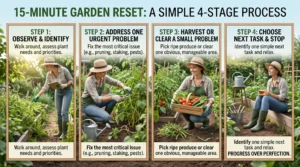
- Minutes 1–3 — Walk around and look. Don’t fix anything yet. Just see what’s actually there.
- Minutes 4–8 — Handle the most urgent thing. Check for whatever genuinely can’t wait another day. In a dry garden, that may be watering; in another garden, it could be harvesting, removing a damaged plant, or dealing with an obvious pest problem.
- Minutes 9–12 — Harvest or clear anything obviously overdue. Ripe vegetables, dead material that’s clearly done — nothing that requires a decision, just the obvious stuff.
- Minutes 13–15 — Pick one task for tomorrow, then stop. Not a list. One thing.
The goal is not to catch up on everything. The goal is to make the garden manageable again and give yourself one clear next step.
You don’t need to complete every job you missed before the routine “counts” again.
Trying to fix everything at once is exactly what makes people avoid the garden even longer. Triage first, perfection never.
Use a Weekly Check-In Instead of a Daily Checklist
A daily gardening checklist can become another thing to fail at. A weekly check-in gives you more flexibility.
Once a week, ask:
- What needs attention first?
- Is anything likely to be damaged if I wait?
- What is ready to harvest?
- What can safely wait?
- What’s one job I’d like to finish this week?
Then choose one priority. If you do more, great. If you only complete that one job, the check-in still did its job.
Let the Routine Change With the Seasons
Your gardening routine shouldn’t look identical all year.
Spring may mean planting and preparing beds.
Summer may put more emphasis on watering and harvesting. Autumn can shift toward clearing, collecting, and preparing plants for colder weather.
Winter may require much less hands-on maintenance, depending on your climate and what you’re growing.
Rather than creating one permanent checklist, adjust the routine around what your garden actually needs that month.
The Royal Horticultural Society’s monthly gardening guidance can help you identify seasonal jobs without trying to remember everything yourself.
Quick Fixes When the Routine Breaks
| What’s happening | Likely cause | Try this |
|---|---|---|
| You can’t get started | The task is too vague or large | Choose one specific action |
| You keep forgetting | The routine relies on memory | Add a visible cue or reminder |
| You start and get distracted | Too many tasks are competing for attention | Pick one task and set a timer |
| You garden for hours and burn out | There’s no stopping point | Set an end time before you begin |
| The garden feels overwhelming | Too much has built up | Use the 15-minute reset |
| You missed several days | You’re trying to catch up all at once | Deal with urgent care first, then choose one next task |
| Plants keep dying | The care routine may be too demanding | Simplify the garden or add an automatic backup where appropriate |
| You keep avoiding the same job | The task may be boring, difficult, or poorly matched to your setup | Break it down, change the setup, or pair it with accountability |
Don’t Turn Watering Into a Rigid Schedule
How often a plant needs water depends on factors such as the plant itself, the container or garden bed, soil, weather, temperature, and recent rainfall.
That means a fixed rule like “water every day” isn’t reliable for every garden.
Check the actual growing conditions instead.
Container plants often dry out faster than plants growing in the ground, while rainfall, temperature, soil, and exposure can all change how quickly growing media dries.
Oregon State University Extension’s guidance on watering basics is a good reference if you want a clearer sense of when plants actually need water versus when a schedule just says they should.
If remembering to water is a recurring problem, an appropriate irrigation system, self-watering container, or other backup can reduce the amount of care that depends on memory.
The goal isn’t to remove all routine. It’s to make the routine more forgiving.
And if a particular plant keeps dying no matter how consistent you get, that’s useful information, not a personal failing.
Some plants simply demand more precision and attention than a flexible routine can reliably deliver.
Swapping it for something more forgiving is often a better fix than trying to become a more attentive gardener.
The Point Isn’t a Perfect Garden
None of this is about becoming a more disciplined person.
It’s about building a system that still works on the days when discipline doesn’t show up — when you forget, get pulled somewhere else, lose track of time, or don’t have the energy for more than one small task.
A routine that needs perfect consistency is probably too demanding. A better routine is one you can shrink on difficult days, pause when life gets busy, and restart without rebuilding the entire system.
If you’re just getting oriented to the idea of ADHD-friendly gardening more broadly, our full guide to ADHD gardening is a good place to start.
But if you already know gardening works for you and the problem is just sticking with it — the answer isn’t a stricter routine.
It’s a more forgiving one.