If you have ever handed your child a trowel with big plans for a peaceful afternoon in the garden, only to watch them lose interest three minutes later, you are not doing anything wrong — and neither is your child.
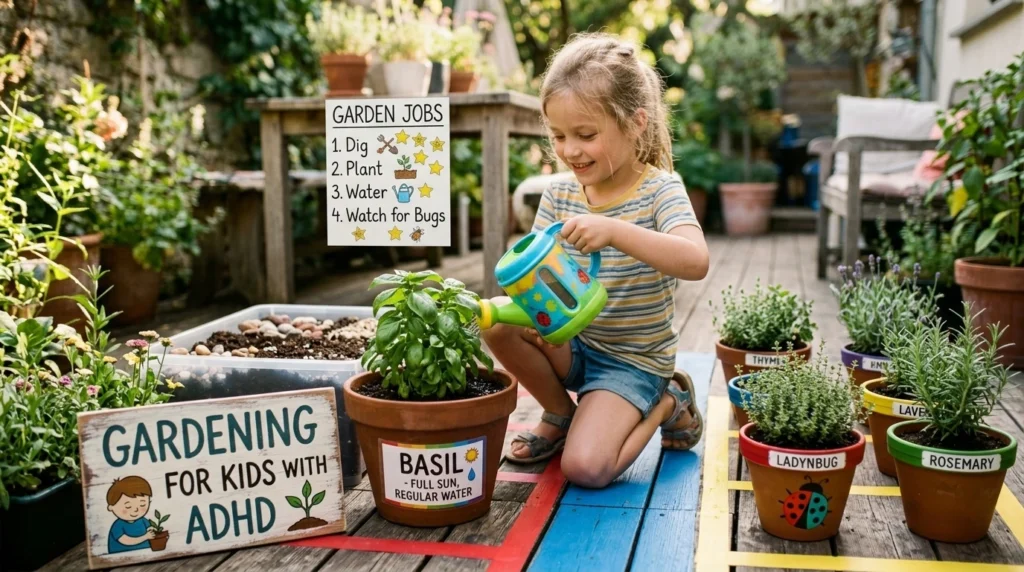
Gardening for kids with ADHD works best when it’s built around short, flexible projects instead of long, structured sessions.
The goal isn’t to get your child to sit still and finish a perfect flower bed.
It’s engagement: a few minutes of digging, watering, or discovery that leaves them curious to come back tomorrow.
This guide gives you seven easy, low-pressure gardening projects, plus a simple system for matching the right activity to your child’s energy, attention, and mood on any given day — because the “best” project isn’t the same one every time.
Is gardening good for kids with ADHD?
Gardening can be a good ADHD-friendly activity because it combines movement, sensory input, and quick hands on feedback in short bursts.
It isn’t a treatment or cure for ADHD, but many families find it a useful outlet for restless energy and a low stakes way to build focus, responsibility, and time outdoors.
Can Gardening Help Kids With ADHD?
Why Nature May Support Attention
A growing body of research connects time in nature with better attention, though it’s worth being precise about what the evidence actually shows.
Much of the research examines general nature exposure — parks, green space, forests — rather than gardening specifically.
A 2015 Barcelona study of 2,593 schoolchildren found greater school greenery was linked to better working memory and less inattentiveness — partly due to lower traffic pollution near greener schools.
That’s a meaningful signal about the value of green environments generally, but it isn’t proof that a specific gardening activity will change how your child focuses.
The concept researchers often point to is attention restoration: the idea that natural environments may help attention recover after it’s been taxed by sustained, effortful concentration — the kind kids do all day at school.
Gardening, with its mix of purposeful tasks and unstructured outdoor time, may tap into some of that same restorative quality, even though it hasn’t been studied as its own distinct intervention.
Why Gardening Can Be a Good ADHD-Friendly Activity

Gardening activities for kids with ADHD tend to work well because they naturally include:
- Movement — digging, carrying, watering, and walking between plants
- Sensory input — soil, water, textures, and smells
- Immediate feedback — a watered plant looks different right away; a planted seed is a small, visible accomplishment
- Clear start and end points — a task like “water these three pots” has a natural finish line
- Choice and independence — kids can often pick what to plant, water, or check on
None of this means gardening treats ADHD.
It means gardening can be structured in ways that fit how many kids with ADHD engage best with a task.
How to Choose the Right Gardening Activity for a Child With ADHD
Before picking a project, run through a quick check-in. This is the core framework behind every recommendation in this article:
- Check energy — is your child low-energy, restless, or bursting with it?
- Check attention span — can they handle a 5-minute task, or a multi-step project?
- Check sensory tolerance — are they okay with dirt, water, bugs, and outdoor textures today?
- Choose one task that matches steps 1–3.
- Stop before frustration sets in, even if the task isn’t “finished.”
Match the Project to Energy Level
| Child’s state | Best activity type |
|---|---|
| Very high energy | Digging, watering, carrying soil |
| Restless but interested | Planting or harvesting |
| Low energy | Seed sorting or decorating pots |
| Easily frustrated | One-step sensory activity |
| Wants independence | Ownership of one plant |
| Short attention span | 5–10 minute mini-task |
| Highly engaged | Multi-step planting project |
Match the Project to Attention Span
- 5-minute tasks: watering, seed sorting, a quick treasure hunt
- 10–15-minute projects: planting a single pot, building a sensory herb garden
- 20–30-minute projects: a mini container garden, a multi-step planting day
Match the Project to Sensory Preferences
Some kids dive straight into a pile of dirt; others won’t touch it without gloves. Both are fine.
Consider whether your child loves or avoids dirt, enjoys or dislikes water play, is squeamish about insects, prefers repetitive movement (like scooping soil), or does better with quieter, more contained tasks like sorting or labeling.
7 Easy Gardening Projects for Kids With ADHD
You don’t need to do all seven, and you don’t need to do them in order. Pick the one that fits today.
1. Plant a “Snack Garden”
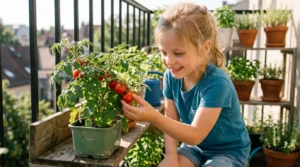
Fast-growing edible plants — cherry tomatoes, snap peas, radishes, or strawberries — give kids something to look forward to that isn’t just decorative.
Let your child “own” one plant: they check it, water it, and eventually get to eat what it produces.
Visible, edible progress tends to hold attention better than a plant they only look at.
What you will need: One or two fast-growing edible seedlings, a pot or garden bed, potting soil Time: 10–15 minutes Make it easier / Scale Down: Skip planting from seed — start with a small seedling so there’s an instant plant to care for.
Make it harder / Scale Up: Have them plant three different snack plants and track which grows fastest.
2. Build a Sensory Herb Garden
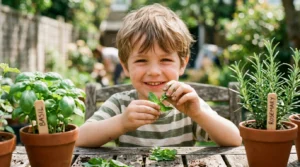
Herbs like mint, basil, and rosemary each have a distinct smell and texture, which makes them a natural fit for sensory exploration.
Let your child touch, crush, and smell each one, then describe what they notice.
Never force contact with a texture they dislike — offer gloves or let them use a leaf instead of bare hands.
What you’ll need: 3–4 small herb plants, small pots, gloves (optional) Time: 10 minutes Make it easier / Scale Down: Use just one herb and focus only on smell, not touch.
Make it harder / Scale Up: Have them create a “smell map,” ranking herbs from mildest to strongest.
3. Create a Seed-Sorting Challenge
This is a low-mess, low-energy option for days when full gardening feels like too much.
Give your child a mix of seeds and let them sort by size, shape, or color. Keep it short — this works best as a quick game, not a long task.
How to sort seeds:
- Mix several types of seeds in a shallow tray.
- Pick one category — size, shape, or color.
- Have your child sort them into small cups or egg-carton sections.
- Switch categories once they finish, or stop there.
What you’ll need: A few types of seeds, a tray, small cups Time: 5 minutes Make it easier / Scale Down: Sort just two seed types into two piles.
Make it harder / Scale Up: Time the sort and try to beat their own record.
4. Make a Mini Container Garden
No backyard? No problem. A container garden on a balcony or windowsill works just as well for building responsibility and watching growth over time.
Give your child one container to manage from planting through harvest, and mark its progress so the “before → growing → harvest” arc is visible.
What you will need: One container with drainage, potting soil, one or two easy plants (herbs, lettuce, marigolds) Time: 15 minutes Make it easier / Scale Down: Plant a single easy-care plant like a marigold instead of multiple varieties.
Make it harder / Scale Up: Set up three containers and assign a different plant to each.
5. Create a Watering Mission
Turn watering into a movement-based “job” instead of a chore.
Give your child a specific, countable task “water these four pots” — rather than an open-ended one.
This also opens up a useful lesson: more water isn’t automatically better, and overwatering can hurt a plant just like underwatering can.
What you will need: A watering can, a set number of pots or plants Time: 5 minutes Make it easier / Scale Down: Reduce the mission to just one or two plants.
Make it harder / Scale Up: Have them check soil moisture with a finger test before deciding which plants need water.
What happens if your child waters everything too much? Overwatered plants often show yellowing leaves or soggy, sinking soil.
Use it as a teaching moment rather than a correction — let your child observe the plant over the next few days and talk through what “too much” looked like.
6. Go on a Garden Treasure Hunt
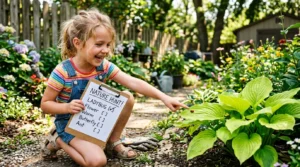
This turns observation into movement, which is often a better fit for kids who struggle to stay still for planting tasks.
Make a short list — a leaf, a flower, a seed, an insect, something rough, something smooth — and send your child off to find each one.
Keep the rules simple and the list short.
What you will need: A short written or drawn checklist, a small basket or bag Time: 10 minutes Make it easier / Scale Down: Cut the list to three items instead of six.
Make it harder / Scale Up: Add a time limit or have them find two examples of each item.
7. Grow Something From Kitchen Scraps
Regrowing plants from scraps — green onion ends, lettuce bases, avocado pits, or celery stumps — is cheap, low-commitment, and genuinely surprising to watch.
Frame it around curiosity rather than a guaranteed result, since not every scrap regrows successfully.
What you will need: A kitchen scrap (green onion end, celery base, or similar), a shallow dish of water or small pot of soil Time: 5 minutes to set up, then a few minutes of checking in over 1–2 weeks Make it easier / Scale Down: Try one reliable regrower, like a green onion end in water.
Make it harder / Scale Up: Set up three different scraps side by side and compare which regrows fastest.
One family we’ve talked to about this kind of project tried regrowing lettuce from scraps with a child who lost interest within a day when nothing visibly changed.
The fix the second time was switching to green onions, which show a visible change within 48 hours — a small adjustment that made the waiting period tolerable and turned a stalled project into a daily two-minute check-in.
What to Do When a Gardening Project Goes Wrong
Not every gardening attempt goes smoothly, and that’s normal — not a sign the activity isn’t working.
My Child Lost Interest
Don’t force the project to a finish. Switch to something movement-based, reduce the task to one final small action (like one more scoop of soil), and try again another day.
Partial completion counts as a win.
My Child Made a Mess
Set up a defined work area before starting — a tray, a mat, or a specific patch of yard — and make cleanup part of the activity itself rather than a separate battle afterward.
The Plant Died
Gardening doesn’t guarantee a thriving plant, and that’s worth saying out loud to your child.
Let them investigate what might have happened — too much water, too little sun — and treat it as troubleshooting rather than failure.
My Child Hates Dirt
Offer alternatives that skip direct soil contact: gardening gloves, container gardening with a trowel, watering-only tasks, seed sorting, plant observation, or labeling pots.
There is no rule that a gardening activity has to involve bare hands in soil.
The Best Gardening Project Depends on the Day
This is the piece most gardening guides skip: the right project isn’t fixed.
It changes based on your child’s energy, attention, sensory tolerance, and how much time and space you actually have that day.
Step 1 — Identify energy: Is the child low-energy, moderately active, or bursting with energy?
Step 2 — Identify attention: Can they handle one instruction, three instructions, or a multi-step project?
Step 3 — Identify sensory tolerance: Are they okay with dirt, water, insects, and outdoor textures today?
Step 4 — Identify available resources: Do you have 5, 15, or 30 minutes? A garden, a balcony, a container, or just what’s in the kitchen?
Step 5 — Match instead of forcing:
| Today looks like… | Choose… | Why |
|---|---|---|
| Lots of energy | Digging/watering | Channels movement |
| Curious but distractible | Treasure hunt | Short discovery tasks |
| Low energy | Seed sorting | Low physical demand |
| Doesn’t want dirty hands | Container/observation | Lower sensory demand |
| Easily frustrated | One-step task | Reduces cognitive load |
| Highly engaged | Multi-step planting | Uses sustained interest |
| Only 5 minutes | Water/check plants | Quick completion |
| No garden | Container project | Requires little space |
You don’t have to complete all seven projects on this list.
Choose the one that fits today’s child, today’s energy, and today’s resources — that’s a more useful approach than working through a fixed checklist.
How Long Should Kids With ADHD Spend Gardening?
There’s no single right duration. Start with a manageable window — often just 5 to 15 minutes — and let your child’s engagement decide whether to continue.
A short, successful session builds more enthusiasm for next time than a long one that ends in frustration.
How long should a child with ADHD garden? There’s no set duration — many kids do well with sessions of 5 to 15 minutes. Start small, watch how engaged your child is, and extend the activity only if they’re still interested, rather than committing to a fixed time up front.
Tips for Making Gardening Easier for Kids With ADHD
- Give one instruction at a time.
- Keep tools and materials visible and limited, so choices aren’t overwhelming.
- Use a timer for short tasks if it helps your child gauge how much is left.
- Offer choices — which plant, which pot, which tool.
- Build movement into the task whenever possible.
- Don’t insist on a perfect result.
- Let your child own a small, specific part of the garden.
- Celebrate observation and effort — noticing a new leaf counts — not just a successful harvest.
Frequently Asked Questions
Is gardening good for kids with ADHD?
Gardening can be a good activity for kids with ADHD because it combines movement, sensory input, and quick feedback.
It isn’t a treatment for ADHD, but many families find it a helpful outlet for energy and a way to build focus in short bursts.
What are the best gardening activities for kids with ADHD?
Short, hands-on tasks work best — watering missions, seed sorting, container gardening, and treasure hunts.
The “best” activity depends on the child’s energy and attention span on a given day rather than any single fixed list.
Can gardening help a child focus?
Time in nature has been associated with attention benefits in research, though most of that evidence looks at general green-space exposure rather than gardening specifically.
Gardening’s short, hands-on tasks may support focus in the moment, but it isn’t a proven attention treatment.
What if my child doesn’t like getting dirty?
Offer gloves, container gardening, watering-only tasks, seed sorting, or plant observation — none of which require bare-hand contact with soil.
How long should a child with ADHD garden?
Start with 5 to 15 minutes and extend only if your child stays engaged. There’s no universal ideal duration.
Can you garden with kids without a backyard?
Yes — container gardens on a balcony, windowsill, or even a kitchen counter work well and require very little space.
What are easy plants for children to grow?
Fast, forgiving options include cherry tomatoes, snap peas, radishes, marigolds, mint, and regrown kitchen scraps like green onions.
The Evidence Behind Nature and Attention
Two studies are worth knowing about if you want to understand where this advice comes from — and where the evidence stops.
A 2024 systematic review searched major research databases and, out of 458 studies identified, included 7 that met its criteria for examining nature exposure — forests, parks, green space, and gardens in children with ADHD.
The included studies consistently reported associations between nature exposure and reduced ADHD symptom severity, though the review’s authors noted the underlying studies used varied methods, and the review discusses Attention Restoration Theory as a possible explanation for the pattern.
A separate 2015 study followed 2,593 schoolchildren across 36 primary schools in Barcelona for a year, tracking cognitive performance every three months alongside satellite-measured greenness around each school.
Children at greener schools showed measurably greater progress in working memory and a modest reduction in inattentiveness over the study period, with part of that association explained by lower exposure to traffic-related pollution near greener schools.
Neither study concludes that gardening cures or treats ADHD, and neither examined a structured gardening program specifically.
What they support is more modest: nature exposure has been associated with attention-related benefits in children, which is a reasonable basis for treating gardening as a worthwhile, enjoyable activity — not a substitute for medication, therapy, or other treatment your child’s care team recommends.