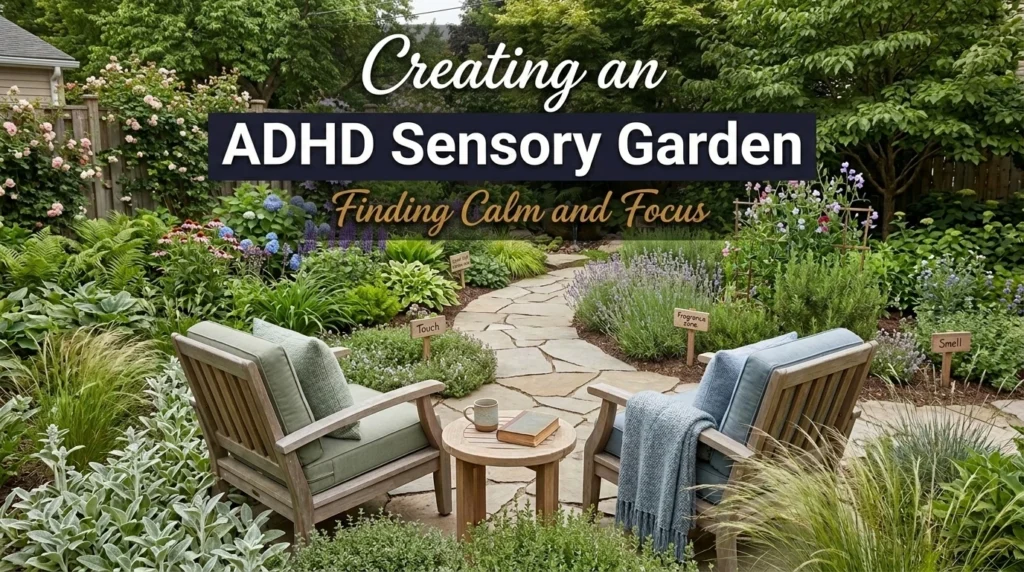
An ADHD sensory garden works best when it stays calm, not busy. Skip the mix of bright colors, strong smells, loud sounds, and busy textures all packed into one spot.
The goal is balance, not more input.
A good garden gives you space to enjoy things you like, and space to get away when things feel like too much.
What an ADHD Sensory Garden Actually Is (and Isn’t)
A sensory garden is an outdoor space built to reach the senses on purpose.
Plants and other features let you see, touch, smell, hear, and sometimes taste things as you move through it.
An ADHD sensory garden is not a special type of garden. It’s not a special group of plants either. It’s a way of planning the space.
The big difference is how you arrange it. Instead of putting every sense in one spot, you spread things out into calmer areas and busier areas.
A good ADHD sensory garden also needs one quiet spot. This gives a person a place to rest when they need less input.
This kind of garden can’t treat or cure ADHD. It should never replace medicine, therapy, or other care a person already gets.
Think of it as one more tool. It may make time outside feel easier and more comfortable.
Why Gardens Can Help With ADHD Overwhelm
Scientists have studied the link between ADHD and green space for more than 20 years.
Much of the early work came from Andrea Faber Taylor and Frances Kuo at the University of Illinois.
In one early study, they asked whether kids with ADHD had milder symptoms after spending regular time playing in green spaces.
The answer was yes, in general.
A bigger study asked 421 parents of kids with ADHD where their kids usually played.
Kids who often played in green spots, like open grass or areas with big trees, had milder symptoms than kids who mostly played in built or indoor spaces.
A small study in the Netherlands compared 12 kids with ADHD in a natural spot and a built spot.
The same kids did better on a focus test after time in the natural spot.
These results are useful, but a few things are worth knowing.
Much of this research looks at green space in general.
It’s not about sensory gardens built just for this purpose. Many of the studies also rely on what parents reported, or use small groups of kids.
A 2024 review looked at seven studies on nature and ADHD in kids.
All seven found a link between more nature and milder ADHD symptoms. That held true even after researchers accounted for things like family income and parent education.
But most of the seven studies tracked kids over time instead of directly testing cause and effect, and most leaned on parent reports.
So the review adds real weight, but it can’t prove that nature alone causes the change.
The fair takeaway isn’t that gardens cure ADHD.
It’s that time in a good outdoor space may help attention and mood for some people.
A sensory garden builds on that idea by giving a person more say over the sights, sounds, smells, textures, and tasks around them.
Hands-on gardening may add even more value. Planting, digging, watering, weeding, and picking herbs all use touch and movement.
That means the garden can be a place to do something, not just sit.
This doesn’t prove that gardening treats ADHD.
It just shows why hands-on tasks fit well in a garden built around the senses.
The Core Design Principle: Regulation, Not Stimulation
A common mistake is thinking a sensory garden needs as many sights, sounds, smells, and textures as possible.
For an ADHD sensory garden, more is not always better.
People with ADHD don’t all respond to input the same way.
Some people enjoy moving grasses or strong plant smells.
Others find the same things distracting or too much.
There is no single list of “best” plants that works for everyone.
That’s why the garden should offer choice.
Put stronger sensory features where a person can choose to walk up to them.
Keep the quiet spot simple and easy to reach.
The goal isn’t a garden that grabs your attention everywhere you look.
The goal is a space where you decide how much input you want, and can walk away from it when you don’t.
Sensory Needs Can Vary From Person to Person
People with ADHD do not all respond to sensory input in the same way. One person may find moving grasses calming, while another may find them distracting.
A strong plant scent may feel pleasant to one person and overwhelming to another.
That is why there is no single list of “best” ADHD sensory garden plants.
The most useful design gives people choice. They should be able to move toward sensory input when they want it and step away when they do not.
Step 1: Pick the Quiet Zone First
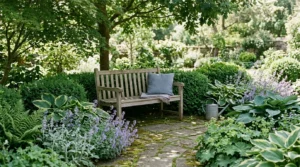
Before you pick a single plant, decide where the quietest spot will go.
This spot is the main retreat. It doesn’t need to be big.
A good quiet zone usually has:
-
A clear edge, like a low hedge, wall, or trellis
-
Comfortable seating that feels sturdy and stable
-
Shade or soft, filtered sun
-
Simple green or muted-color plants
-
Little to no strong smell
-
Some shelter from wind
-
A clear view, without much going on around it
Keep this spot simple on purpose. You don’t need a fountain, wind chimes, bright flowers, and strong-smelling plants all around one seat.
The quiet zone should give a person a place to do less, not one more thing to take in.
Step 2: Build in Zones, Not One Big Mix
Once you’ve picked the quiet zone, build outward in separate pockets. Don’t blend everything into one busy space.
A simple plan uses three zones.
1. Calm zone — the quiet retreat. Soft textures, plain colors, and little to no strong smell.
2. Touch-and-smell zone — a bit more active. Good for touching plants, smelling herbs, watering, planting, or weeding.
3. Active zone (optional) — for stronger input, like bright flowers, moving grasses, birds, or a small water feature.
Keeping these zones apart makes the whole garden easier to use.
This idea works in small spaces too. A balcony could have one quiet chair, a few herb pots, and one pot of ornamental grass.
Plants by Sense
Use this table as a starting menu, not a checklist. You don’t need every plant or every sense.
Pick a few that match the person using the garden and what grows well where you live.

| Sense | Calmer choices | More active choices |
|---|---|---|
| Touch | Soft foliage, moss, smooth stones | Lamb’s ear, woolly thyme, textured leaves |
| Scent | Little or no scent near seating | Mint, basil, rosemary, thyme, lavender |
| Sight | Green, silver, blue, or soft purple foliage | Sunflowers, zinnias, marigolds |
| Sound | Gentle leaf movement | Ornamental grasses, seed heads, water |
| Taste | Familiar herbs | Strawberries, chives, cherry tomatoes |
Always choose plants that fit your local climate, light, soil, and watering needs.
A plant that works well in one region may struggle in another.
Non-Plant Elements Worth Including
Plants are only part of a sensory garden.
Large stones, wood, paths, and water can also add sensory experiences.
A smooth path can make the route to the quiet area feel more predictable.
A rougher or crunchy surface may work better in an active zone.
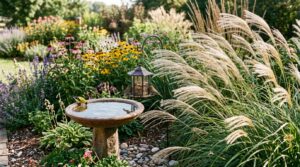
Water can provide sound, movement, and visual interest. But a water feature should be optional if possible because its sound can become distracting.
The same is true of wind chimes. They may be enjoyable for some people but irritating for others.
For that reason, stronger sound features are usually better placed away from the quiet zone.
Plants and Materials to Avoid
A sensory garden invites people to get close to plants, so safety matters.

Skip highly toxic plants in hands-on areas. Foxglove, oleander, and castor bean are examples of plants that can pose serious poisoning risks.
Watch for thorns and spines. Keep sharp plants away from paths, seating, and areas where people are likely to reach or play.
Watch for irritating plant sap. Some plants can cause skin or eye irritation when their sap is exposed.
Keep edible plants clearly identified. Never encourage anyone to taste an unfamiliar plant.
Be careful with pesticides. Avoid treating plants with products that could leave unsafe residues in areas designed for touching or tasting. Always follow the product label when any pesticide is used.
If children will use the garden, check every plant before planting it.
Do a final walk-through and look for anything toxic, sharp, irritating, unstable, or otherwise unsafe.
Common Mistakes That Backfire
Too Much in One Spot
The most common mistake is treating “sensory garden” as a reason to cram every sense into one area.
Too many strong smells, bright colors, sounds, and textures can make the space harder to use.
No True Quiet Space
If the whole garden feels busy, there’s nowhere to retreat. Even a small corner with one seat and simple plants can make the whole garden more useful.
Overusing Strong Smell Plants
Lavender, rosemary, and mint are great plants. But their smell is strong.
Put them where a person chooses to walk up and smell them, not right next to the main seat or path.
Adding Too Many Sounds
You do not need birds, wind chimes, fountains, rustling grasses, and other sound sources in the same area.
Start with one gentle sound source and see how it feels.
Ignoring Maintenance
A garden that becomes overgrown can create visual clutter.
Choose plants that match the amount of time you can realistically spend caring for them.
A simple garden that stays tidy may be more useful than a complicated garden that becomes difficult to maintain.
How to Use the Garden Once It’s Built
There is no single right way to use an ADHD sensory garden.
Some days, the quiet zone may be the best choice.
On other days, watering plants, harvesting herbs, or sitting near moving grasses may feel better.

Try these simple approaches:
-
Visit the garden before you feel too overwhelmed, not just after
-
Pick the zone that feels right that day
-
Keep louder sensory features as a choice, not a must
-
Add a simple task, like watering or weeding, when hands-on activity feels good
-
Remove anything that keeps causing discomfort
-
Change the garden as your needs change
The garden should stay flexible.
It should help you choose how much input you want, not decide for you.
How Big Does an ADHD Sensory Garden Need to Be?
It does not need to be large.
The same ideas can work in a backyard, courtyard, raised bed, patio, balcony, or a few containers.
Start with four basic elements:
- A quiet place to sit
- A clear path
- A few intentional sensory features
- A way to move away from stronger stimulation
Start small and add features slowly.
It is easier to add sensory elements later than to remove an entire garden that has become too busy.
A Simple ADHD Sensory Garden Plan
If you are starting from scratch, build the garden in this order:
1. Choose the quietest spot.
Look for an area away from unwanted noise and heavy activity.
2. Add seating.
Make the quiet zone useful before adding the rest of the garden.
3. Create a clear path.
Use a stable, easy-to-follow surface.
4. Add the touch-and-scent zone.
Choose a small number of plants with textures or scents you enjoy.
5. Add an active zone if wanted.
Use brighter colors, movement, or sound.
6. Add edible plants carefully.
Keep edible plants clearly identified and separate from unsafe ornamentals.
7. Try each zone.
Use the garden at different times of day and notice what feels calming or distracting.
8. Remove what does not work.
A sensory feature does not have to stay just because it looks good. If it causes discomfort, change it or take it out.
FAQs
Does a sensory garden actually reduce ADHD symptoms?
Research on green space and ADHD has found some links between natural settings, attention, and reported symptoms, especially in studies involving children. It does not show that a sensory garden can treat or cure ADHD.
How big does an ADHD sensory garden need to be?
It can be very small. The same basic design can work in a backyard, courtyard, raised bed, patio, balcony, or several containers.
What’s the single most important element to include?
A defined quiet zone is one of the most useful features. It gives the person a place to move when the rest of the garden feels too stimulating.
Are lavender and other strongly scented herbs a bad choice for ADHD gardens?
Not necessarily. The main issue is choice. Place strong-smelling plants where the person can approach them when they want to rather than making the scent unavoidable.
Can adults with ADHD benefit from this kind of garden too?
The research base is stronger for children than adults, so more research is needed. Still, the basic design ideas can be used by adults who find outdoor spaces and gardening helpful.
Conclusion
The best ADHD sensory garden is not the garden with the most plants.
It is a garden that gives the person using it more control over what they see, hear, smell, touch, and do.
Research on ADHD and green space is promising, but it does not show that a sensory garden can treat ADHD. A well-planned garden is better viewed as one environmental tool that may support attention, comfort, and outdoor time.
Start with a quiet place to sit. Add sensory features slowly. Keep stronger stimulation optional.
Most of all, design the garden for the person who will use it.