Carrots often split when soil stays dry for a while and is then suddenly saturated by heavy rain or irrigation.
The rapid change in moisture can make the roots swell and crack along their length.
Older, larger roots are most at risk. A cracked carrot isn’t always spoiled, but check it for softness, slime, or mold before you use it.
Before you decide what to do, work out which kind of damage you have.
A growth crack, a break from pulling the carrot, a forked root, and a rotting root can look alike at a glance.
Each one calls for a different response.
Why Do Carrots Crack or Split While Growing?
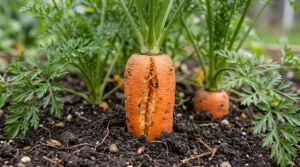
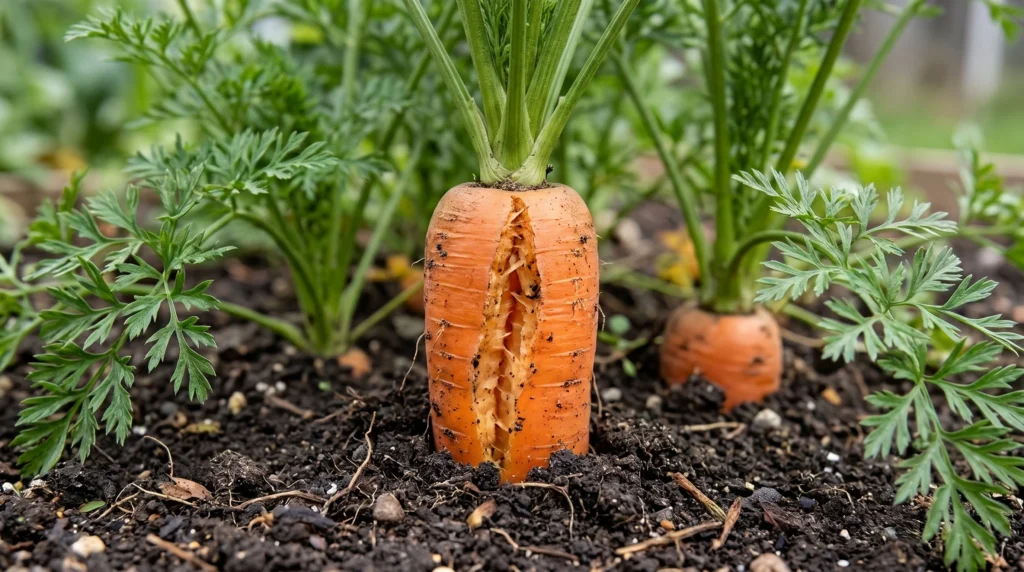
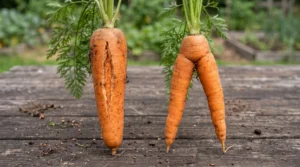
Carrot cracks run lengthwise along the root.
They often start at the top, near the shoulder, and some go deep enough to show the core.
Many gardeners don’t spot them until harvest, because the damage happens underground.
The cause is usually water.
Uneven watering lets roots take in extra water and expand quickly, and that can make them crack.
The soil stays dry for a while, then plenty of water arrives.
The root soaks it up and grows faster than its outer layers can stretch, so the surface gives way along its length.
That also explains why one carrot can split while its neighbor looks fine.
Older and larger roots take in more water and tend to crack more often than smaller, younger ones.
Roots in the same row can also differ in size, depth, and how much water reaches them.
The crack itself is a growing problem, not a disease. The risk comes afterward, because an open split can let rot in.
What Causes Carrots to Split Underground?
Dry Soil Followed by Heavy Rain or Watering
Carrots slow down when the soil dries out. Then a downpour, or a long soaking from the hose, arrives.
Heavy rain after a long dry spell can make roots take up a great deal of water at once and grow faster than their structure can handle.
You can check the soil without harming the crop.
Slide a hand trowel in a few inches from the row, not through it, and look at the soil several inches down.
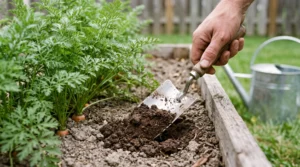
If the soil is dry and powdery several inches down, the root zone may not be receiving enough moisture.
Soil that feels slightly moist below the surface is generally a better sign, although the right watering frequency depends on the soil and weather.
Consistent watering helps carrots grow evenly.
Water thoroughly when the soil needs it, allowing moisture to reach the developing roots, rather than repeatedly letting the bed dry out and then soaking it heavily.
Don’t stop watering carrots to avoid splits, though.
The goal is even moisture, not wet soil. Soil that stays soggy brings its own trouble for roots, so let water drain between waterings.
Older or Oversized Carrots
A carrot that stays in the ground well past its prime keeps getting bigger, and bigger roots are more likely to crack.
Leaving carrots in the bed as a handy pantry has a cost in root quality.
Varieties mature at different speeds, so no single timeline fits every crop.
The seed packet lists days to maturity for your variety.
Count from sowing, and pull a test carrot once that window is close. Compare the width at the top with what the packet describes.
Carrot Variety and Growing Conditions
Large-rooted varieties split more often than small ones.
Some varieties are sold as resistant to splitting, but results can differ by region and season.
Check seed catalog descriptions and ask your local Extension office what has worked nearby.
Soil matters too. Sandy soil dries fast and holds little water, so it swings between dry and wet more than loam or clay does.
Heat and wind speed up drying. Carrots in containers and raised beds can dry out faster than carrots planted in the ground.
Stones and compacted soil are more commonly associated with forked or twisted roots than with lengthwise cracking.
For ordinary growth cracks, focus first on soil moisture patterns and the maturity of the carrots.
How Can You Tell What Caused the Cracks?
Cracks aren’t all alike. Look at the shape of the damage and where it sits on the root.
A growth crack runs lengthwise, often from the top, and the rest of the root feels firm.
Harvest damage tends to look fresh and clean, and it usually sits where the fork or your hand pulled.
Roots can also split or shatter at harvest, especially when they are very cold when dug.
Forking is a shape problem: the carrot grows several thick roots, not one with a split. Decay shows up as soft, slimy, or moldy tissue.
| What you see | Possible cause | What to check | What to do |
| Long crack down a firm carrot | Growth cracking from moisture swings | Recent rain, your watering pattern, soil moisture a few inches down | Harvest soon; even out watering for the rest |
| Fresh break noticed while pulling | Harvest damage | How the root came out; hard or very cold soil | Loosen soil with a fork before pulling |
| Several thick roots instead of one | Forking | Stones, packed soil, fresh manure | Prepare the bed better next time |
| Crack with soft, slimy, or moldy tissue | Rot after damage | Smell, softness, mold | Discard the carrot |
Can You Still Eat Carrots That Have Split?
Often, yes. Carrots with minor splits are usually fine to eat, because roots tend to pick up secondary infections less readily than juicier crops.
A crack alone doesn’t make a carrot spoiled.
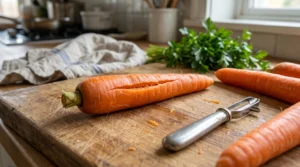
Inspect each one before you use it:
- The root should feel firm all the way through.
- The crack should be clean, with no slime, mold, or dark, soft patches.
- It should smell like a normal carrot, not sour or musty.
Dirt packs into cracks, so scrub the carrot well and clean out the split before you cook it.
Discard carrots that are slimy, moldy, mushy, or have an unpleasant odor.
Do not rely on cutting away visibly rotten tissue to make a badly spoiled carrot suitable to eat.
Appearance can’t prove a carrot is safe, so when you’re unsure, throw it out.
Split carrots also tend to spoil sooner than sound ones. Eat them first, and keep them away from the carrots you plan to store.
Should You Harvest Cracked Carrots Immediately?
Pull the cracked ones soon. Rot can set in through the split, and a carrot that’s still clean today may not be in a week.
For the rest of the row, check size first. Ease one carrot out and compare it with the description on the seed packet.
If the roots are near full size, or if heavy rain is forecast after a dry stretch, harvesting is the safer choice.
If they’re still small and the soil is evenly moist, you can leave them and check again in a few days.
Roots left in the ground past their prime may become more vulnerable to cracking, so harvest timing for different vegetables is worth planning ahead.
Pulling carefully also cuts down on breakage.
Loosen the soil carefully beside the row with a garden fork, keeping the tines away from the roots.
Then gently lift each carrot from the loosened soil to avoid snapping or puncturing it. Avoid digging when the ground is very cold.
Keep damaged carrots separate from sound ones, and use them first.
Can a Split Carrot Heal While Still Growing?
A split carrot won’t return to its original smooth, unbroken shape.
Although the damaged surface may change as the root continues growing, better watering cannot reverse the split that has already formed.
The root may keep growing, but the open tissue is an easy way in for rot, and more swings in moisture may make the crack worse.
A practical rule: if the carrot is close to full size, harvest it.
If it’s young and the crack is shallow, you can leave it for a short while and check it often.
Pull it at the first sign of softness or mold.
Steadier watering won’t repair the damaged root, but it can protect the carrots around it and the ones you sow later.
How Can You Prevent Carrots From Cracking Next Time?
No method guarantees crack-free carrots in a very wet or very dry season. These steps lower the odds.
- Keep moisture even. Check the soil several inches down, and water based on what you find, not on the calendar. Rainfall, heat, soil type, and drainage all change how often you need to water.
- Avoid big wet-dry swings. A deep soaking after a long dry spell is the usual trigger. Water a little more often during dry weather instead of letting the bed dry out.
- Mulch the bed. A layer of straw or shredded leaves slows evaporation and smooths out moisture changes.
- Build the soil. Well-rotted compost adds organic matter that helps soil hold water. Skip fresh manure, which can cause forked roots. Loose soil helps drainage, but it doesn’t guarantee smooth roots.
- Harvest on time. Follow the maturity date for your variety, and check root size as that date nears.
- Choose varieties with care. Look for descriptions that mention resistance to splitting, and favor smaller-rooted types if cracking keeps happening.
- Plan for your weather. Sandy soil, containers, and raised beds dry out faster and may need more frequent watering. Watch the forecast for heavy rain after a dry spell.
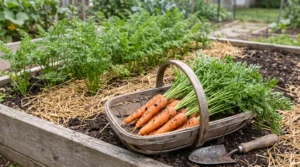
Ordinary cracking doesn’t call for fertilizer or pesticides.
What Should You Do Next?
Start with the carrot in your hand. Check whether the crack is clean and the root is firm, or whether you see slime, mold, or soft tissue.
Then look at your recent rain and watering pattern, and decide whether the rest of the row is ready to pull.
For the next crop, focus on maintaining steadier soil moisture and harvesting when the roots reach their intended size.
Those two habits can reduce the risk of cracking, even though weather conditions will never be completely within your control.