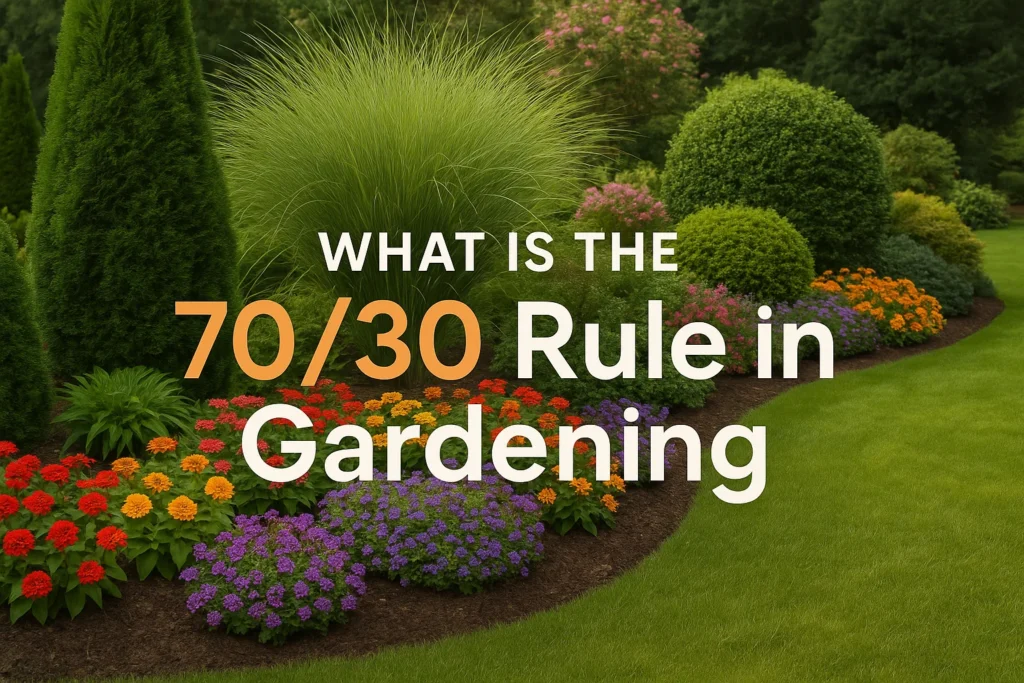
The 70/30 rule in gardening is a simple way to keep your garden balanced and healthy.
It means using 70% of one important thing and 30% of another to create the best results.
This rule can help you choose plants, design your yard, and even mix your soil the right way.
Even though it sounds like one rule, it actually has four helpful uses.
I have been gardening for over ten years, and if there is one principle that has genuinely transformed the way I plan, plant, and maintain my garden, it is the 70/30 rule.
The funny thing is, I did not even know I was using it for the first few years.
I just knew that some planting combinations felt balanced and looked great year after year, while others always seemed off — too crowded, too sparse, or just visually chaotic.
It was only after reading about what is the 70/30 rule in gardening that everything clicked into place.
Suddenly I had a name for the instinct I had been developing through years of trial and error.
And once I understood the principle properly, I could apply it deliberately rather than accidentally.
In this guide, I am going to walk you through all the major interpretations, explain which one applies to your situation, and give you practical steps to start using each one in your garden.
Key Highlights
- The 70/30 rule in gardening recommends 70% perennial plants and 30% annual plants for balanced, sustainable gardens with year-round interest.
- This principle extends to other garden aspects including evergreen vs. deciduous plants, sun vs. shade areas, and maintenance vs. enjoyment time allocation.
- Implementing the 70/30 rule reduces long-term maintenance costs while providing continuous seasonal interest and visual appeal.
- The rule helps create resilient gardens that withstand environmental stressors and require fewer resources over time.
- Adapting the 70/30 principle to your specific climate, available space, and personal preferences ensures sustainable gardening success.
What Is the 70/30 Rule in Gardening
At its heart, the 70/30 rule is about balance.
It says that the healthiest, most beautiful, and most functional gardens are built on a ratio — 70% of one foundational element, and 30% of a complementary one.
That complementary 30% is what adds variety, interest, and flexibility without disrupting the underlying structure.
Think of it like a good meal.
If 70% of your plate is made up of wholesome, nutritious food and 30% is the thing you really enjoy eating, you have a meal that is both satisfying and sustainable.
Go too far in either direction and the balance break down.
The same logic applies directly to your garden.
The reason this ratio comes up across so many different areas of gardening is that 70/30 hits a sweet spot that human beings find naturally pleasing — enough consistency to feel cohesive, and enough variety to feel interesting.
Garden designers, ecologists, and soil scientists have all independently arrived at similar conclusions, just from completely different starting points.
This balanced approach offers multiple benefits:
- Reduced maintenance over time as perennials establish themselves
- Year-round interest with a stable backbone of plants
- Environmental sustainability through reduced replanting needs
- Cost efficiency with fewer plants to purchase each season
- Design cohesion that maintains structure while allowing for creativity
The principle extends beyond just plant types to encompass various aspects of garden design and management, which we’ll explore throughout this article.
Historical Context of the 70/30 Rule
The 70/30 rule did not just start one day. It slowly developed over many years from gardening experience all around the world.
Where the idea came from:
In Europe during the 1600s and 1700s, garden designers used strong plants like hedges and trees as the main part of the garden.
Then they added colorful flowers as a small extra touch.
Japanese gardens have done something similar for a long time. They use rocks, evergreen trees, and strong plants as the base.
Seasonal flowers are added to bring color and beauty.
By the late 1900s, gardeners wanted gardens that saved water, helped nature, and needed less work. The 70/30 rule became a simple way to do all three.
Why it matters today:
Home gardeners use it to grow gardens that are easy to care for and look nice all year.
Professional designers use it to create outdoor spaces that last a long time.
It works in big gardens, small gardens, and even container gardens.
The main idea is simple: build a strong base first, then add a little variety. This keeps your garden healthy, beautiful, and easy to manage.
The Science Behind the 70/30 Rule
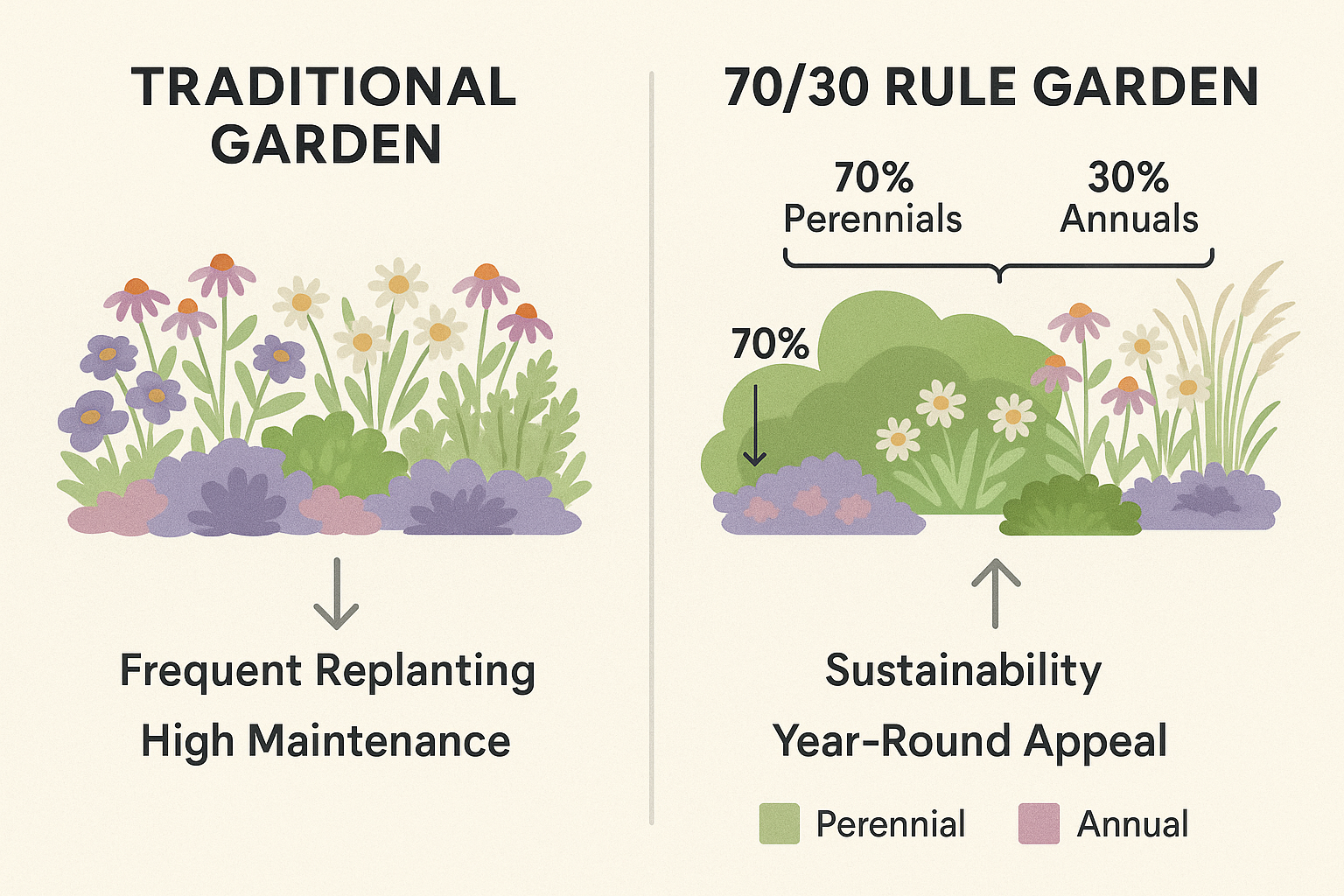
The 70/30 rule isn’t just an arbitrary guideline—it’s supported by ecological principles and plant biology that explain why this ratio tends to create successful gardens.
Ecological Balance and Biodiversity
In nature, most places are not filled with short-lived plants.
Instead, they are mostly made up of plants that live for many years.
These are called perennials.
They include trees, shrubs, grasses, and other long-lasting plants.
Small plants that grow for just one season, called annuals, grow in open spaces where they can fit in.
When we copy this natural balance in our gardens using the 70/30 rule, many good things happen:
-
More birds, bees, and butterflies visit
-
The soil becomes healthier
-
Plants handle heat, cold, and storms better
-
The garden helps store carbon from the air
-
Less water, fertilizer, and chemicals are needed
Studies show that gardens with more long-lasting plants build healthier soil over time and support more kinds of living things.
In simple words, when we garden the way nature grows, everything works better.
Plant Lifecycle Considerations
The biological differences between annuals and perennials explain why the 70/30 balance works so effectively:
| Plant Type | Lifecycle | Resource Allocation | Garden Benefits |
|---|---|---|---|
| Perennials | Multiple years to decades | Energy invested in deep roots and long-term structures | Soil stabilization, drought resistance, habitat creation |
| Annuals | Single growing season | Energy focused on rapid growth and abundant seed production | Quick color, seasonal adaptation, pollinator attraction |
Perennial plants spend a lot of energy growing strong roots and sturdy stems.
Once they are settled in, they can handle heat, cold, and dry weather better.
Their deep roots help hold the soil in place and keep it healthy.
After they are established, they usually need less watering.
Annual plants are different. They grow, flower, and make seeds all in one season.
They grow fast and give bright color quickly. But they need more care, more water, and often need to be replanted every year.
The 70/30 rule uses the best parts of both.
Perennials give strength and stability.
Annuals add bright color and excitement.
Together, they create a garden that is strong but still full of life and beauty.
Applications of the 70/30 Rule in Garden Design
The 70/30 principle extends far beyond the basic perennial-to-annual ratio.
Let’s explore how this versatile rule applies to various aspects of garden design and planning.
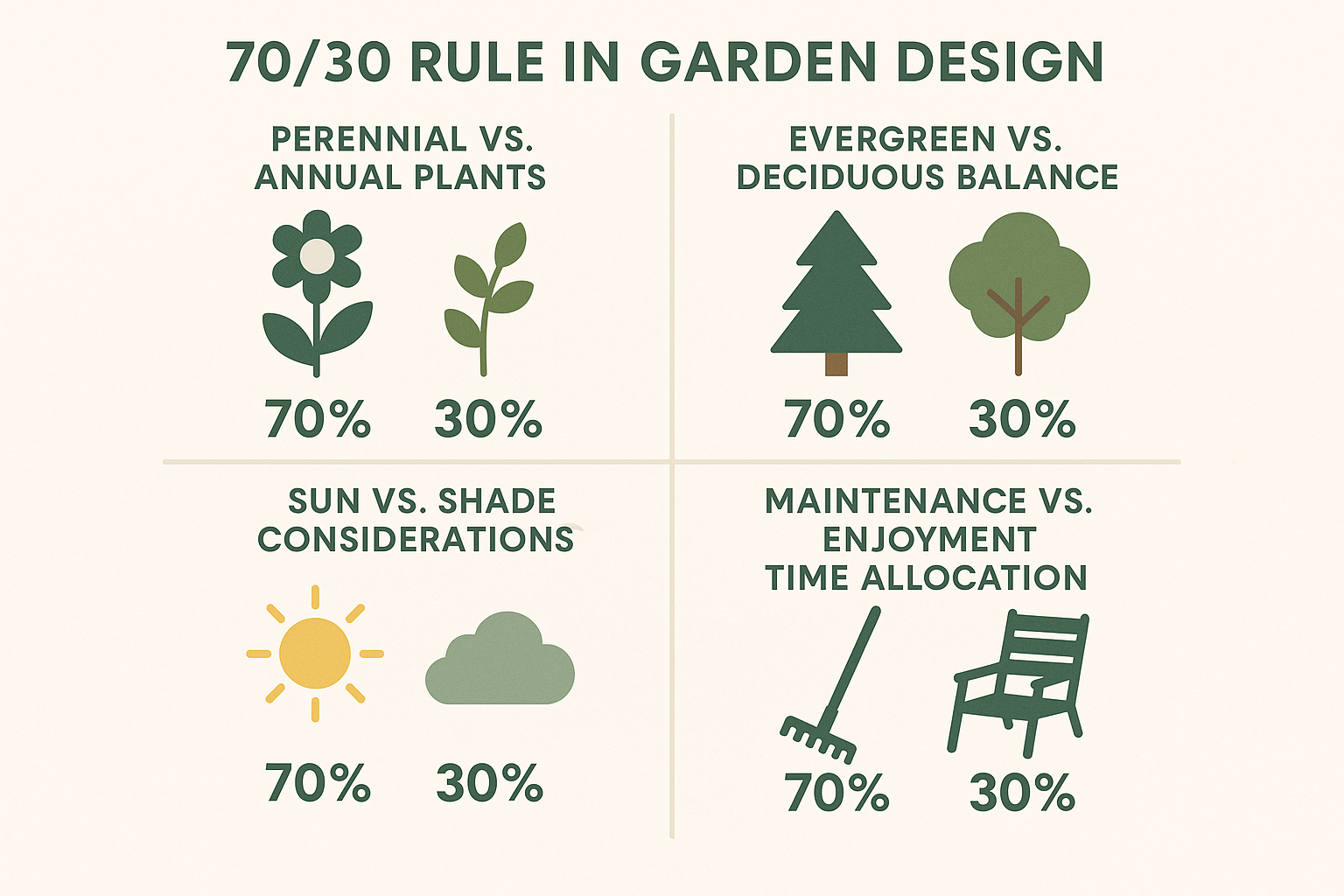
Perennial vs. Annual Plants
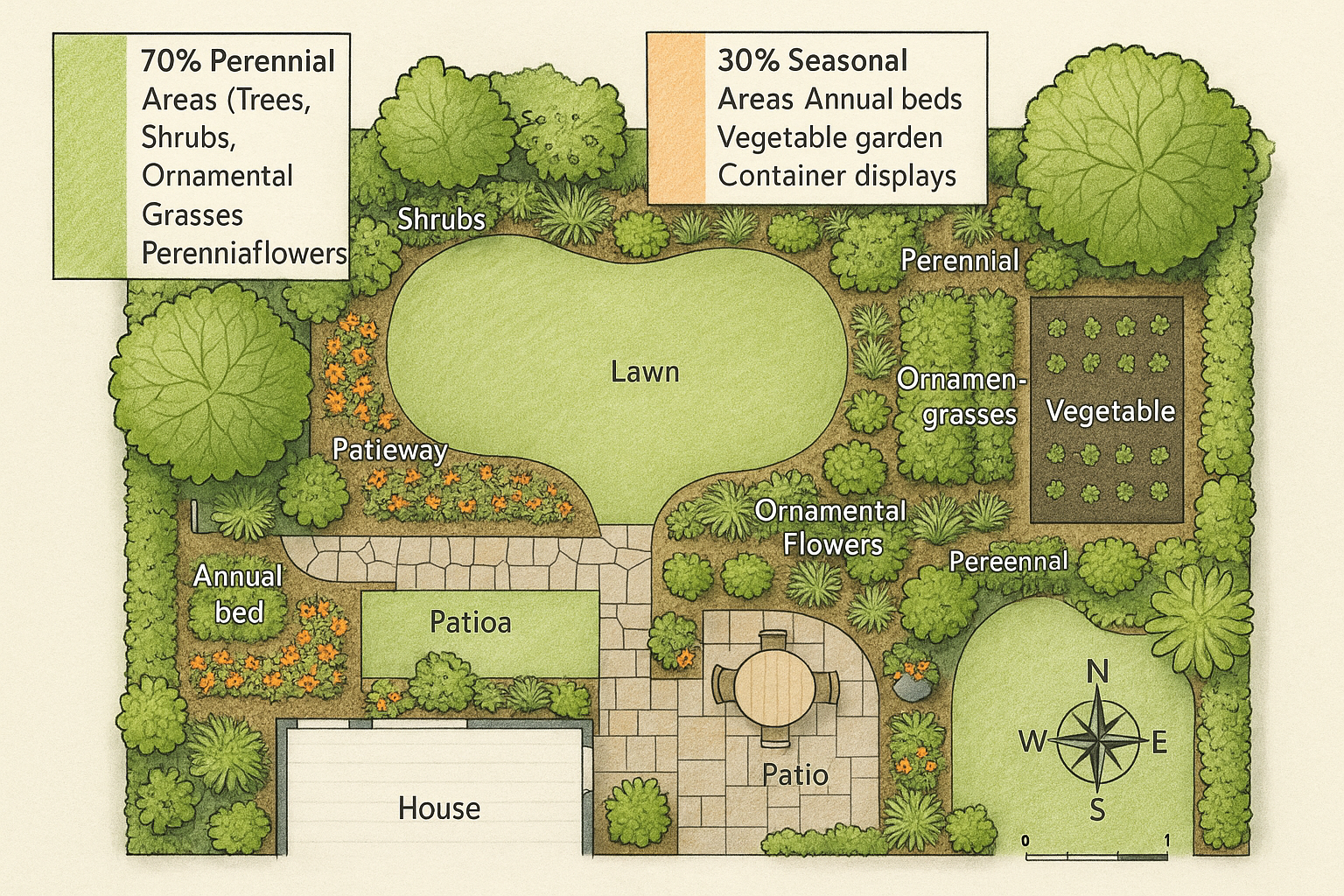
The most common application of the 70/30 rule involves the balance between perennial and annual plants:
The 70% Perennial Foundation:
- Trees and shrubs that provide structure
- Ornamental grasses that offer movement and winter interest
- Herbaceous perennials that return reliably each year
- Bulbs that naturalize and multiply over time
- Native plants adapted to local conditions
The 30% Annual Accent:
- Seasonal flowering annuals for color bursts
- Vegetables and herbs for edible gardens
- Experimental plant varieties you want to try
- Container plantings that can be changed seasonally
- Cut flower varieties for indoor arrangements
This balance ensures your garden maintains its fundamental character year after year while still offering fresh interest and opportunities for creativity.
Evergreen vs. Deciduous Balance
The 70/30 rule can also help you choose between evergreen and deciduous plants.
Evergreen plants stay green all year. Deciduous plants lose their leaves in fall and grow new ones in spring.
70% Evergreen Plants — Your Garden’s Strong Base
- Keep your garden looking full and green all year long
- Give your garden a good shape even in the middle of winter
- Create a nice background that makes other plants stand out
- Less work for you — no big pile of leaves to clean up
- Give birds and small animals a safe place to live all year
30% Deciduous Plants — Your Garden’s Seasonal Surprise
- Change colour and look exciting through the seasons
- Bring beautiful flowers in spring and rich colours in autumn
- Let sunlight through in winter when other plants need it
- Often produce the most colourful flowers in the garden
- Keep your garden feeling fresh and new throughout the year
This balance is very helpful in cold areas where winters are long.
Evergreen plants keep the garden from looking empty, while deciduous plants add color and excitement during the growing season.
Together, they help your garden look good all year long.
Sun vs. Shade Considerations
The 70/30 principle can guide planning for light conditions:
For most productive gardens:
- Aim for approximately 70% sun and 30% shade
- This balance supports a wide plant palette while providing necessary relief from intense sun
- Creates microclimates that extend growing seasons
- Allows for diverse habitat creation
For woodland gardens:
- Reverse the ratio to 70% shade and 30% sun
- Focus on shade-loving perennials as the foundation
- Use sunny pockets for seasonal color highlights
- Emphasize texture and form over flower abundance
Thoughtfully planning this balance helps create a garden that works with your site’s natural conditions rather than fighting against them.
Maintenance vs. Enjoyment Time Allocation
Perhaps one of the most practical applications of the 70/30 rule relates to how you spend time in your garden:
Aim for:
- 70% enjoyment (relaxing, observing, harvesting, entertaining)
- 30% maintenance (planting, weeding, pruning, fertilizing)
When you plan your garden with this balance in mind, gardening becomes fun instead of feeling like too much work.
The right plant choices can save you time.
Using simple watering systems can make watering easier.
Adding mulch helps keep weeds down and soil moist.
Choosing the right paths and garden layout can also reduce work.
When you plan wisely, you spend less time fixing problems and more time enjoying your garden.
Your garden should bring you joy — not feel like a never-ending chore
Benefits of Implementing the 70/30 Rule
Adopting the 70/30 rule in your garden planning offers numerous advantages that impact everything from your wallet to your garden’s environmental footprint.
Economic Advantages
The financial benefits of the 70/30 approach are significant and compound over time:
- Reduced plant replacement costs: With 70% perennials, you’ll purchase fewer new plants each season
- Lower water bills: Established perennials typically require less supplemental irrigation
- Decreased fertilizer expenses: Perennial gardens often need less supplemental feeding
- Minimized soil amendment needs: As perennials improve soil structure naturally
- Long-term value increase: Well-designed gardens with mature perennials can increase property values by 5-15%
According to landscape industry data, gardens designed with the 70/30 principle can reduce annual maintenance costs by 30-40% compared to gardens dominated by annual plantings.
Environmental Impact
The environmental benefits of the 70/30 approach align with sustainable gardening practices:
- Reduced water consumption: Established perennial gardens can use up to 60% less water than annual-dominated landscapes
- Lower carbon footprint: Less frequent replanting means reduced fuel use for transportation and cultivation
- Decreased plastic waste: Fewer nursery pots and plant tags enter the waste stream
- Improved soil health: Perennial root systems enhance soil structure and microbial activity
- Enhanced carbon sequestration: Woody perennials and deep-rooted plants store more carbon long-term
- Habitat creation: Stable perennial plantings provide more consistent wildlife support
Research indicates that converting just 30% of traditional annual beds to perennial plantings can reduce a garden’s overall environmental impact by more than 50%.
Aesthetic and Psychological Benefits
The visual and emotional impacts of a well-balanced garden shouldn’t be underestimated:
- Year-round interest: The perennial backbone ensures the garden never looks completely bare
- Evolving beauty: The garden develops character and maturity over time
- Reduced visual stress: Less seasonal upheaval creates a more peaceful environment
- Sense of permanence: Established perennials create a connection to place
- Opportunities for mindfulness: Less maintenance time means more observation and enjoyment
- Seasonal anticipation: The changing 30% creates something to look forward to each season
Studies in environmental psychology suggest that gardens with a balance of permanence and change—like those following the 70/30 rule—provide optimal psychological benefits to their caretakers and visitors.
Resilience and Adaptability
Perhaps most importantly in our changing climate, the 70/30 rule creates gardens with enhanced resilience:
- Weather tolerance: Established perennials generally withstand weather extremes better than annuals
- Pest resistance: Diverse perennial plantings reduce the impact of pest outbreaks
- Disease buffering: Mixed plantings limit the spread of pathogens
- Adaptability: The 30% flexible component allows for adjustments as conditions change
- Recovery capacity: If one section struggles, the 70% backbone maintains garden integrity
This resilience becomes increasingly valuable as gardeners face more unpredictable weather patterns and environmental challenges.
Implementing the 70/30 Rule in Different Garden Types
The versatility of the 70/30 principle makes it applicable across virtually any garden style or purpose.
Let’s explore how to adapt this rule to different garden types.
Ornamental Gardens
In purely decorative gardens, the 70/30 rule creates stunning visual displays with sustainable foundations:
For the 70% perennial foundation:
- Choose structural shrubs with multi-season interest (hydrangeas, viburnums, ninebark)
- Include ornamental grasses for movement and winter presence
- Select long-blooming perennials (salvias, coreopsis, echinacea)
- Incorporate spring and fall bulbs that naturalize
- Add architectural plants with distinctive forms (yucca, bergenia, hostas)
For the 30% seasonal component:
- Designate specific beds or container areas for seasonal color
- Focus annuals where they’ll have maximum visual impact (entryways, focal points)
- Consider a cutting garden section that changes annually
- Use annuals to fill gaps while perennials establish
- Experiment with color themes that can change yearly
This approach creates gardens with reliable beauty that still offer fresh interest each season.
Vegetable and Edible Gardens
Even productive food gardens benefit from the 70/30 approach:
For the 70% perennial foundation:
- Establish fruit trees and shrubs as garden anchors
- Plant perennial vegetables (asparagus, rhubarb, artichokes)
- Include perennial herbs (rosemary, thyme, sage, mint)
- Incorporate edible flowers that return yearly (bee balm, daylilies)
- Add perennial greens where climate allows (sorrel, Good King Henry)
For the 30% annual component:
- Dedicate space for seasonal vegetables with high yields
- Rotate annual crops for soil health
- Try new vegetable varieties each season
- Grow annual herbs for culinary variety
- Plant cutting flowers that support pollinators
This balanced approach ensures food production throughout the seasons while reducing the annual workload of complete garden replanting.
Wildlife and Habitat Gardens
For gardens focused on supporting biodiversity, the 70/30 rule creates stable ecosystems:
For the 70% perennial foundation:
- Select native trees and shrubs that support local wildlife
- Include perennial wildflowers with different bloom times
- Plant native grasses that provide shelter and nesting material
- Add water features with permanent aquatic plants
- Create permanent habitat structures (rock piles, brush piles, bee hotels)
For the 30% flexible component:
- Allow some areas for self-seeding annuals
- Adjust plantings based on observed wildlife needs
- Create seasonal feeding stations that can be modified
- Leave some soil bare for ground-nesting insects
- Experiment with new native plant introductions
This approach creates habitat stability while allowing adaptation to changing wildlife populations and needs.
Small Space and Container Gardens
Even limited spaces can benefit from the 70/30 principle:
For balconies and patios:
- Use larger containers for permanent plantings (dwarf shrubs, small perennials)
- Dedicate 70% of container space to long-term plants
- Reserve smaller containers for seasonal displays
- Consider vertical elements for the permanent component
- Select compact perennials bred for container culture
For urban plots:
- Maximize perennial plantings along boundaries and permanent features
- Use the central 30% for seasonal changes
- Incorporate structural elements (trellises, obelisks) in the permanent section
- Layer plantings vertically to maximize the 70% foundation
- Choose multi-functional perennials (beautiful and edible)
This approach brings the benefits of the 70/30 rule to even the smallest gardens, creating more sustainable and lower-maintenance small spaces.
Seasonal Considerations for the 70/30 Rule
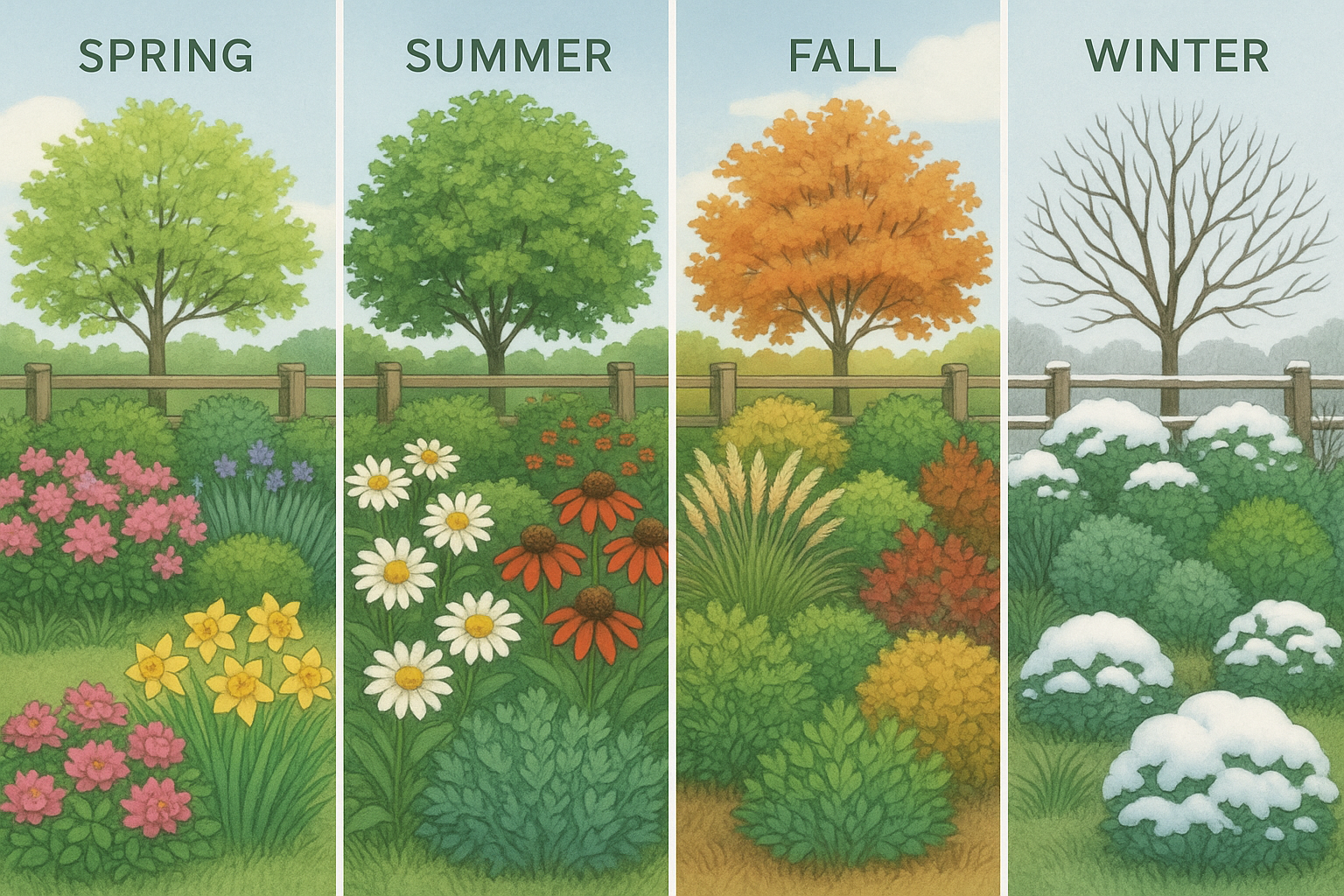
The changing seasons present both challenges and opportunities when implementing the 70/30 rule.
Understanding how to work with seasonal rhythms enhances the effectiveness of this approach.
Spring Planning and Planting
Spring is the ideal time to establish or reinforce your garden’s 70% perennial foundation:
Spring priorities:
- Plant new perennials early to allow establishment before summer heat
- Divide and relocate existing perennials as needed
- Assess winter losses and replace key structural elements
- Apply mulch to perennial beds to suppress weeds and conserve moisture
- Wait to install the 30% annual component until after frost danger passes
Spring planning tips:
- Map your garden to clearly identify the 70% permanent areas
- Take photos of the garden in early spring to identify “empty spots” needing attention
- Order perennial plants early for best selection
- Consider spring-blooming perennials and bulbs for early-season interest
- Start annual seeds indoors while waiting for planting time
Spring is also the time to assess whether your 70/30 balance needs adjustment based on the previous year’s performance.
Summer Maintenance Strategies
Summer is when the benefits of the 70/30 rule become most apparent:
For the 70% perennial component:
- Focus on establishment watering for newly planted perennials
- Deadhead selectively to encourage reblooming while allowing some seed formation
- Monitor for pest issues but tolerate minor damage
- Prune spring-flowering shrubs after bloom period ends
- Avoid disturbing soil around established perennials
For the 30% annual component:
- Maintain regular watering schedules for annual plantings
- Fertilize annuals according to their specific needs
- Harvest frequently from annual vegetables and cutting gardens
- Succession-plant quick-growing annuals for continuous harvests
- Take notes on particularly successful annual varieties
Summer maintenance should follow the same 70/30 time allocation principle—spend most of your garden time enjoying the space rather than constantly maintaining it.
Fall Transition and Preparation
Fall is crucial for reinforcing the 70/30 structure for the following year:
For the 70% perennial foundation:
- Plant new perennials, trees, and shrubs to establish roots before winter
- Divide overcrowded perennials to maintain vigor
- Leave perennial structures standing for winter interest and wildlife habitat
- Apply mulch to protect perennial roots in cold climates
- Consider adding spring-blooming bulbs to perennial beds
For the 30% flexible spaces:
- Remove spent annuals and add to compost
- Plant cover crops in vegetable garden areas
- Collect seeds from successful annuals for next year
- Prepare annual beds for spring planting
- Consider fall vegetable crops in appropriate climates
Fall is also an excellent time to evaluate the overall success of your 70/30 balance and make notes for adjustments in the following year.
Winter Assessment and Planning
Winter offers valuable planning time for maintaining the 70/30 balance:
Winter activities:
- Evaluate the “bones” of the garden when perennials are dormant
- Identify areas where additional evergreen structure is needed
- Plan next year’s 30% component (new varieties, color schemes)
- Order seeds and specialty plants during winter sales
- Prune dormant trees and shrubs that are part of the 70% foundation
Winter planning tools:
- Garden journals documenting successes and challenges
- Photographs from different seasons to identify gaps
- Seed catalogs and nursery websites for inspiration
- Garden design software to visualize changes
- Reference books on perennial combinations
Winter assessment ensures your 70/30 balance continues to evolve and improve year after year.
Plant Selection for the 70/30 Rule
Choosing the right plants is crucial to successfully implementing the 70/30 rule.
The selections for both the permanent and flexible components should work together to create a cohesive, functional garden.
Selecting Perennials for the 70% Foundation
The perennial component forms the backbone of your garden, so these selections deserve careful consideration:
Key characteristics to prioritize:
- Longevity: Choose plants known to thrive for many years without division
- Multi-season interest: Select perennials offering more than just a brief flowering period
- Climate appropriateness: Focus on plants well-adapted to your local conditions
- Structural value: Include plants with distinctive forms that maintain presence year-round
- Low maintenance requirements: Prioritize plants that don’t need frequent intervention
Recommended perennial categories:
-
Structural woody plants (trees and shrubs):
- Deciduous options: Serviceberry, viburnum, hydrangea, dogwood
- Evergreen options: Boxwood, holly, juniper, rhododendron
- Consider mature size carefully to avoid overcrowding
-
Ornamental grasses and grass-like plants:
- Cool-season options: Fescue, sedge, blue oat grass
- Warm-season options: Switchgrass, little bluestem, muhly grass
- Evergreen options: Carex species, liriope, mondo grass
-
Long-lived perennial flowers:
- Early season: Hellebores, peonies, baptisia
- Mid-season: Echinacea, rudbeckia, salvia
- Late season: Asters, anemones, goldenrod
- Extended bloomers: Geranium ‘Rozanne’, Russian sage, coreopsis
-
Architectural perennials:
- Large-leaved: Hosta, bergenia, rodgersia
- Vertical accents: Yucca, foxglove, veronicastrum
- Ground-covering: Heuchera, epimedium, waldsteinia
-
Edible perennials:
- Fruits: Blueberry, strawberry, raspberry
- Herbs: Thyme, sage, oregano, chives
- Vegetables: Asparagus, rhubarb, sea kale
By selecting plants from these categories with attention to bloom time, texture, and form, you can create a 70% foundation that offers interest throughout the year.
Choosing Annuals for the 30% Seasonal Component
The annual component provides flexibility and seasonal highlights:
Selection strategies:
- Grouping: Plant annuals in concentrated areas for visual impact
- Succession: Select varieties with different bloom times for continuous interest
- Experimentation: Use this 30% to try new plants without redesigning the entire garden
- Color coordination: Choose annuals that complement your perennial palette
- Specific functions: Select annuals for cutting, pollinators, or edible production
Recommended annual categories:
-
Flowering annuals:
- Spring: Pansies, snapdragons, sweet alyssum
- Summer: Zinnias, cosmos, sunflowers, petunias
- Fall: Marigolds, celosia, ornamental kale
- Extended season: Calibrachoa, verbena, lantana
-
Edible annuals:
- Quick crops: Lettuce, radishes, arugula
- Summer staples: Tomatoes, peppers, basil
- Fall harvest: Kale, spinach, carrots
- Dual-purpose (ornamental and edible): Nasturtiums, Swiss chard, purple basil
-
Specialty annuals:
- Cutting garden: Larkspur, bachelor’s buttons, annual dahlias
- Pollinator support: Borage, phacelia, calendula
- Fragrance: Sweet peas, stock, nicotiana
- Structure: Annual vines, ornamental amaranth, castor bean
-
Fillers and transitions:
- Quick color: Impatiens, begonias, coleus
- Gap fillers: Annual poppies, nigella, annual baby’s breath
- Season extenders: Pansies, ornamental cabbage, mums
The 30% component allows for creativity and adaptation while the 70% foundation maintains garden stability.
Native vs. Non-Native Considerations
The 70/30 rule works well with either native or non-native plant selections, though there are special considerations for each:
For native-focused gardens:
- Dedicate the majority of the 70% foundation to regional native perennials
- Use the 30% component for:
- Native annuals that would naturally self-seed
- Experimentation with natives from adjacent regions
- Showcasing rare native species in protected locations
- Research historical plant communities in your area for inspiration
- Consider including some near-natives that offer specific functions
For mixed gardens:
- Create a foundation that includes both native and well-adapted non-native perennials
- Use native plants where they excel (wildlife support, site-adaptation)
- Select non-natives for specific functions (extended bloom, unique forms)
- Avoid potentially invasive non-native species
- Use the 30% component to compare native and non-native performance
For specialized gardens:
- Consider the garden’s primary purpose when selecting the balance
- Food gardens may rely more heavily on non-native annual and perennial crops
- Formal gardens might emphasize non-native ornamentals with specific forms
- Restoration gardens should prioritize local native species for the 70% component
Regardless of native status, the key is selecting plants that will thrive in your conditions with minimal intervention, particularly for the 70% foundation component.
Design Principles for the 70/30 Garden
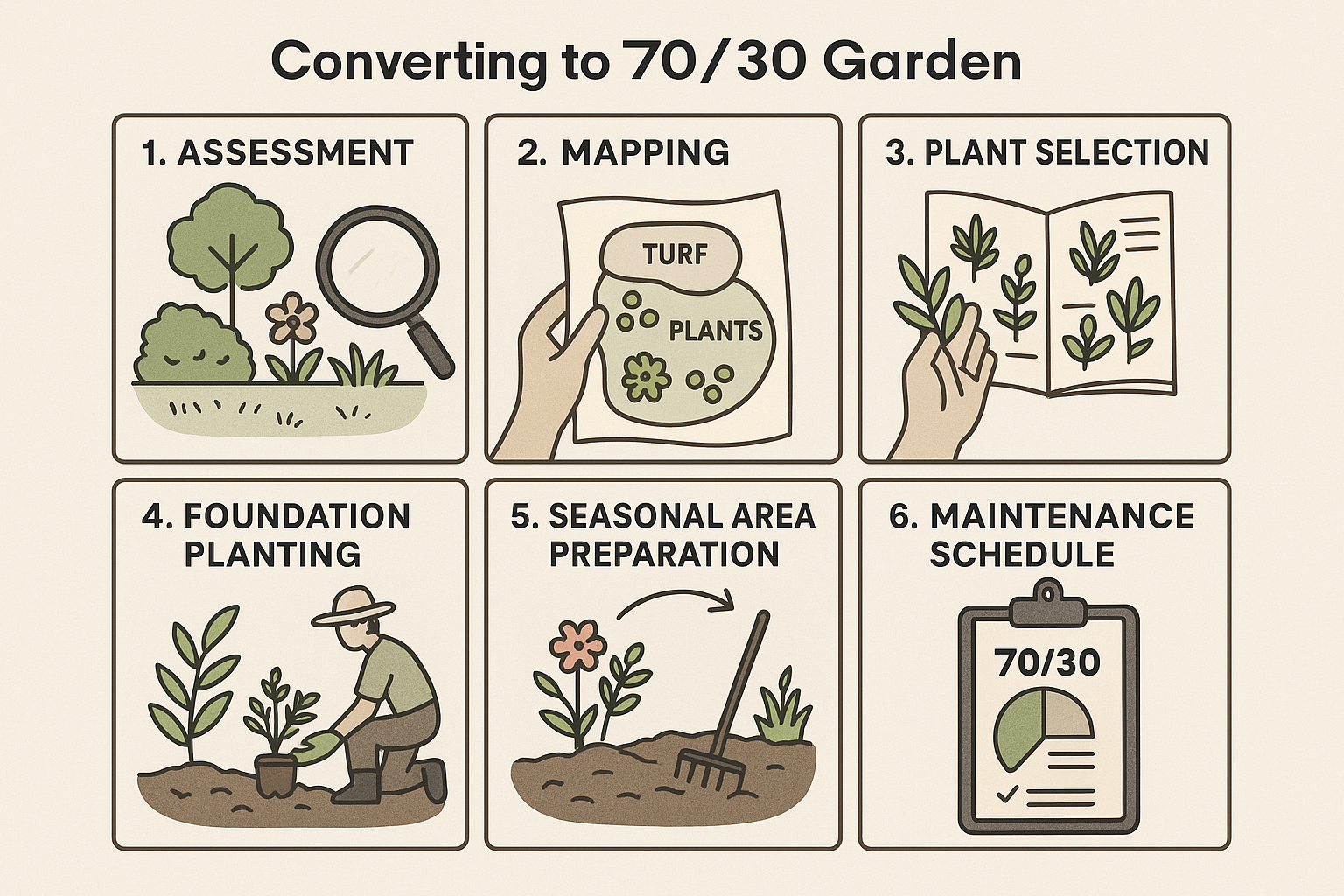
Implementing the 70/30 rule most effectively requires thoughtful design.
These principles help create a garden that’s both beautiful and functional while maintaining the desired balance.
Layout and Spatial Planning
The physical arrangement of your 70/30 garden significantly impacts its success:
Foundational guidelines:
- Define clear zones: Designate specific areas for the permanent 70% and the flexible 30%
- Consider viewing angles: Place the 30% component where it will have maximum visual impact
- Create flow: Arrange the 70% foundation to guide movement through the garden
- Layer strategically: Position taller perennials toward the back/center with lower plants in front
- Allow access: Ensure maintenance paths reach both permanent and seasonal plantings
Effective layout strategies:
-
The backbone approach:
- Use woody plants and structural perennials to create the main garden “architecture”
- Designate beds along paths, boundaries, and key sightlines for the 70% component
- Reserve foreground areas and focal points for the 30% seasonal plantings
- This approach creates a stable framework with high-visibility seasonal highlights
-
The island approach:
- Create permanent perennial “islands” throughout the garden space
- Use these islands as anchors that provide year-round structure
- Fill the spaces between islands with seasonal plantings that can change
- This approach works well in larger spaces and creates distinct garden “rooms”
-
The matrix approach:
- Establish a base planting of reliable ground-covering perennials
- Intersperse structural perennials throughout this matrix
- Designate specific pockets within the matrix for seasonal plantings
- This approach creates a naturalistic look with seamless integration of components
-
The container complement:
- Use in-ground plantings for the 70% permanent component
- Utilize containers for much of the 30% seasonal element
- This approach allows for easy seasonal changes without disturbing the main garden
Whichever layout you choose, ensure that both components are positioned to fulfill their specific roles in the garden ecosystem.
Color Theory and Visual Harmony
Color planning enhances the effectiveness of the 70/30 balance:
For the 70% foundation:
- Focus on foliage colors that provide long-term presence
- Select a limited palette of complementary colors for cohesion
- Include silver, blue, and burgundy foliage for year-round interest
- Consider plants that change color seasonally (fall foliage, winter stems)
- Use neutral tones (greens, silvers) as the dominant colors
For the 30% seasonal component:
- Create color themes that can change yearly
- Use bold, attention-grabbing colors for maximum impact
- Consider color psychology (cool colors for relaxation, warm colors for energy)
- Plan color progressions that evolve through the seasons
- Use color to direct attention to specific garden areas
Color harmony strategies:
- Analogous scheme: Use colors adjacent on the color wheel for subtle harmony
- Complementary scheme: Pair opposites on the color wheel for vibrant contrast
- Monochromatic scheme: Use variations of a single color for sophisticated unity
- Seasonal color shifts: Plan different color emphases for each season
Remember that green acts as a neutral in the garden, allowing the 70% foundation to serve as a cohesive backdrop for more colorful seasonal displays.
Texture and Form Considerations
Beyond color, texture and form create year-round interest in a 70/30 garden:
Texture principles:
- Include a mix of fine, medium, and coarse textures in the 70% foundation
- Use textural contrasts to create visual interest even without flowers
- Position plants with distinctive textures where they’ll catch light (backlit grasses, fuzzy lamb’s ears)
- Consider seasonal texture changes (emerging leaves, seed heads, bark patterns)
- Use the 30% component to introduce temporary textural highlights
Form guidelines:
- Include these five basic plant forms in your 70% foundation:
- Vertical (spikes, columns)
- Mounding (rounded, cushion-like)
- Horizontal (spreading, ground-covering)
- Arching (fountains, cascades)
- Specimen (architectural, focal)
- Create rhythmic repetition of forms throughout the garden
- Use distinctive forms as focal points and visual anchors
- Consider how forms change seasonally (particularly in winter)
- Use the 30% component to temporarily reinforce or contrast with permanent forms
By thoughtfully combining color, texture, and form, your 70/30 garden will maintain visual interest throughout the year, even when the 30% seasonal component is at its minimum.
Maintenance Strategies for the 70/30 Garden
One of the primary benefits of the 70/30 approach is reduced maintenance over time, but proper care techniques are essential to realize this advantage.
Establishing the Perennial Foundation
The initial establishment period for the 70% perennial component requires special attention:
First-year priorities:
- Consistent watering: Keep soil consistently moist until plants establish
- Weed management: Prevent weed competition during the critical establishment phase
- Mulching: Apply 2-3 inches of organic mulch to suppress weeds and retain moisture
- Limited pruning: Remove only damaged material during the first year
- Patience: Resist the urge to overplant—allow for mature spread
Establishment timeline:
- Herbaceous perennials: Generally require 1-2 full growing seasons to establish
- Shrubs: Typically need 2-3 years to develop sufficient root systems
- Trees: May take 3-5 years to become fully established
- The establishment rule of thumb: “First year sleep, second year creep, third year leap”
Supporting establishment:
- Consider temporary irrigation systems during the establishment phase
- Use organic fertilizers sparingly to avoid pushing excessive top growth
- Provide protection from extreme weather during the first year
- Document plant locations to avoid accidental damage
- Be prepared to provide extra attention during establishment, knowing it’s a short-term investment for long-term low maintenance
Once established, the 70% foundation will require significantly less intervention, allowing more focus on the 30% seasonal component.
Seasonal Maintenance Calendar
A year-round maintenance approach helps maintain the 70/30 balance effectively:
Spring (March-May):
- Cut back previous year’s perennial growth before new growth emerges
- Divide and relocate overcrowded perennials
- Apply compost as a top dressing around perennials
- Edge beds to maintain clean boundaries
- Prepare areas for the 30% annual component
- Install early-season annuals as weather permits
Summer (June-August):
- Deadhead spent flowers selectively on perennials
- Monitor and adjust irrigation as needed
- Provide support for tall perennials before they flop
- Harvest from edible components regularly
- Replace spring annuals with summer options as needed
- Take photos and notes for future planning
Fall (September-November):
- Plant new perennials for next year’s display
- Divide spring and summer blooming perennials
- Leave seed heads and structural elements for winter interest
- Apply mulch to protect roots in cold climates
- Remove spent annuals and prepare beds for winter
- Collect seeds from desirable annuals
Winter (December-February):
- Prune dormant trees and shrubs as needed
- Leave perennial structures standing for wildlife habitat
- Plan next year’s 30% component
- Order seeds and specialty plants
- Maintain winter interest with strategic lighting and hardscape elements
- Protect vulnerable plants during extreme cold
This seasonal approach ensures both components of your 70/30 garden receive appropriate care throughout the year.
Sustainable Practices for Long-term Success
To maximize the benefits of the 70/30 approach, incorporate these sustainable practices:
Water management:
- Install drip irrigation for efficient water delivery
- Group plants with similar water needs (hydrozoning)
- Use rain barrels or cisterns to capture and reuse rainwater
- Apply mulch to reduce evaporation
- Water deeply but infrequently to encourage deep root growth
Soil health:
- Avoid disturbing soil around established perennials
- Use organic mulches that break down to improve soil over time
- Incorporate compost annually as a top dressing
- Consider no-dig approaches for the 30% annual areas
- Test soil every 3-5 years to monitor nutrient levels
Integrated pest management:
- Accept minor pest damage as part of a healthy ecosystem
- Encourage beneficial insects by including host plants in your 70% foundation
- Use physical barriers rather than chemicals when possible
- Select resistant varieties, particularly for the 70% component
- Intervene only when damage reaches threshold levels
Resource cycling:
- Compost garden waste on-site when possible
- Chop and drop prunings as mulch where appropriate
- Save seeds from the 30% component for future use
- Divide perennials to create new plants rather than purchasing
- Share excess plants with neighbors to spread sustainable practices
These practices enhance the environmental benefits of the 70/30 rule while further reducing maintenance requirements over time.
Adapting the 70/30 Rule to Different Climates
The 70/30 principle works across climate zones, but implementation details vary significantly.
Here’s how to adapt this approach to different growing conditions.
Cold Climate Considerations (USDA Zones 3-5)
In regions with long, harsh winters, the 70/30 rule requires special adaptations:
For the 70% foundation:
- Emphasize winter interest through structural elements
- Include at least 40% evergreen plants within the 70% component
- Select extremely hardy perennials rated for your specific zone
- Focus on late-spring to early-fall bloomers that complete their cycle within a shorter growing season
- Include plants with distinctive bark, berries, or seed heads for winter interest
For the 30% seasonal component:
- Plan for a compressed growing season with quick succession
- Start annuals indoors 6-8 weeks before last frost
- Consider cold-hardy annuals that can extend the season (pansies, snapdragons)
- Use containers that can be moved to protected locations
- Include spring-blooming bulbs for early season interest
Special considerations:
- Provide winter protection for marginally hardy perennials
- Select plants that can handle snow load without breaking
- Consider raised beds to improve drainage and soil warming
- Use microclimates (south-facing walls, protected corners) for less hardy specimens
- Plan for snow removal pathways that won’t damage the 70% foundation
Temperate Climate Adaptations (USDA Zones 6-8)
Temperate regions offer the most flexibility for implementing the standard 70/30 approach:
For the 70% foundation:
- Balance deciduous and evergreen elements for year-round interest
- Include plants with multiple seasons of appeal
- Select perennials with staggered bloom times for continuous display
- Include structural grasses that provide winter presence
- Incorporate spring bulbs that naturalize over time
For the 30% seasonal component:
- Plan three seasonal rotations (spring, summer, fall)
- Include cool-season annuals for spring and fall
- Use heat-loving annuals for summer impact
- Consider winter vegetables in milder areas
- Experiment with tender perennials as annuals
Special considerations:
- Prepare for fluctuating winter temperatures that can damage plants
- Select plants that can handle both occasional freezes and summer heat
- Consider rain gardens to manage seasonal precipitation changes
- Include drought-tolerant options for summer dry periods
- Plan for seasonal transitions with overlap between displays
Hot and Arid Climate Adaptations (USDA Zones 9-11)
In hot, dry regions, water conservation becomes a central concern when implementing the 70/30 rule:
For the 70% foundation:
- Focus on drought-adapted native and desert-adapted plants
- Include succulents and cacti for structural elements
- Select plants with gray or silvery foliage that reflects heat
- Choose species with natural drought-avoidance strategies
- Incorporate desert trees for crucial shade elements
For the 30% seasonal component:
- Focus on cool-season annual displays during winter months
- Use heat-tolerant annuals sparingly during summer
- Consider a summer dormancy period with minimal seasonal plantings
- Utilize container plantings that can be moved to shadier locations
- Include spring wildflowers that complete their cycle before intense heat
Special considerations:
- Implement efficient irrigation systems for establishment
- Use inorganic mulches (gravel, decomposed granite) in some areas
- Create shade structures to protect sensitive plantings
- Consider rain harvesting systems to maximize natural precipitation
- Group plants with similar water needs in distinct hydrozones
Tropical and Subtropical Considerations (USDA Zones 10-13)
In frost-free regions, the 70/30 rule takes on different dimensions:
For the 70% foundation:
- Focus on tropical evergreens with distinctive foliage
- Include architectural plants like palms, cycads, and tree ferns
- Select plants that can handle high humidity and rainfall
- Choose species resistant to tropical pests and diseases
- Incorporate flowering trees and shrubs for vertical interest
For the 30% seasonal component:
- Focus on dry-season bloomers for color when needed
- Use container plantings for flexibility
- Consider seasonal foliage plants rather than just flowers
- Rotate shade-loving understory plants
- Include edibles with quick production cycles
Special considerations:
- Plan for heavy rainfall periods with proper drainage
- Select plants resistant to fungal issues in humid conditions
- Create multiple canopy layers mimicking natural tropical ecosystems
- Consider the impact of potential hurricanes/typhoons on plant selection
- Implement rainwater management systems for wet seasons
By adapting the 70/30 rule to your specific climate, you can create a garden that works with, rather than against, your local conditions.
Common Mistakes and How to Avoid Them
Even with the best intentions, gardeners can encounter challenges when implementing the 70/30 rule. Understanding common pitfalls helps ensure success.
Overplanting the Perennial Foundation
One of the most frequent mistakes is failing to account for the mature size of perennial plants:
The problem:
- Plants installed too closely compete for resources
- Overcrowded perennials become stressed and prone to disease
- The garden requires constant pruning to maintain paths and sightlines
- Some plants may be smothered by more aggressive neighbors
- The natural forms of plants cannot develop properly
The solution:
- Research mature sizes before purchasing plants
- Follow spacing guidelines on plant tags
- Create a scaled garden plan before planting
- Use temporary annuals to fill spaces while perennials mature
- Be patient—a properly spaced garden will fill in beautifully over time
Planning tip: When designing your 70% foundation, place plants based on their mature size, not their size at purchase. This may look sparse initially but will prevent future problems.
Neglecting Seasonal Transitions
Another common issue involves poor planning for the 30% seasonal component:
The problem:
- Gaps appear when transitioning between seasonal displays
- Spring displays are removed with no immediate replacement
- The garden looks unfinished during transition periods
- Seasonal plantings are installed too late to establish properly
- The 30% component becomes an afterthought rather than an integral design element
The solution:
- Plan overlapping displays with different peak periods
- Prepare replacement plants before removing existing displays
- Use container plantings that can be swapped quickly
- Create a detailed calendar for seasonal transitions
- Consider “bridge plants” that provide interest between main seasons
Transition tip: Maintain a small nursery area or holding bed where incoming seasonal plants can be grown to size before being moved to display areas.
Improper Plant Selection
Choosing unsuitable plants undermines the benefits of the 70/30 approach:
The problem:
- Short-lived plants are mistakenly included in the 70% foundation
- High-maintenance plants require constant attention
- Plants unsuited to local conditions struggle and fail
- Invasive species overwhelm other garden elements
- The wrong plants are assigned to each component
The solution:
- Research plant longevity before assigning to the 70% component
- Select naturally low-maintenance species for the foundation
- Choose plants adapted to your specific conditions
- Avoid known invasive species in your region
- Be realistic about maintenance requirements
Selection tip: When in doubt about a plant’s suitability for the 70% foundation, observe its performance in established gardens in your area or consult with local horticultural experts.
Inconsistent Maintenance
Maintenance lapses can undermine the 70/30 balance over time:
The problem:
- Perennials aren’t divided when needed and decline in vigor
- The 30% component isn’t refreshed regularly
- Volunteer seedlings blur the intentional design
- Seasonal tasks are postponed until problems develop
- Documentation is lacking, leading to accidental damage
The solution:
- Create a maintenance calendar with reminders
- Divide perennials according to their specific needs
- Schedule dedicated time for seasonal transitions
- Remove unwanted volunteers promptly
- Maintain a garden journal with maps and notes
Maintenance tip: Set calendar reminders for critical maintenance tasks at the beginning of each season to ensure they aren’t overlooked.
Impatience and Overcomplication
Perhaps the most fundamental mistake is expecting instant results or creating unnecessarily complex designs:
The problem:
- Gardeners abandon the approach before seeing long-term benefits
- Too many plant varieties create a chaotic appearance
- Constant redesign prevents the 70% foundation from maturing
- Overambitious plans exceed available maintenance time
- The fundamental simplicity of the 70/30 rule gets lost
The solution:
- Understand that the full benefits emerge over 3-5 years
- Start with a simpler design and expand gradually
- Limit plant varieties, especially for beginners
- Be realistic about available maintenance time
- Remember that the 70/30 rule is meant to simplify gardening, not complicate it
Simplification tip: When in doubt, reduce the number of plant varieties and focus on creating impact through repetition and massing rather than through excessive diversity.
Advanced Applications of the 70/30 Rule
Once you’ve mastered the basics of the 70/30 approach, consider these advanced applications to further enhance your garden’s performance and appeal.
Layering for Four-Season Interest
Strategic layering creates gardens with continuous appeal:
Vertical layering:
- Canopy layer (tallest): Trees, large shrubs, tall perennials
- Middle layer: Medium shrubs, ornamental grasses, mid-height perennials
- Ground layer: Low-growing perennials, ground covers, bulbs
- Seasonal layer: Annual displays integrated at appropriate heights
Temporal layering:
- Early season: Spring bulbs, flowering shrubs, early perennials
- Mid-season: Summer perennials, grasses beginning growth
- Late season: Fall bloomers, ornamental grasses, autumn foliage
- Winter: Evergreens, plants with winter interest, structural elements
Implementation strategy:
- Map your garden by both height and bloom time
- Identify and fill gaps in either dimension
- Ensure each garden area has at least three seasons of interest
- Position plants so that emerging growth masks declining plants
- Use the 30% component strategically to fill temporal gaps
This advanced layering creates gardens that maintain the 70/30 balance while offering continuous visual interest throughout the year.
Microclimate Manipulation
Understanding and creating microclimates enhances the 70/30 garden’s performance:
Identifying existing microclimates:
- Note areas with different sun exposure, wind patterns, and moisture levels
- Observe where snow melts first or last
- Identify heat-sink areas near buildings or hardscape
- Map cold air drainage patterns
- Document soil variations across the garden
Creating beneficial microclimates:
- Use the 70% foundation to create shelter from prevailing winds
- Position heat-loving plants near south-facing walls
- Create shade for cool-loving species with taller perennials
- Use hardscape elements to modify temperature extremes
- Adjust soil composition in specific areas for specialized plants
Strategic applications:
- Extend the growing season for the 30% component
- Include marginally hardy perennials in protected locations
- Create specialized niches for plants with specific requirements
- Moderate temperature extremes through thoughtful placement
- Maximize plant diversity within the same garden
By working with and enhancing microclimates, you can expand your plant palette while maintaining the 70/30 balance.
Succession Planting Techniques
Advanced succession strategies maximize the impact of both components:
For the 70% foundation:
- Select perennials with complementary life cycles
- Position spring ephemerals beneath later-emerging perennials
- Layer bulbs at different depths for sequential emergence
- Include plants with staggered bloom times within the same area
- Select species with attractive seedheads following bloom periods
For the 30% component:
- Plan precise transitions between seasonal displays
- Use succession sowing for continuous harvests in edible areas
- Maintain a nursery area for growing replacement plants
- Implement “relay planting” where new plants are added before old ones are removed
- Create detailed calendars for succession timing
Advanced techniques:
- Interplanting: Placing quick-growing annuals between slower-developing perennials
- Sequence planting: Following one crop immediately with another
- Temporal stacking: Combining plants with different seasonal peak periods
- Spatial succession: Moving seasonal displays to follow optimal conditions
- Functional succession: Changing plant types based on ecosystem needs
These succession techniques maximize productivity and visual impact while maintaining the fundamental 70/30 balance.
Biodiversity and Ecosystem Services
The most advanced application involves designing your 70/30 garden as a functioning ecosystem:
Biodiversity enhancement:
- Include plants from multiple families and genera
- Provide habitat for diverse wildlife species
- Incorporate plants with different root structures and depths
- Select species that support specialist pollinators
- Create habitat niches for beneficial insects
Ecosystem services:
- Carbon sequestration: Include woody plants and deep-rooted perennials
- Water filtration: Create rain gardens and bioswales
- Pollinator support: Ensure continuous bloom throughout growing seasons
- Temperature moderation: Use plants to reduce heat island effects
- Soil building: Select plants that enhance soil structure and fertility
Implementation approach:
- Assess which ecosystem services are most needed in your location
- Select foundation plants that provide multiple services
- Use the 30% component to fill functional gaps
- Monitor wildlife usage and ecosystem health
- Adjust the balance to enhance underperforming functions
This ecosystem-focused approach represents the highest evolution of the 70/30 rule, creating gardens that are not only beautiful but also ecologically valuable.
Case Studies: Successful 70/30 Gardens
Examining real-world examples provides valuable insights into successful implementation of the 70/30 rule across different settings.
Urban Courtyard Transformation
Location: Chicago, Illinois (Zone 5b) Size: 400 square feet Challenge: Creating year-round interest in a small space with limited sunlight
Implementation:
-
70% Foundation:
- Structural evergreens in corners (compact boxwood, dwarf hinoki cypress)
- Shade-tolerant perennials (hostas, heuchera, ferns)
- Spring bulbs naturalized throughout (snowdrops, species tulips)
- Climbing hydrangea on north-facing wall
- Container-grown Japanese maple as focal point
-
30% Component:
- Seasonal container displays flanking entrance
- Window boxes with 3x yearly rotation
- Small cutting garden in sunniest spot
- Winter container arrangements with evergreen boughs and colorful stems
Results:
- Maintenance reduced from 8 hours weekly to 3 hours weekly
- Garden provides interest in all four seasons
- Owner reports significant reduction in plant replacement costs
- Space feels larger due to layered plantings
- Neighbors regularly comment on continuous display
Key takeaway: Even in small spaces, the 70/30 rule creates gardens that offer maximum impact with minimal maintenance.
Suburban Family Garden
Location: Portland, Oregon (Zone 8b) Size: Quarter-acre lot Challenge: Creating a family-friendly space that balances beauty with functionality
Implementation:
-
70% Foundation:
- Mixed shrub border defining property boundaries
- Rain garden with moisture-loving perennials
- Ornamental trees providing privacy and shade
- Native plant hedgerow supporting local wildlife
- Structural ornamental grasses dividing activity zones
-
30% Component:
- Raised vegetable beds with seasonal rotations
- Annual cutting garden for family flower arrangements
- Children’s planting area with quick-growing annuals
- Seasonal containers near entertainment areas
- Experimental bed for testing new plant varieties
Results:
- Garden maintenance fits within weekend hours only
- Family reports increased outdoor time and engagement
- Vegetable production meets 40% of household needs during growing season
- Wildlife sightings increased significantly
- Garden serves multiple functions: play, entertainment, food production, and beauty
Key takeaway: The 70/30 approach creates multi-functional family spaces that balance beauty with practicality.
Rural Homestead Garden
Location: Vermont (Zone 4b) Size: 1.5 acres of cultivated space Challenge: Creating a productive, beautiful landscape in a challenging climate with a short growing season
Implementation:
-
70% Foundation:
- Fruit tree guild with perennial understory
- Mixed native hedgerows for windbreaks
- Ornamental grass meadow for winter interest
- Herb spiral with perennial culinary and medicinal plants
- Berry bushes integrated into landscape design
-
30% Component:
- Intensive vegetable gardens with season extension
- Annual cut flower production for market sales
- Experimental beds for crop trials
- Cold frames for early and late season production
- Seasonal displays near home entrance
Results:
- Garden provides approximately 60% of household food
- Generates supplemental income through flower sales
- Maintenance concentrated in 6-month growing season
- Winter interest from structural elements visible from home
- Significant increase in beneficial wildlife observed
Key takeaway: The 70/30 rule scales effectively to larger properties and can support productive homesteading while maintaining aesthetic appeal.
Commercial Landscape Renovation
Location: Austin, Texas (Zone 8b) Size: 2-acre commercial property Challenge: Converting a high-maintenance, water-intensive landscape to a sustainable, attractive commercial setting
Implementation:
-
70% Foundation:
- Drought-tolerant native trees and shrubs
- Ornamental grass masses for year-round structure
- Rain gardens capturing parking lot runoff
- Perennial wildflower meadow replacing lawn areas
- Strategic evergreens near building entrances
-
30% Component:
- Seasonal color at main entrance and signage
- Rotating container displays in high-visibility areas
- Demonstration gardens showcasing seasonal plants
- Edible landscaping near employee break areas
- Annual wildflower areas for spring impact
Results:
- Water usage reduced by 65% compared to previous landscaping
- Maintenance costs decreased by 50% after establishment period
- Employee satisfaction increased with natural environment
- Property became showcase for sustainable commercial landscaping
- Wildlife habitat value significantly improved
Key takeaway: The 70/30 rule translates effectively to commercial settings, offering significant economic and environmental benefits.
These case studies demonstrate the versatility of the 70/30 approach across different scales, climates, and purposes.
The fundamental principle remains consistent, while the specific implementation adapts to meet the unique needs of each situation.
The Future of the 70/30 Rule in Sustainable Gardening
As gardening practices continue to evolve in response to environmental challenges, the 70/30 rule is likely to gain even greater relevance. Here’s how this principle may develop in the coming years.
Climate Adaptation and Resilience
The 70/30 rule provides a framework for creating gardens resilient to climate change:
Emerging trends:
- Climate-shifted plant selection: Choosing perennial foundation plants from slightly warmer zones to anticipate temperature increases
- Extreme weather resilience: Designing the 70% component to withstand increasingly frequent weather extremes
- Adaptive management: Using the 30% flexible component to test plant responses to changing conditions
- Water-wise design: Implementing hydrozoning more precisely within the 70/30 framework
- Carbon-conscious gardening: Selecting foundation plants for carbon sequestration potential
Future applications:
- Gardens designed with specific climate resilience goals
- Regional adaptations of the 70/30 rule based on climate projection models
- Increased emphasis on deep-rooted perennials in the 70% component
- Community resilience gardens using the 70/30 framework
- Climate monitoring integrated with garden management
As climate challenges intensify, the stability provided by the 70% perennial foundation will become increasingly valuable, while the 30% flexible component will allow for necessary adaptations.
Technological Integration
Emerging technologies will enhance implementation of the 70/30 principle:
Current and upcoming innovations:
- Smart irrigation systems: Precision watering based on plant needs within different garden zones
- Garden planning apps: Software specifically designed to maintain the 70/30 balance
- Plant selection algorithms: AI-powered recommendations for optimal plant combinations
- Remote monitoring: Sensors tracking garden conditions to optimize maintenance
- Augmented reality design: Visualization tools showing mature growth and seasonal changes
Practical applications:
- More precise implementation of the 70/30 rule based on data
- Reduced resource use through technology-optimized maintenance
- Easier planning and visualization of seasonal transitions
- Better matching of plants to microclimate conditions
- Simplified record-keeping for garden evolution
Technology will make the 70/30 rule more accessible to beginning gardeners while helping experienced practitioners refine their approach.
Community and Collaborative Applications
The 70/30 principle is expanding beyond individual gardens to community spaces:
Emerging models:
- Community garden frameworks: Using the 70/30 rule to balance permanent community plots with seasonal allotments
- Public space design: Municipal landscapes designed with 70% low-maintenance areas and 30% high-impact seasonal displays
- Neighborhood coordination: Adjacent properties coordinating their 70/30 implementation for greater ecological impact
- School garden programs: Educational gardens using the 70/30 framework to balance learning opportunities with summer maintenance realities
- Healthcare settings: Therapeutic gardens designed with 70/30 balance for year-round healing benefits
Future developments:
- Standardized 70/30 guidelines for public space management
- Community plant-sharing networks based on 70/30 principles
- Coordinated neighborhood habitat corridors
- Policy incentives for 70/30 implementation in public and commercial spaces
- Research quantifying community benefits of the 70/30 approach
As resource constraints affect public space management, the efficiency of the 70/30 rule makes it increasingly attractive for community applications.
Research and Quantification
The benefits of the 70/30 rule are becoming more precisely quantified:
Current research areas:
- Measuring carbon sequestration in 70/30 gardens compared to conventional landscapes
- Quantifying water conservation benefits across different climate zones
- Assessing biodiversity support in gardens with varying implementations of the rule
- Calculating maintenance time and cost savings over multi-year periods
- Evaluating psychological benefits of 70/30 balanced landscapes
Future directions:
- Long-term studies tracking garden evolution over decades
- Economic models for cost-benefit analysis of 70/30 implementation
- Standardized metrics for 70/30 garden performance
- Optimization research for different climate zones and purposes
- Integration with broader sustainability certification systems
As research provides more concrete data on benefits, the 70/30 rule is likely to move from general guideline to evidence-based best practice.
Next Steps for Implementing the 70/30 Rule
Ready to apply the 70/30 rule to your garden? Here are practical steps to begin:
- Assess your current garden to determine its existing balance between perennial and annual elements
- Create a simple map identifying areas for the 70% foundation and 30% seasonal component
- Inventory existing perennials that can form part of your 70% foundation
- Research appropriate plants for your specific conditions and goals
- Start small by converting one section of your garden to the 70/30 balance
- Document your progress with photos and notes to track the evolution
- Connect with other gardeners implementing similar approaches for support and inspiration
- Be patient and allow time for the benefits to emerge as your garden matures
Remember that the journey toward a balanced 70/30 garden is itself a process of growth and discovery—one that will reward your efforts with a more beautiful, sustainable, and enjoyable garden for years to come.
Conclusion
Understanding what is the 70/30 rule in gardening is one of those things that genuinely changes how you see your outdoor space.
Once you know it, you start noticing it everywhere — in the gardens that always look right no matter what time of year you visit, in the raised beds that stay productive season after season, and in the spaces that feel alive with wildlife even in an urban setting.
The beauty of this principle is its flexibility.
You do not need to apply all four interpretations overnight.
Start with the one that addresses your most pressing gardening challenge right now — whether that is improving your soil, supporting more wildlife, creating year-round structure, or getting your hardscape balance right — and build from there.
Your action today is simple: pick just one step and do it.
Small changes, done again and again each season, can turn an average garden into a beautiful one.
If this guide helped you, share it with a friend who wants a better garden.
The 70/30 rule might be exactly what they need
Frequently Asked Questions
| Q: Is the 70/30 rule in gardening a strict requirement or just a guideline?
A: It is absolutely a guideline rather than a strict rule. The 70/30 ratio is a starting point that helps gardeners avoid common imbalances — too much paving, too many fillers, not enough native plants. A 65/35 or 75/25 split works perfectly well in practice. The goal is to develop an awareness of balance in your garden, not to measure every plant and paving slab to the nearest percentage point. |
| Q: Can I apply the 70/30 rule to a very small garden or balcony?
A: Yes, and in fact the 70/30 principle becomes even more important in small spaces where every plant and every square metre of surface counts. For balconies and tiny gardens, focus on the structural versus filler planting ratio and the soil mix rule for containers. Even three or four structural plants chosen well can anchor a small space beautifully. The hardscape ratio is also worth considering — a balcony that is all decking with a few token pots will always feel less inviting than one where plants genuinely share the space. |
| Q: What is the best 70/30 soil mix for growing tomatoes in raised beds?
A: For tomatoes specifically, a 70/30 mix of quality loam-based topsoil to compost works very well as a base. Some experienced growers adjust this slightly to 60% topsoil, 30% compost, and 10% perlite or coarse grit to improve drainage — tomatoes dislike sitting in waterlogged soil. The key is avoiding mixes that are too high in compost, which can lead to nitrogen-heavy growing conditions that produce lush foliage at the expense of fruit production. |
| Q: How long does it take to see results after applying the 70/30 rule?
A: It depends on which application you are focusing on. Soil improvements using the 70/30 mix ratio show results within the same growing season — plants establish faster and soil levels remain stable. Structural planting changes typically show their full impact after two to three seasons as plants mature. Wildlife responses to native planting increases can be noticed within a single summer, with more significant biodiversity gains building over two to four years as your garden becomes established as a reliable habitat. |