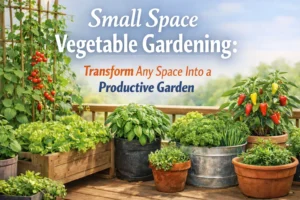
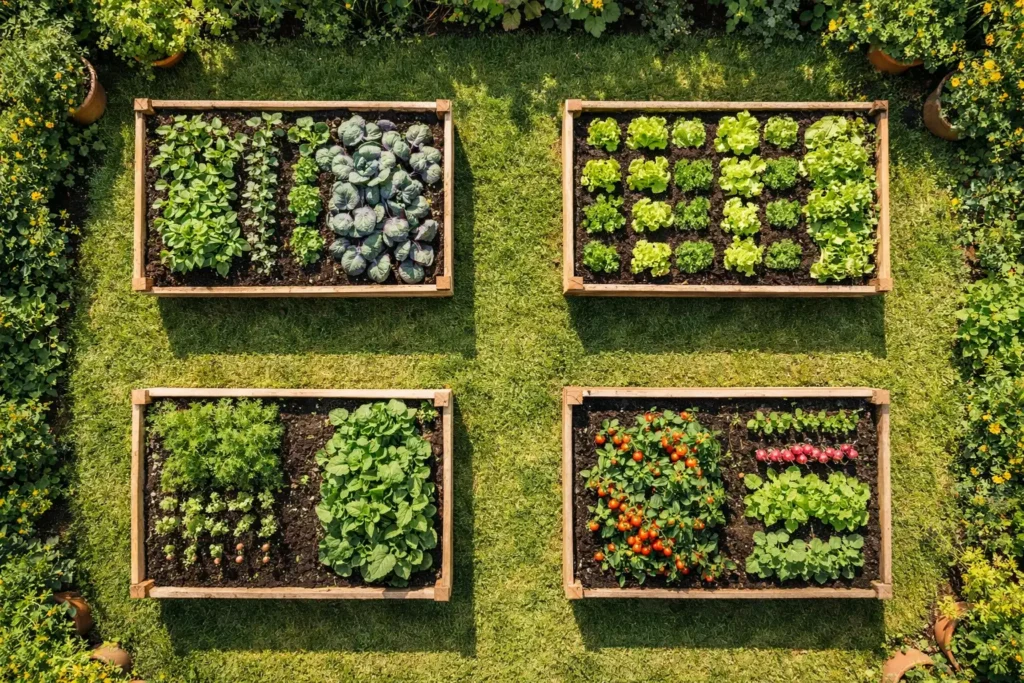
The best vegetable garden layout ideas for small spaces are the 4×8 raised bed for beginners, square foot gardening for maximum production, vertical growing for tight spots, and container layouts for patios and balconies.
The right layout depends on three things: how much space you have, how much sun that space gets, and how much time you can give your garden each week.
This guide covers six proven vegetable garden layout ideas that actually work in small spaces — with real planting plans, spacing guides, and honest advice on which one suits where you are starting from right now.
What Is a Vegetable Garden Layout?
A vegetable garden layout is the plan that decides where your beds sit, how they are shaped, how wide the paths between them are, and which crops go where inside each bed.
A good layout makes the most of every square foot you have, gives every plant enough sunlight and space to grow well, and makes daily tasks like watering, weeding, and harvesting as simple as possible.
The layout you choose does not need to be complicated. Even a single 4×8 foot raised bed with a simple planting plan is a complete and productive vegetable garden layout for any beginner.
Key Facts About Vegetable Garden Layout Ideas
A 4×8 foot raised bed is large enough to grow tomatoes, greens, and root crops yet small enough for a new gardener to manage with confidence.
Square foot gardening can produce more vegetables in a 4×4 foot bed than traditional row planting in a 10-foot row.
Keep all beds no wider than 4 feet across so you can reach the centre from both sides without stepping on the soil.
Raised beds warm up faster in spring and allow earlier planting than in-ground growing.
Vertical growing on a trellis can double the productive space in a small vegetable garden by using height instead of ground area.
| Quick Summary — Best Vegetable Garden Layout Ideas for Small Spaces
Single bed beginner: A 4×8 raised bed is the best first vegetable garden layout for any new grower. Maximum crops small space: Square foot gardening in a 4×4 or 4×8 raised bed. Patio or balcony: Container layout with 5 to 8 large pots in the sunniest available spot. Fence or wall: Vertical growing on a trellis doubles productive space without extra ground. Growing more: A multi-bed layout of 3 to 4 coordinated raised beds with clear paths between them. |
How to Choose the Right Vegetable Garden Layout for Your Space
Before you look at any vegetable garden layout idea, you need to know three things about your space: how much direct sun it gets, how much ground you actually have, and how much time you can realistically give your garden each week.
A layout that works brilliantly for a large sunny backyard will not suit a shaded patio with two square metres of usable space.
The starting point is always your own situation — not what looks best in a magazine.
| Your Situation | Best Vegetable Garden Layout Idea |
| Complete beginner with a small backyard | Single 4×8 raised bed — simple, productive, manageable |
| Want maximum crops in a very small space | Square foot gardening in a 4×4 or 4×8 raised bed |
| Patio or balcony with no ground at all | Container layout — large pots and grow bags in the sunniest spot |
| Fence, wall, or narrow strip of ground | Vertical growing layout with trellis or wall-mounted planters |
| Awkward curved or L-shaped space | Keyhole garden — circular bed with a central access path |
| Ready to grow more after a first season | Multi-bed layout with 3 to 4 coordinated raised beds |
At Iowa State University Extension recommend drawing your layout on paper before you buy or build anything — marking the sunniest spots first, then placing beds where sun is strongest and access from the house is easiest.
That is the one step most beginners skip and the one that causes the most problems later.
Twenty minutes with a pencil and paper saves hours of frustration once the season is underway.
1. Vegetable Garden Layout Idea 1: The 4×8 Raised Bed
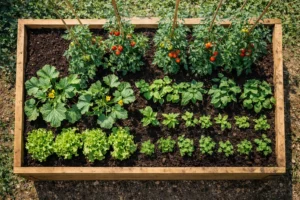
If you are starting out for the first time, a single 4×8 foot raised bed is the best vegetable garden layout idea available to you right now.
It is narrow enough to reach the centre from both sides without ever stepping on the soil.
It is long enough to grow a genuinely useful variety of crops.
And it is small enough to manage comfortably in about ten minutes a day.
In our experience, beginners who start with one well-managed 4×8 bed are far more likely to still be gardening three years later than those who start too big and feel overwhelmed before summer is even half over.
What to Grow in a 4×8 Raised Bed Vegetable Garden Layout
| Zone in the Bed | Best Crops | Notes |
| Front row — sunny side | Lettuce, spinach, radishes, herbs | Short crops that do not shade plants behind them |
| Middle zone | Courgette, green beans, peppers, beetroot | Medium height crops — good access from both sides |
| Back row — shaded side | Tomatoes, cucumbers on trellis | Tallest plants at the back so their shade falls away from the bed |
Always place your tallest plants — tomatoes, climbing beans, cucumbers — at the north end of the bed if you are in the northern hemisphere.
This stops them casting shade over the shorter crops in front. It is a small detail that makes a real difference to the whole bed’s productivity.
| A Single 4×8 Bed Can Make a Real Difference
The Old Farmer’s Almanac confirms that a well-planted 4×8 foot raised bed can grow enough salad leaves, herbs, and main crops to meaningfully reduce a family’s weekly grocery spend throughout the growing season — from one bed, in one small corner of a garden. |
Vegetable Garden Layout Idea 2: Square Foot Gardening for Small Spaces
Square foot gardening is one of the most productive vegetable garden layout ideas for small spaces that any beginner can use from their very first season.
You divide your raised bed into a grid of one-foot squares using string, wooden dividers, or even just a mental map.
Each square gets a set number of plants based on their mature size.
One tomato per square.
Four lettuces per square. Sixteen radishes per square.
Gardening writer Mel Bartholomew developed this intensive layout and Savvy Gardening explains the core principle clearly: grow in dense blocks, use every inch productively, and keep the whole bed reachable without ever stepping inside it.
Square Foot Planting Guide for a Beginner Vegetable Garden Layout
| Plants per Square Foot | Vegetables That Use This Spacing |
| 1 plant per square foot | Tomatoes, peppers, courgette, broccoli, cabbage |
| 2 plants per square foot | Cucumbers, climbing beans, Swiss chard |
| 4 plants per square foot | Lettuce heads, kale, basil, parsley |
| 9 plants per square foot | Spinach, beetroot, bush beans |
| 16 plants per square foot | Radishes, carrots, spring onions, chives |
A 4×4 foot bed divided into 16 squares can hold a genuinely impressive range of crops.
In our experience, beginners are always surprised by how much a small square foot garden produces once everything is established and growing well.
| Square Foot vs Traditional Row Planting
Square foot gardening produces more vegetables per square foot than traditional row planting because no space is lost to access aisles between rows. Every single inch of growing area is used for plants. According to Seed Sheets, a 4×4 foot square foot bed can out-produce a traditional 10-foot row for most common crops. |
Vegetable Garden Layout Idea 3: Vertical Growing for Tiny Garden Spaces

If your vegetable garden layout is limited by ground area, growing upwards is one of the most practical and effective moves you can make.
A trellis, wall-mounted planter, or a simple frame of bamboo canes lets climbing crops grow vertically — effectively doubling your productive growing space without using a single extra square foot of ground.
This is one of the best vegetable garden layout ideas for a balcony, a narrow side passage, or a fence line where ground space is genuinely tight.
Best Crops for a Vertical Vegetable Garden Layout in a Small Space
- Climbing beans grow quickly up a bamboo frame and produce abundantly all summer. A teepee of six canes takes up almost no ground footprint.
- Cucumbers trained up a trellis stay cleaner, get better air circulation, and are far easier to spot and harvest than those sprawling along the ground.
- Peas climb simple stick frames or netting and use minimal ground space for a genuinely generous harvest.
- Cherry tomatoes tied to a tall stake or grown in a wall planter work brilliantly against a sunny south-facing wall or fence.
- Courgette can be trained upward on a sturdy trellis in a very small space rather than allowed to sprawl across the whole garden.
| Vertical Growing Tip for Any Vegetable Garden Layout
Fix your trellis or frame to the north side of your vegetable garden layout. Your climbing plants get full sun as they grow upward and their shade falls away from your other crops rather than over them. |
Vegetable Garden Layout Idea 4: Container Layout for Patios and Balconies
A container vegetable garden layout is perfect for anyone with no ground space at all — a paved patio, a flat balcony, or a small courtyard that gets decent sun.
The key to a productive container layout is treating each pot as its own growing zone.
Group containers by water needs, arrange taller pots so they do not shade shorter ones, and position everything in the sunniest available spot.
How to Arrange a Container Vegetable Garden Layout
- Start with your largest pots. Place them first in the sunniest spots — these hold tomatoes, cucumbers, and courgette.
- Add medium pots around them for green beans, peppers, and chard.
- Use smaller pots and window boxes for lettuce, herbs, radishes, and spring onions.
- Group pots with the same watering needs close together to save time each day.
- Raise pots on pot feet or a small stand. This improves drainage and air circulation underneath.
| Container Size | Best Crops for a Container Vegetable Garden Layout |
| Large pot 40cm+ wide and deep | Cherry tomatoes, cucumbers, courgette, peppers |
| Medium pot 30cm wide and deep | Green beans, beetroot, chard, dwarf peas |
| Small pot 20cm wide | Lettuce, spinach, spring onions, herbs |
| Window box 60cm long | Salad leaves, radishes, chives, parsley, basil |
| Standard grow bag | Tomatoes, courgette, potatoes — one to two plants per bag |
One important warning about containers: they dry out much faster than raised beds or in-ground soil.
In hot summer weather, large pots may need watering every single day.
Check them every morning and water whenever the top 2cm of compost feels dry to the touch.
Vegetable Garden Layout Idea 5: The Keyhole Garden for Awkward Spaces
A keyhole garden is a circular raised bed with a narrow path cut into the centre — shaped exactly like a keyhole when viewed from above.
It is one of the best vegetable garden layout ideas for awkward corners, curved spaces, or anywhere a standard rectangular bed would waste space or look out of place.
The central path gives you access to every part of the bed without stretching or stepping inside.
The circular shape means no wasted corners and the maximum planting area for the footprint the bed takes up.
How to Set Up a Keyhole Vegetable Garden Layout
- Build a circular raised bed around 2 metres in diameter. This is reachable from all sides and gives a generous growing area.
- Leave a 40cm path from one outer edge to the centre. This is your access point for planting and harvesting.
- Fill with the standard raised bed mix — 40% compost, 40% topsoil, 20% perlite.
- Plant taller crops like tomatoes or climbing beans in the centre where they get maximum sun exposure.
- Plant shorter crops like lettuce, herbs, and radishes around the outer edge for easy daily picking.
Vegetable Garden Layout Idea 6: Multi-Bed Layout
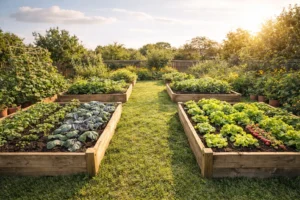
Once you have had a successful first season with a single bed, a multi-bed vegetable garden layout is the most natural and rewarding next step.
The Old Farmer’s Almanac recommends a layout of four coordinated 4×8 raised beds for gardeners who want to grow a full variety without the complexity of a large in-ground plot.
Four beds gives you enough space to practise proper crop rotation — moving plant families between beds each year to prevent pests and disease from building up.
How to Arrange a Multi-Bed Vegetable Garden Layout
| Bed | What to Grow in Each Bed |
| Bed 1 — salad and leaf bed | Lettuce, spinach, radishes, spring onions, herbs — all cool season crops |
| Bed 2 — legume bed | Peas, green beans, climbing beans — nitrogen-fixing crops that improve soil |
| Bed 3 — root vegetable bed | Carrots, beetroot, turnips, parsnips |
| Bed 4 — brassica bed | Kale, chard, broccoli, cabbage |
| Long warm season bed | Tomatoes, cucumbers, peppers, courgette — heat lovers in the absolute sunniest spot |
Leave a path of at least 45cm between every bed. You need enough room to walk comfortably, move a watering can through, and kneel down to plant and harvest without ever treading on the growing areas.
| The Crop Rotation Advantage in a Multi-Bed Layout
Moving plant families between different beds each year prevents pests and soil diseases from building up in one place. Iowa State University Extension confirms that multiple raised beds make crop rotation simple to manage — one of the strongest practical reasons to move from a single bed to a multi-bed vegetable garden layout. |
How to Orient Your Vegetable Garden Layout for Maximum Sun
The direction your beds run has a real effect on how much sun every plant gets through the course of a day.
The general rule for any vegetable garden layout is to run beds on a north-south axis.
This means plants get an even share of sun as it moves from east to west across the sky and no row permanently shades the one behind it.
- Place tallest crops — tomatoes, climbing beans, sweet corn — at the northern end of each bed in the northern hemisphere.
- Place medium height crops in the middle zones.
- Place short crops — lettuce, herbs, radishes — at the southern end where they get full unobstructed sun.
- Never plant tall crops in front of short ones. Shade from taller plants is the most common cause of underperforming crops in any beginner vegetable garden layout.
Companion Planting and Succession Planting
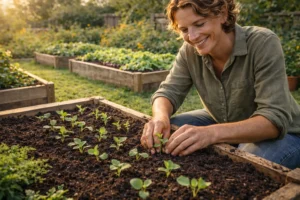
Companion Planting Ideas for a Small Vegetable Garden Layout
Companion planting means growing certain crops close together because they actively help each other.
Some deter pests. Some improve flavour. Some make better use of shared space.
| Grow Together | Why It Works |
| Tomatoes and basil | Basil is said to improve tomato flavour and deter aphids and whitefly |
| Carrots and spring onions | The scent of spring onions confuses carrot fly and reduces damage |
| Courgette and nasturtiums | Nasturtiums attract aphids away from courgette and other nearby crops |
| Beans and courgette | Beans fix nitrogen into the soil that hungry courgette uses well all season |
| Lettuce under tall crops | Lettuce benefits from gentle afternoon shade in hot weather from taller neighbours |
Succession Planting to Keep Your Vegetable Garden Layout Productive All Season
Succession planting means sowing small amounts of the same crop every two to three weeks rather than everything at once.
The result is a continuous harvest all season long instead of one big glut followed by empty beds.
- Sow radishes, lettuce, and spinach every two to three weeks from early spring right through to late summer.
- When one crop finishes, add a handful of compost to the space and plant the next batch straight away.
- Keep a simple planting notebook or note on your phone recording what you sow and when. This tells you exactly when each batch will be ready to pick.
| Key Takeaways — Vegetable Garden Layout Ideas for Small Spaces
1. Start with a single 4×8 raised bed. It is the best first vegetable garden layout for any beginner. 2. Use square foot gardening to maximise production in a small space — more crops per square foot than any other method. 3. Grow vertically with a trellis if ground space is limited. Vertical growing doubles your productive area. 4. Container layouts work brilliantly on patios and balconies with no ground at all. 5. Always orient beds north to south and place tall crops at the north end to avoid shading shorter ones. 6. A multi-bed layout with crop rotation is the natural next step after your first successful season. |
Plan Your Vegetable Garden Layout and Start Growing
You now have six proven vegetable garden layout ideas for small spaces — from a single beginner raised bed to a full multi-bed setup with crop rotation and companion planting built in.
The best vegetable garden layout is always the one that fits the space and time you actually have right now.
Start there. Build from there. Every experienced gardener started with something small.
Do this, this week: Walk your outdoor space at different times of day and find the sunniest spot.
Measure it. Pick one layout idea from this guide that fits what you have. Draw it on paper.
is your vegetable garden layout planned and ready to build.
Frequently Asked Questions
Q: What is the best vegetable garden layout for beginners?
A: The best vegetable garden layout for beginners is a single 4×8 foot raised bed placed in the sunniest available spot. It is narrow enough to reach the centre from both sides without stepping on the soil, large enough to grow a useful variety of crops, and small enough to manage comfortably in about 10 minutes a day. The Old Farmer’s Almanac confirms that a 4×8 bed can grow tomatoes, peppers, greens, and root crops while remaining completely manageable for a first-time grower.
Q: What is the best vegetable garden layout idea for a very small space?
A: Square foot gardening in a 4×4 or 4×8 raised bed is the best vegetable garden layout idea for a very small space. Dividing the bed into one-foot squares and planting the right number of crops in each — one large plant or up to sixteen small ones per square — means every single inch of growing area is used productively. Seed Sheets confirms that a square foot bed out-produces traditional row planting in the same footprint for most common crops.
Q: How wide should the beds in a vegetable garden layout be?
A: Beds in a vegetable garden layout should be no wider than 4 feet so you can reach the centre from both sides without stepping inside. Iowa State University Extension recommends 3 to 4 feet as the ideal bed width for comfortable access. Stepping on soil compacts it, damages its structure, and makes it harder for roots to grow. Keeping beds narrow enough to reach across is one of the simplest and most effective vegetable garden layout principles.
Q: Can I create a productive vegetable garden layout on a patio or balcony?
A: Yes. A container vegetable garden layout works very well on a patio or balcony. Use large pots at least 30 to 40cm wide and deep for tomatoes, cucumbers, and courgette. Use medium pots for beans and peppers. Use window boxes for lettuce, herbs, and radishes. Place everything in the sunniest available spot. The key difference with container growing is that pots dry out far faster than beds — check moisture every morning and water whenever the top 2cm feels dry.
Q: What is succession planting and how does it improve a vegetable garden layout?
A: Succession planting means sowing small amounts of the same crop every two to three weeks rather than all at once. Instead of a short glut followed by empty beds, you get a continuous harvest across the whole growing season. It works especially well for fast crops like radishes, lettuce, and spinach. When one batch finishes, the next is already growing. It is one of the most effective ways to keep a small vegetable garden layout producing food consistently from early spring through to late autumn.