
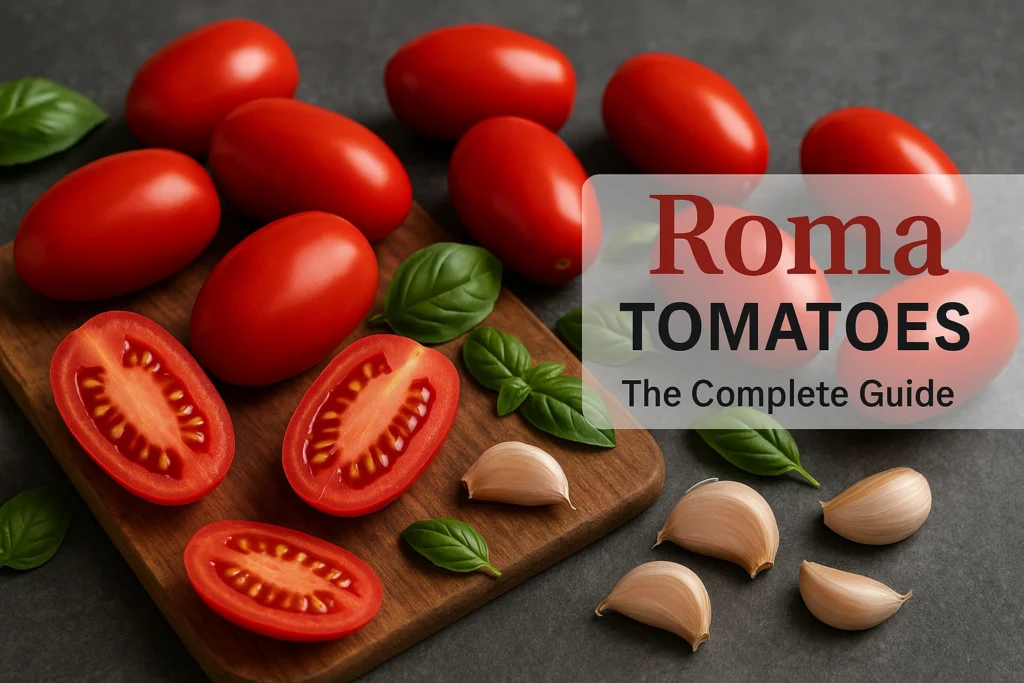
Tomatoes Roma are egg-shaped tomatoes that are really good for cooking.
They have thick walls, less water inside, and fewer seeds than regular round tomatoes.
This makes them perfect for making sauces, soups, and pasta dishes because they don’t get mushy.
They are also called paste tomatoes or plum tomatoes.
When you cut one open, you will notice it’s meatier and drier than a regular tomato you’d put on a sandwich.
Lots of people grow them in their gardens because they produce tons of tomatoes on each plant.
If you have ever had really good homemade tomato sauce, it was probably made with tomatoes roma.
In my years working with home gardeners and professional chefs alike, I’ve watched countless people fall in love with tomatoes roma.
Whether you are a seasoned gardener looking to perfect your tomato crop, a home cook seeking to elevate your Italian dishes, or simply curious about this distinctive variety, this comprehensive guide will take you through everything you need to know about Roma tomatoes in 2025.
What Are Roma Tomatoes?
Roma tomatoes—scientifically known as Solanum lycopersicum—stand as one of the most recognizable and widely cultivated tomato varieties in the world.
But what exactly sets them apart from other tomatoes you might find at your local market?
Distinctive Characteristics
When you look at a tomato Roma, several features immediately stand out:
- Shape: Distinctly oblong or egg-shaped (sometimes called plum tomatoes)
- Size: Medium-sized, typically 3-4 inches long
- Flesh: Dense, meaty with fewer seeds and less water content
- Skin: Smooth and thick
- Color: Vibrant red when fully ripe
- Taste: Rich, tangy flavor with a perfect balance of sweetness and acidity
The Roma’s unique physical structure—fewer seed compartments and thicker flesh—creates that signature meaty texture that home cooks and professional chefs prize.
Unlike slicing tomatoes that release juice when cut, Romas hold their shape and contain less liquid, making them perfect for cooking down into thick sauces and pastes.
History and Origins
The story of Roma tomatoes begins in Italy, though tomatoes themselves aren’t native to Europe.
Tomatoes originated in the Andean region of South America, where indigenous peoples cultivated them for thousands of years before Spanish explorers brought them to Europe in the 16th century.
Initially, Europeans viewed tomatoes with suspicion—some even believed them to be poisonous due to their relationship to deadly nightshade.
It wasn’t until the late 17th and 18th centuries that tomatoes became widely accepted as food, particularly in Mediterranean countries.
The tomato Roma as we know it today is the result of decades of selective breeding.
The modern commercial Roma variety was developed in the 1950s by the USDA’s Agricultural Research Service.
Plant breeders specifically sought to create a tomato with thick walls, few seeds, and disease resistance—perfect for industrial processing.
Since then, numerous Roma-type varieties have been developed, including:
- San Marzano (often considered the premium Roma variety)
- Amish Paste
- Big Mama
- Martino’s Roma
- Plum Regal
Today in 2025, Roma tomatoes represent one of the most commercially important tomato varieties globally, with Italy, China, the United States, and Mexico leading production.
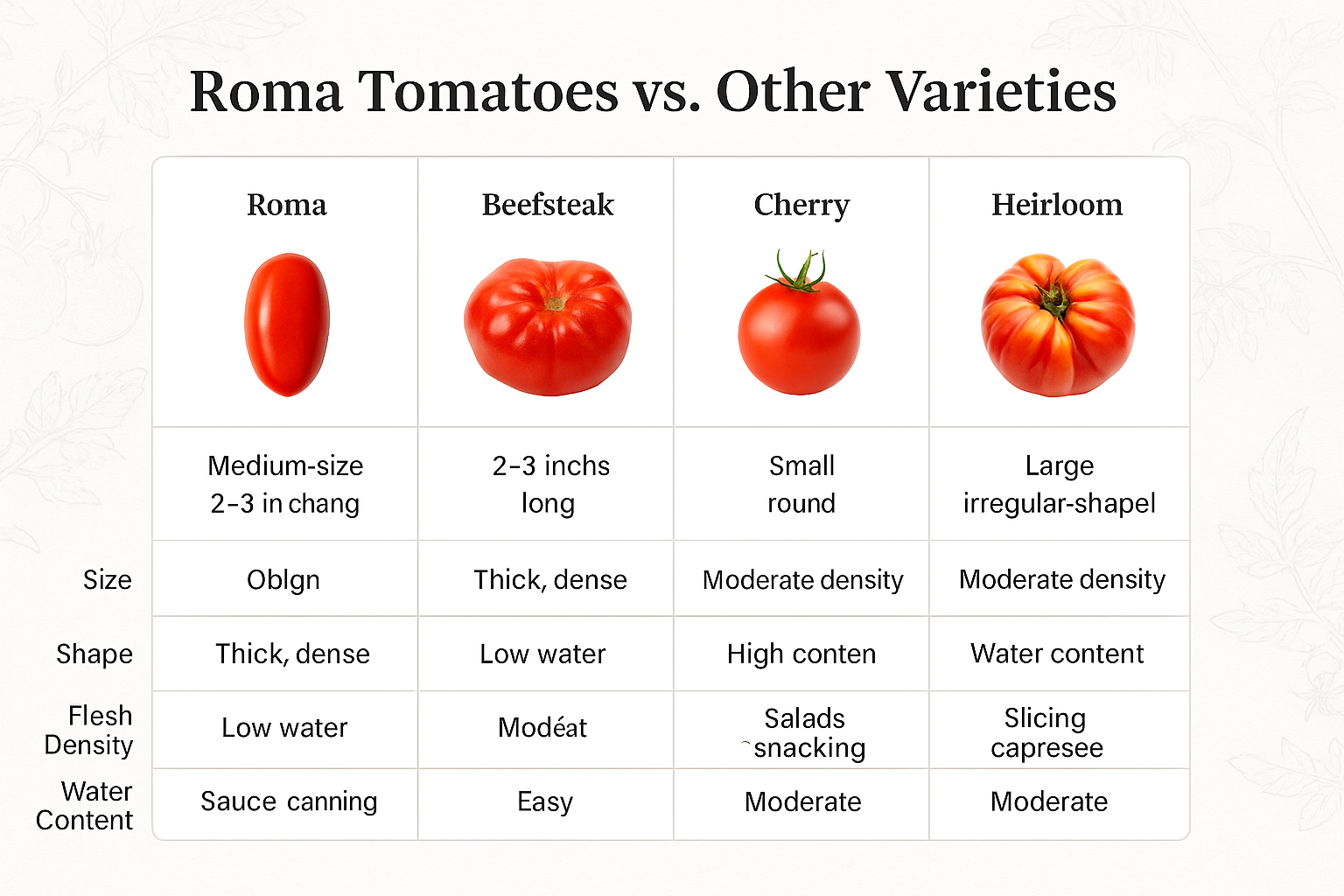
Roma vs. Other Tomato Varieties
To truly appreciate Roma tomatoes, it helps to understand how they compare to other popular varieties:
| Characteristic | Roma Tomatoes | Beefsteak Tomatoes | Cherry Tomatoes | Heirloom Tomatoes |
|---|---|---|---|---|
| Size | Medium (3-4 inches) | Large (4+ inches) | Small (1-2 inches) | Varies widely |
| Shape | Oblong/egg-shaped | Round, often lobed | Small and round | Varied (often irregular) |
| Flesh | Dense, meaty | Juicy, many seed cavities | Juicy, sweet | Varies by variety |
| Water Content | Low | High | Medium-high | Varies by variety |
| Best Uses | Sauces, pastes, canning | Slicing, sandwiches | Salads, snacking | Varied uses depending on variety |
| Growing Difficulty | Moderate | Moderate-difficult | Easy | Varies (often challenging) |
“I’ve grown dozens of tomato varieties over the years,” shares Maria Conti, a third-generation Italian-American gardener I interviewed for this article.
“But I always reserve at least half my garden space for Romas.
Nothing else gives me the versatility I need for my family’s traditional recipes—from Sunday gravy to homemade ketchup for my grandkids.”
Growing Tomatoes Roma
Whether you’re a seasoned gardener or just starting out, growing tomatoes Roma can be a rewarding experience.
Their relatively compact growth habit and productivity make them suitable for various growing environments—from sprawling garden plots to modest container gardens on urban balconies.
Ideal Growing Conditions
Roma tomatoes, like most tomato varieties, have specific requirements for optimal growth:
- Sunlight: 6-8 hours of direct sunlight daily
- Temperature: Daytime temperatures between 70-85°F (21-29°C); nighttime temperatures above 55°F (13°C)
- Soil: Well-draining, fertile soil with pH between 6.0-6.8
- Spacing: Plants should be spaced 24-36 inches apart in rows 36-48 inches apart
- Water: Consistent moisture (1-2 inches per week), preferably delivered at soil level
- Support: Staking or caging is recommended, as even determinate Roma varieties can become unwieldy with a full fruit load
Tip: With changing climate patterns affecting many growing regions, consider selecting Roma varieties bred for your specific conditions.
Heat-tolerant varieties like ‘Roma VF’ excel in warmer southern regions, while ‘Plum Regal’ offers better performance in cooler northern climates.
Planting and Care Guide
Starting Seeds Indoors:
- Start seeds indoors 6-8 weeks before your last expected frost date
- Use a quality seed starting mix in clean containers with drainage
- Plant seeds ¼ inch deep
- Maintain soil temperature around 70-75°F (21-24°C) for germination
- Once seedlings develop their first true leaves, provide 14-16 hours of light daily
- Harden off seedlings by gradually exposing them to outdoor conditions over 7-10 days
Transplanting Outdoors:
- Transplant after danger of frost has passed and soil has warmed to at least 60°F (16°C)
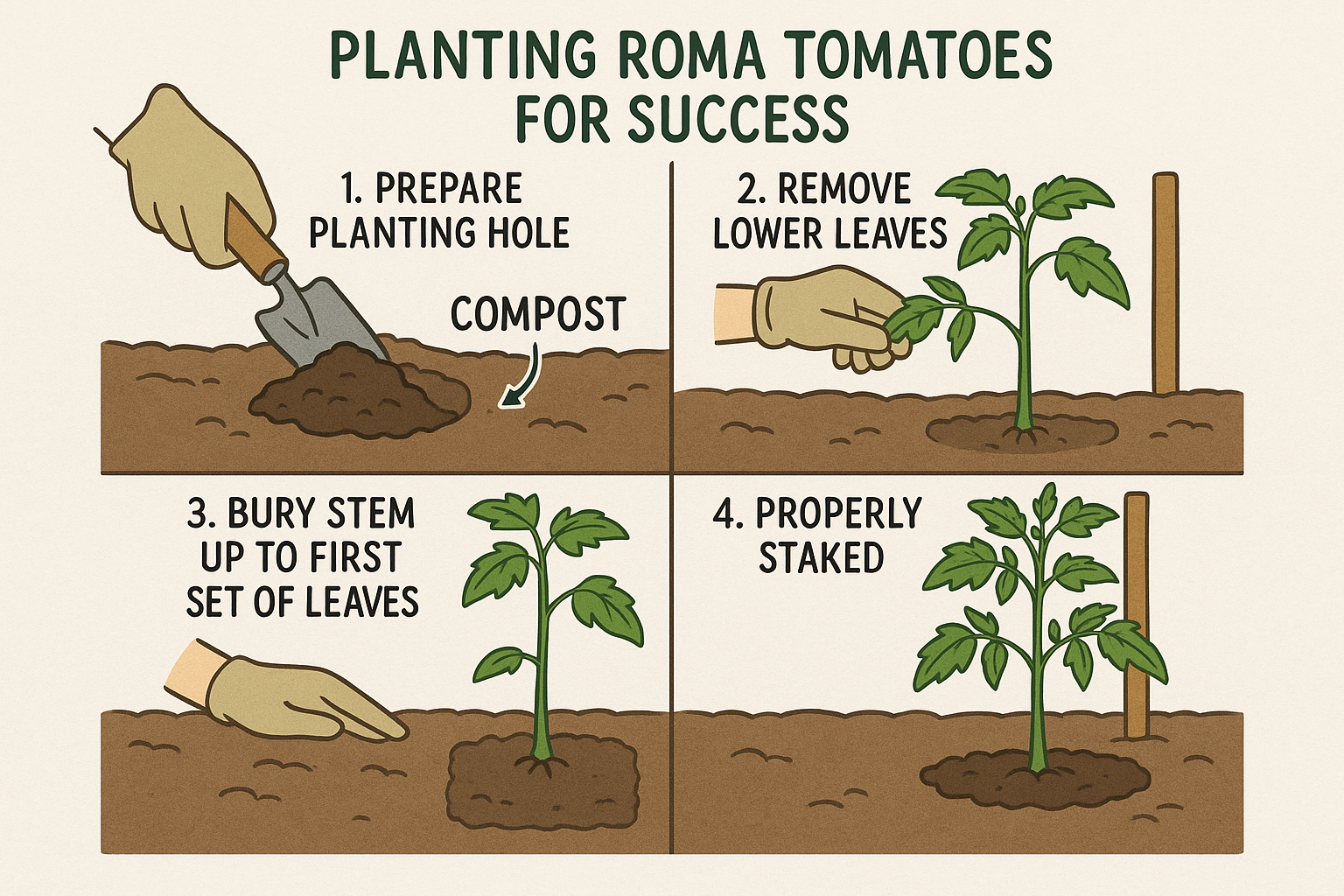
- Dig holes deep enough to bury plants up to their first set of true leaves
- Add compost or aged manure to planting holes
- Water thoroughly after planting
- Consider using black plastic mulch to warm soil and prevent weeds
Ongoing Care:
- Watering: Maintain consistent soil moisture with deep, infrequent watering rather than frequent shallow watering
- Feeding: Apply balanced organic fertilizer (like 5-5-5) at planting time, then switch to a lower-nitrogen, higher-phosphorus formula (like 5-10-10) when flowering begins
- Mulching: Apply 2-3 inches of organic mulch around plants to retain moisture and suppress weeds
- Pruning: Remove suckers (the shoots that form in the crotch between branches) for indeterminate varieties; determinate varieties require minimal pruning
- Support: Install stakes or cages early to avoid disturbing established root systems
Common Pests and Diseases
Roma tomatoes, while generally robust, can fall victim to several common problems:
Pest Management:
- Hornworms: Large green caterpillars that can defoliate plants overnight
- Control: Handpick, use Bt (Bacillus thuringiensis), or introduce parasitic wasps
- Aphids: Tiny insects that cluster on new growth and suck plant juices
- Control: Strong water spray, insecticidal soap, or ladybugs as natural predators
- Whiteflies: Small white insects that swarm when plants are disturbed
- Control: Yellow sticky traps, insecticidal soap, or neem oil
- Stink Bugs: Shield-shaped insects that pierce fruits
- Control: Row covers, trap crops, or targeted organic insecticides
Disease Prevention:
- Early Blight: Causes dark spots with concentric rings on lower leaves
- Prevention: Crop rotation, adequate spacing, avoiding overhead watering
- Late Blight: Causes dark water-soaked spots on leaves and fruits
- Prevention: Copper fungicides, resistant varieties, avoiding wet foliage
- Fusarium Wilt: Causes yellowing and wilting of lower leaves
- Prevention: Resistant varieties (look for “F” in variety descriptions), crop rotation
- Blossom End Rot: Black sunken areas on fruit bottoms
- Prevention: Consistent watering, adequate calcium levels in soil
“The secret to disease-free Roma tomatoes isn’t treating problems—it’s preventing them,” “Proper spacing for air circulation, watering at the base rather than overhead, and selecting resistant varieties can eliminate 90% of disease issues before they start.”
Harvesting and Storage
Knowing when and how to harvest Roma tomatoes is crucial for maximizing both yield and flavor:
Harvesting Tips:
- Harvest when fruits are firm and fully colored (typically bright red)
- Roma tomatoes should feel slightly heavy for their size when ripe
- For fresh eating, harvest when fully ripe
- For canning or processing, slightly under-ripe fruits (just turning red) can be harvested and will continue to ripen off the vine
- Use pruning shears or scissors to cut fruits from vines rather than pulling, which can damage plants
- Harvest in the morning when temperatures are cooler for best flavor
Storage Best Practices:
- Fresh consumption: Store at room temperature (55-70°F/13-21°C) away from direct sunlight
- Refrigeration: Not recommended for regular storage as it diminishes flavor, but can extend life of fully ripe tomatoes for 2-3 days
- Long-term storage options:
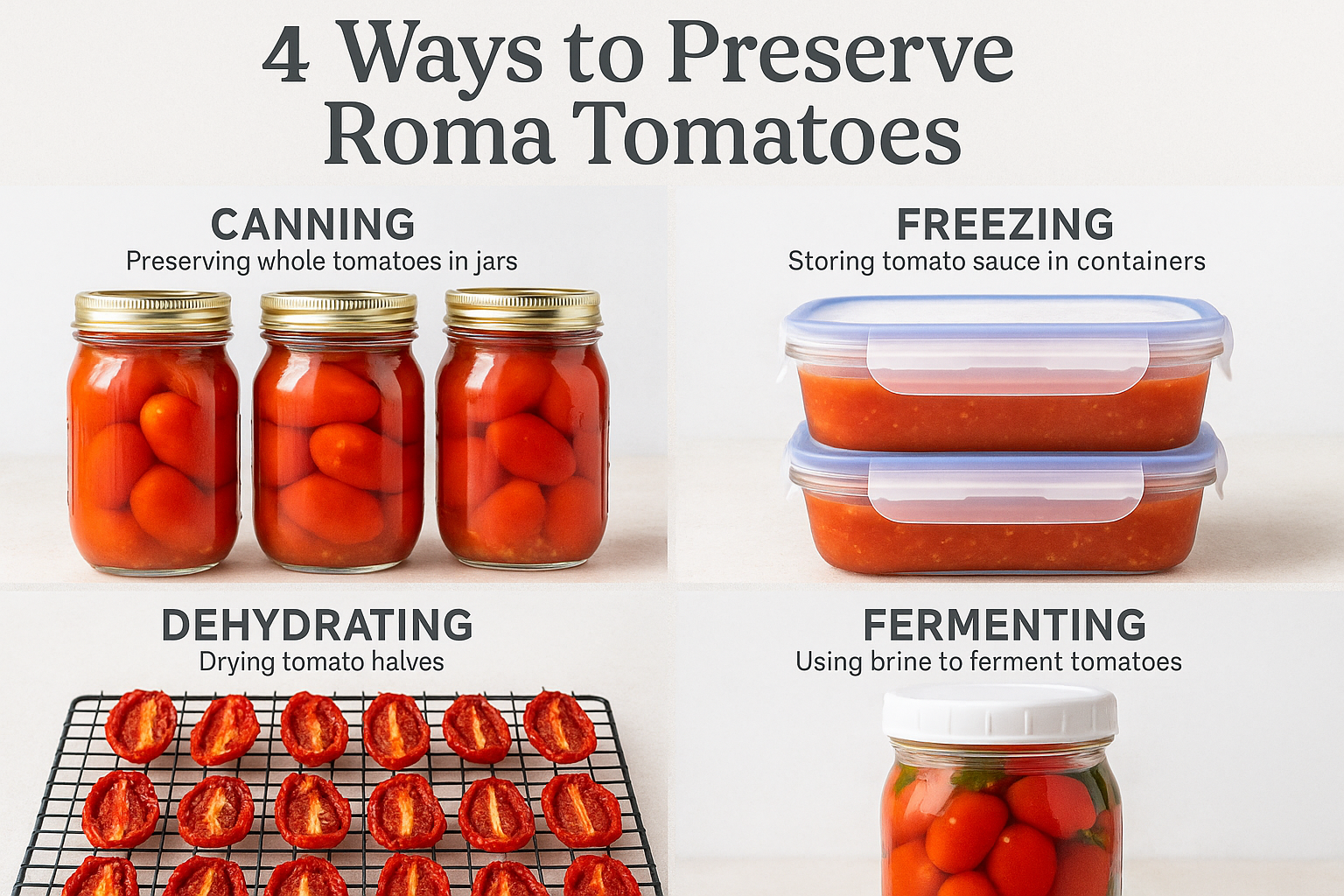
- Freezing: Whole, sliced, or puréed (best for cooking uses)
- Canning: Whole, halved, or as sauce/paste
- Drying: Sliced and dehydrated for “sun-dried” tomatoes
- Fermenting: Preserved in brine for unique flavor development
Nutritional Benefits of Roma Tomatoes
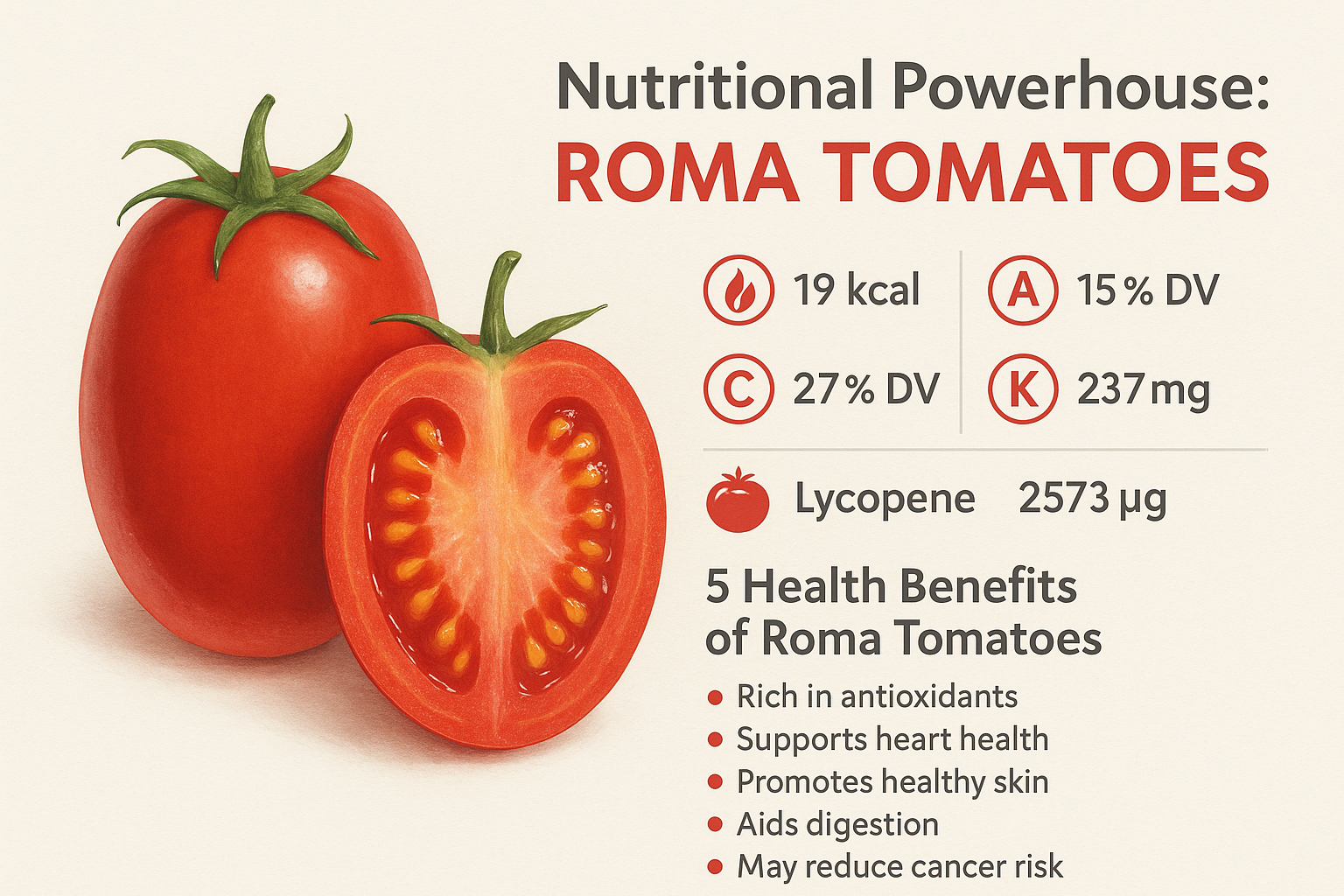
Roma tomatoes aren’t just culinary workhorses—they’re nutritional powerhouses as well.
Their dense flesh concentrates nutrients, making them particularly valuable additions to your diet.
Nutrient Composition
A one-cup serving (about 150g) of raw Roma tomatoes provides:
- Calories: Approximately 35
- Carbohydrates: 7g
- Fiber: 2g
- Protein: 1g
- Fat: 0.5g
- Vitamin C: 25mg (28% of Daily Value)
- Vitamin A: 1499 IU (30% of Daily Value)
- Potassium: 427mg (12% of Daily Value)
- Folate: 22mcg (5.5% of Daily Value)
- Vitamin K: 14mcg (12% of Daily Value)
Beyond these basic nutrients, Roma tomatoes contain numerous beneficial plant compounds:
- Lycopene: The powerful antioxidant that gives tomatoes their red color
- Beta-carotene: A precursor to vitamin A that supports eye health
- Naringenin: A flavonoid with anti-inflammatory properties
- Chlorogenic acid: A polyphenol that may help regulate blood sugar
Health Benefits Tomatoes Roma
The nutritional profile of Roma tomatoes translates to several significant health benefits:
Heart Health: Regular consumption of lycopene-rich foods like Roma tomatoes is associated with reduced risk of heart disease.
The combination of potassium, fiber, and antioxidants helps maintain healthy blood pressure and cholesterol levels.
Cancer Prevention: Lycopene, the red pigment in tomatoes, has antioxidant and detoxifying properties.
Higher intake of tomatoes and lycopene is linked to lower rates of prostate and stomach cancer
Skin Protection: The antioxidants in Roma tomatoes, particularly lycopene, help protect skin cells from UV damage.
While not a replacement for sunscreen, regular consumption may provide some additional protection against sun-induced skin aging.
Eye Health: Roma tomatoes contain lutein and zeaxanthin, carotenoids that accumulate in the retina and help protect against age-related macular degeneration.
Digestive Health: The fiber content in Roma tomatoes supports healthy digestion and may help prevent constipation.
Additionally, the prebiotic qualities of this fiber feed beneficial gut bacteria.
Lycopene: The Superstar Antioxidant
Lycopene deserves special attention when discussing the health benefits of tomatoes Roma.
This powerful carotenoid antioxidant is what gives tomatoes their characteristic red color, and Roma tomatoes contain particularly high concentrations.
What makes lycopene especially valuable:
- It’s one of the most potent antioxidants found in food
- Unlike many nutrients, lycopene becomes more bioavailable when tomatoes are cooked
- It’s fat-soluble, meaning it’s best absorbed when consumed with some healthy fat
- It remains stable during processing, so canned tomato products and paste retain high levels
Roma tomatoes are among the most efficient dietary sources of lycopene,” note researchers in the Nutrition Research Reviews, highlighting their role in supporting heart and metabolic health.
Their dense flesh and lower water content mean you’re getting more lycopene per bite compared to slicing tomatoes.
Additionally, their cooking properties make them ideal for preparing dishes that maximize lycopene absorption.”
To get the most lycopene benefit from your tomatoes Roma:
- Cook them with a small amount of olive oil or other healthy fat
- Process them into paste or sauce for concentrated lycopene content
- Include them regularly in your diet rather than as occasional additions
Culinary Uses of Tomatoes Roma
The culinary versatility of Roma tomatoes is legendary.
Their meaty texture, concentrated flavor, and low moisture content make them the preferred choice for countless classic dishes around the world.
Traditional Italian Applications
In Italian cuisine, Roma tomatoes (particularly the San Marzano variety) are considered essential for authentic flavor:
Pasta Sauces:
- Marinara: The classic simple sauce of tomatoes, garlic, herbs, and olive oil
- Arrabbiata: Spicy tomato sauce with garlic, red chili peppers, and olive oil
- Puttanesca: Bold sauce featuring tomatoes, olives, capers, anchovies, and garlic
- Amatriciana: Traditional sauce with tomatoes, guanciale (cured pork cheek), and pecorino cheese
Pizza: Roma tomatoes form the foundation of authentic pizza sauce, where their thick consistency prevents the crust from becoming soggy. Many pizzaiolos (pizza makers) insist on San Marzano Romas for their DOP-certified pizzas.
Preserves:
- Conserva di Pomodoro: Concentrated tomato paste used as a flavor base
- Passata: Uncooked tomato purée, strained of seeds and skin
- Pomodori Secchi: Italian sun-dried tomatoes, often packed in olive oil
“In my grandmother’s kitchen in Naples, Roma tomatoes weren’t just an ingredient—they were a way of life,” recalls Chef Antonio Rossi. “Every August, the entire family would gather to process bushels of Romas for the coming year. Some became sauce, others paste, and the perfect ones were carefully canned whole. That tradition connected us to our food in a way that’s increasingly rare today.”
Modern Culinary Applications
Beyond traditional Italian cuisine, Roma tomatoes have found their way into diverse culinary traditions worldwide:
Mediterranean Cuisine:
- Greek stewed tomato dishes like “yemista” (stuffed tomatoes)
- Spanish sofrito base for paellas and stews
- Middle Eastern shakshuka and muhammara dip
Mexican and Latin American Dishes:
- Salsas (particularly cooked varieties)
- Enchilada sauces
- Sofrito base for beans and rice dishes
American Classics:
- Homemade ketchup and barbecue sauce
- Tomato soup
- Chili and stews
Innovative Uses:
- Tomato jam (a sweet-savory spread perfect for cheese plates)
- Tomato powder (dehydrated and ground for flavor enhancement)
- Tomato leather (similar to fruit leather but savory)
- Tomato cocktails beyond Bloody Marys
Cooking Techniques for Roma Tomatoes
Different cooking methods highlight various aspects of Roma tomatoes’ flavor profile:
Roasting: Roasting Roma tomatoes concentrates their sweetness by caramelizing their natural sugars. Simply halve tomatoes lengthwise, drizzle with olive oil, sprinkle with salt, and roast at 400°F (205°C) for 25-30 minutes until caramelized.
Slow-Cooking: Low, slow cooking transforms Romas into rich, complex sauces. The extended cooking time allows flavors to meld while maintaining the tomatoes’ structure.
Grilling: Grilled Roma tomatoes develop a smoky char that complements their natural acidity. Their firm texture holds up well on the grill compared to juicier varieties.
Raw Preparations: While not as common as cooked applications, diced Roma tomatoes can add substance to salsas and bruschetta toppings where excess moisture would be problematic.
Canning and Preserving: Roma tomatoes’ high pectin and solid flesh make them ideal for home canning, whether whole, diced, or as sauce. Their acidic pH (typically around 4.3-4.9) makes them safe for water bath canning when properly prepared.
Tomatoes Roma Recipes
Let’s put theory into practice with some standout recipes that showcase the versatility of Roma tomatoes:
Classic Marinara Sauce
Ingredients:
- 3 lbs Roma tomatoes
- ¼ cup extra virgin olive oil
- 1 medium onion, finely diced
- 4 garlic cloves, minced
- 1 carrot, finely grated (optional, for sweetness)
- 2 tbsp tomato paste
- 1 tsp dried oregano
- 1 tsp dried basil (or ¼ cup fresh, chopped)
- 2 bay leaves
- 1 tsp salt
- ¼ tsp red pepper flakes (optional)
- 1 tbsp sugar (optional, to balance acidity)
Instructions:
- Bring a large pot of water to a boil. Score an X on the bottom of each tomato.
- Blanch tomatoes for 30-60 seconds, then transfer to an ice bath.
- Peel tomatoes, remove cores, and roughly chop.
- Heat olive oil in a large, heavy-bottomed pot over medium heat.
- Add onion and cook until translucent, about 5 minutes.
- Add garlic and cook for 30 seconds until fragrant.
- Add grated carrot (if using) and cook for 2 minutes.
- Add tomato paste and cook, stirring constantly, for 1 minute.
- Add chopped tomatoes, herbs, bay leaves, salt, and red pepper flakes.
- Bring to a simmer, then reduce heat to low.
- Simmer uncovered for 45-60 minutes, stirring occasionally, until sauce has thickened.
- Taste and adjust seasoning, adding sugar if needed to balance acidity.
- Remove bay leaves before serving or storing.
This sauce freezes beautifully for up to 6 months or can be refrigerated for up to 1 week.
Oven-Dried Tomatoes Roma
Ingredients:
- 2 lbs Roma tomatoes
- 2 tbsp olive oil
- 1 tsp salt
- 1 tsp dried herbs (such as oregano, thyme, or Italian blend)
- 2 garlic cloves, thinly sliced (optional)
Instructions:
- Preheat oven to 225°F (107°C).
- Line baking sheets with parchment paper.
- Halve tomatoes lengthwise and remove seeds (optional).
- Place tomatoes cut-side up on baking sheets.
- Drizzle with olive oil and sprinkle with salt and herbs.
- Place a thin slice of garlic on each tomato half if using.
- Bake for 3-4 hours, until tomatoes are shriveled but still slightly moist.
- Cool completely before storing in airtight containers.
- For longer preservation, cover dried tomatoes with olive oil and refrigerate.
These intensely flavored tomatoes can elevate sandwiches, pastas, salads, and antipasto platters.
Tomato Roma and Basil Bruschetta
Ingredients:
- 8 Roma tomatoes, diced
- 3 garlic cloves (2 minced, 1 whole)
- ¼ cup fresh basil, chopped
- 3 tbsp extra virgin olive oil, plus more for drizzling
- 1 tbsp balsamic vinegar
- ½ tsp salt
- ¼ tsp freshly ground black pepper
- 1 baguette, sliced diagonally
- Flaky sea salt for finishing
Instructions:
- In a bowl, combine diced tomatoes, minced garlic, basil, olive oil, balsamic vinegar, salt, and pepper.
- Cover and let sit at room temperature for 30 minutes to allow flavors to meld.
- Preheat broiler or grill.
- Toast baguette slices until golden brown.
- Rub each toast with the whole garlic clove.
- Top each toast with tomato mixture.
- Drizzle with additional olive oil and sprinkle with flaky sea salt.
- Serve immediately.
This simple appetizer showcases the pure flavor of Roma tomatoes and makes an elegant start to any meal.
Homemade Tomato Roma Paste
Ingredients:
- 5 lbs Roma tomatoes
- 2 tbsp olive oil
- 1 tsp salt
Instructions:
- Preheat oven to 300°F (150°C).
- Wash and quarter tomatoes.
- Process tomatoes through a food mill to remove skins and seeds.
- In a large pot, simmer tomato purée for 30-45 minutes until reduced by one-third.
- Stir in olive oil and salt.
- Spread mixture evenly onto parchment-lined baking sheets (about ¼ inch thick).
- Bake for 3-4 hours, stirring occasionally, until paste is thick and dark red.
- Cool completely.
- Store in small containers, topped with a thin layer of olive oil, in the refrigerator for up to 3 weeks, or freeze in ice cube trays for up to 9 months.
One tablespoon of this intensely flavored paste can transform soups, stews, and sauces with authentic tomato flavor.
Growing Tomatoes Roma Commercially
While home gardeners appreciate Roma tomatoes for their versatility and productivity, commercial growers value them for additional reasons.
Tomatoes Roma remain one of the most economically significant processing tomato varieties worldwide.
Commercial Production Practices
Commercial Roma tomato production differs significantly from home gardening:
Scale and Mechanization:
- Commercial fields often span hundreds or thousands of acres
- Mechanical transplanters set seedlings at precise spacing
- Drip irrigation delivers water and nutrients directly to root zones
- Mechanical harvesters collect ripe fruit in a single pass
- GPS-guided equipment ensures precise application of inputs
Variety Selection: Commercial growers select Roma varieties based on:
- Disease resistance package
- Yield potential
- Uniformity of ripening
- Shipping durability
- Processing characteristics (soluble solids, pH, viscosity)
- Contract specifications from processors
Crop Management:
- Precise nutrient management through soil testing and tissue analysis
- Integrated pest management (IPM) to minimize chemical interventions
- Growth regulators to control plant architecture and fruit set
- Harvest timing coordinated with processing facility schedules
Economic Importance
The economic impact of Roma tomatoes extends throughout the food supply chain:
Global Production: As of 2025, global Roma tomato production exceeds 35 million metric tons annually, with major production centers in:
- California’s Central Valley (United States)
- Emilia-Romagna and Campania regions (Italy)
- Xinjiang Province (China)
- Sinaloa and Sonora states (Mexico)
Processing Infrastructure: Roma tomatoes support extensive processing industries:
- Canneries producing whole, diced, and crushed tomatoes
- Paste factories concentrating tomatoes for industrial use
- Sauce manufacturers creating finished products
- Dehydration facilities producing tomato powder and flakes
Employment Impact: The Roma tomato industry creates significant employment:
- Field workers for planting, maintenance, and harvest
- Processing plant employees
- Transportation and logistics workers
- Research and development positions
- Marketing and sales professionals
“Roma-type tomatoes form the backbone of California’s processing tomato industry, which generates over $1 billion in direct economic activity annually.
These varieties are preferred for their texture and yield, making up the majority of tomatoes used in sauces, pastes, and canned goods.”
Sustainability Challenges and Solutions
Commercial Roma tomato production faces several sustainability challenges in 2025:
Water Usage: With water scarcity increasing in many growing regions, the industry has implemented:
- Precision irrigation systems reducing water use by up to 30%
- Drought-tolerant Roma varieties requiring less irrigation
- Water recycling systems in processing facilities
- Soil moisture monitoring to optimize irrigation timing
Climate Adaptation: Changing climate patterns have necessitated:
- Shifted planting calendars to avoid extreme heat during critical growth stages
- Heat-tolerant Roma varieties for regions experiencing warming trends
- Improved forecasting models to predict weather-related challenges
- Diversified growing regions to spread climate risk
Soil Health: Maintaining soil productivity requires:
- Extended crop rotations beyond traditional 2-year cycles
- Cover cropping during fallow periods
- Reduced tillage practices to maintain soil structure
- Compost and organic matter additions to build soil carbon
Integrated Pest Management: Reducing chemical interventions through:
- Biological controls using beneficial insects
- Pheromone disruption for pest mating
- Disease-resistant Roma varieties
- Precision application technologies reducing overall chemical use
Preserving Tomatoes Roma
One of the greatest virtues of Roma tomatoes is their excellent preservation quality.
Their dense flesh, lower moisture content, and balanced acidity make them ideal candidates for various preservation methods.
Canning Roma Tomatoes
Home canning remains one of the most popular ways to preserve the summer bounty of Roma tomatoes:
Water Bath Canning Whole or Halved Romas:
Ingredients:
- Roma tomatoes (approximately 3 pounds per quart jar)
- 2 tablespoons bottled lemon juice per quart jar (for safe acidity)
- 1 teaspoon salt per quart jar (optional)
Equipment:
- Water bath canner with rack
- Canning jars with new lids and rings
- Jar lifter, funnel, and other canning tools
- Large pot for blanching
Instructions:
- Prepare canner, jars, and lids according to manufacturer’s instructions.
- Bring a large pot of water to boil for blanching tomatoes.
- Score an X on the bottom of each tomato and blanch for 30-60 seconds.
- Transfer to ice water bath, then slip off skins.
- Add lemon juice and salt (if using) to each jar.
- Pack tomatoes into jars, pressing gently to release juice.
- Leave ½-inch headspace at top of jars.
- Remove air bubbles, wipe jar rims, and apply lids and rings.
- Process in boiling water bath for 85 minutes for quarts (at sea level).
- Adjust processing time for your altitude according to USDA guidelines.
- Allow jars to cool undisturbed for 12-24 hours before checking seals.
Safety Note: Always follow USDA guidelines for safe home canning.
Tomato acidity can vary, so adding bottled lemon juice ensures safe acidity levels to prevent botulism risk.
Freezing Methods
Freezing offers a simpler preservation method with excellent results for cooking uses:
Simple Freezing Method:
- Wash and core Roma tomatoes.
- Optionally blanch and peel (as described above).
- Cut into desired pieces or leave whole.
- Pack into freezer-safe containers or bags.
- Remove as much air as possible.
- Label with date and contents.
- Freeze for up to 12 months.
Roasted Tomato Freezing Method:
- Halve Roma tomatoes lengthwise.
- Toss with olive oil, salt, and herbs if desired.
- Roast at 400°F (205°C) until caramelized (about 30 minutes).
- Cool completely.
- Pack into freezer containers or bags.
- Freeze for up to 12 months.
Sauce Freezing Method:
- Prepare your favorite Roma tomato sauce recipe.
- Cool completely.
- Portion into usable amounts in freezer containers.
- Leave ½-inch headspace for expansion.
- Freeze for up to 6 months.
Tip: Freeze sauce or purée in ice cube trays first, then transfer frozen cubes to larger containers.
This allows you to thaw small portions as needed.
Dehydrating Roma Tomatoes
Dehydration concentrates Roma tomatoes’ flavor into intensely sweet-tart morsels:
Oven Drying Method:
- Halve Roma tomatoes lengthwise.
- Optionally remove seeds for faster drying.
- Place cut-side up on parchment-lined baking sheets.
- Sprinkle lightly with salt and herbs if desired.
- Dry in oven at lowest setting (typically 170-200°F/77-93°C) with door propped slightly open.
- Check after 6 hours, continuing until tomatoes are leathery but not brittle.
- Cool completely before storing in airtight containers.
Food Dehydrator Method:
- Prepare tomatoes as above.
- Arrange on dehydrator trays with space between pieces.
- Set temperature to 135-140°F (57-60°C).
- Dry for 6-12 hours until leathery.
- Condition by placing in a glass jar for 1 week, shaking daily to distribute any remaining moisture.
Sun Drying Method (for dry climates only):
- Prepare tomatoes as above.
- Arrange on screens covered with cheesecloth.
- Place in direct sun during hot, dry weather.
- Cover with additional cheesecloth to protect from insects.
- Bring indoors at night to prevent moisture absorption.
- Dry for 3-7 days, depending on conditions.
Fermenting and Pickling
Fermentation offers unique preservation options with probiotic benefits:
Lacto-Fermented Roma Tomatoes:
Ingredients:
- 2 pounds Roma tomatoes
- 2 tablespoons sea salt
- 4 cups filtered water
- 5 garlic cloves
- 1 tablespoon black peppercorns
- 1 bunch fresh dill or 1 tablespoon dill seeds
- 2 grape leaves (optional, helps maintain crispness)
Instructions:
- Wash tomatoes and remove stems.
- Prick each tomato several times with a fork.
- Dissolve salt in filtered water to create brine.
- Place garlic, peppercorns, dill, and grape leaves in bottom of a clean quart jar.
- Pack tomatoes into jar.
- Pour brine over tomatoes, leaving 1-inch headspace.
- Weight tomatoes to keep submerged (using fermentation weights or a cabbage leaf).
- Cover with airlock lid or regular lid loosened slightly.
- Ferment at room temperature (65-75°F/18-24°C) for 5-10 days.
- Refrigerate after fermentation is complete.
These tangy, probiotic-rich tomatoes make excellent additions to charcuterie boards or can be chopped into salads for a flavor boost.
Tomatoes Roma in Different Cuisines
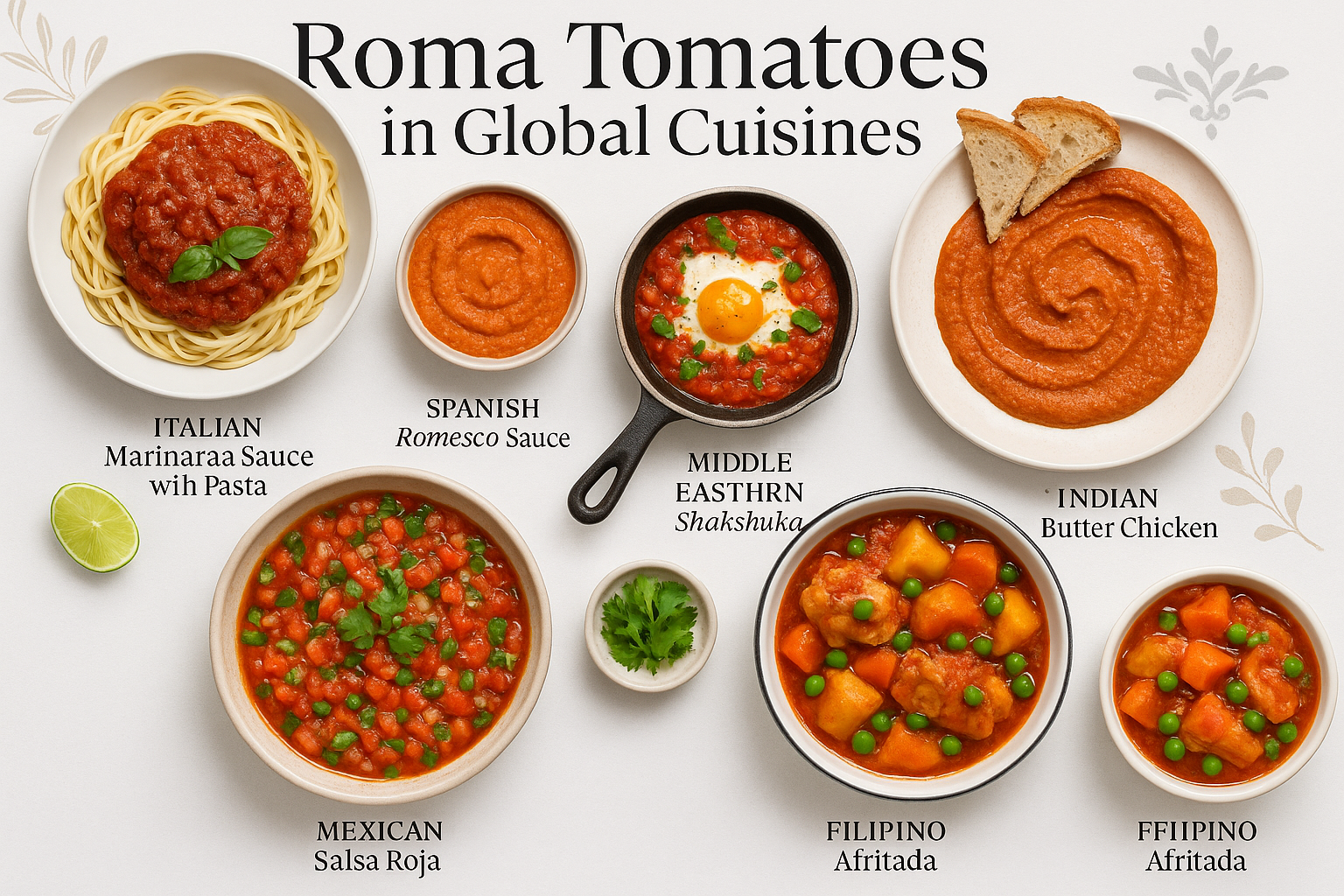
While we’ve touched on Italian applications, Roma tomatoes feature prominently in cuisines worldwide. Their versatility crosses cultural boundaries, making them a truly global ingredient.
Mediterranean Cuisine
Throughout the Mediterranean basin, Roma tomatoes appear in signature dishes:
Greek Cuisine:
- Yemista: Tomatoes stuffed with rice, herbs, and sometimes meat
- Kokkinisto: Meat braised in tomato sauce with cinnamon and allspice
- Dakos: Cretan salad of dried bread topped with tomatoes, feta, and olive oil
Spanish Cuisine:
- Sofrito: Aromatic base of tomatoes, onions, garlic, and peppers
- Romesco Sauce: Catalonian sauce with roasted tomatoes, peppers, and nuts
- Pisto: Spanish ratatouille featuring slowly cooked tomatoes and vegetables
Middle Eastern Cuisine:
- Shakshuka: Eggs poached in spiced tomato sauce
- Muhammara: Roasted red pepper and tomato dip with walnuts
- Kofta: Meatballs in rich tomato sauce spiced with cumin and cinnamon
Latin American Applications
Roma tomatoes feature prominently in Latin American cooking:
Mexican Cuisine:
- Salsa Roja: Cooked tomato sauce with chiles and spices
- Chilaquiles: Fried tortillas simmered in tomato sauce
- Arroz Rojo: Mexican red rice cooked with tomato purée
South American Traditions:
- Pebre: Chilean condiment with tomatoes, onions, cilantro, and ají peppers
- Sofrito Criollo: Base for many dishes in Puerto Rican and Cuban cooking
- Criolla Sauce: Argentine tomato sauce with bell peppers, onions, and vinegar
Asian Adaptations
Even in cuisines not traditionally associated with tomatoes, Roma varieties have found a place:
Indian Cuisine:
- Tamatar ki Chutney: Spiced tomato chutney
- Butter Chicken: Creamy tomato-based curry
- Tomato Rasam: South Indian soup with tamarind and tomatoes
Filipino Cuisine:
- Sarciado: Fried fish with tomato sauce
- Afritada: Chicken stewed with tomatoes and vegetables
- Ginisang Sitaw at Kalabasa: String beans and squash sautéed with tomatoes
Thai Adaptations:
- Nam Prik Ong: Northern Thai dip with tomatoes and minced pork
- Tomato Jeow: Spicy tomato dipping sauce
Chef Mei Lin, who specializes in Asian-European fusion cuisine, notes: “Roma tomatoes have a concentration of flavor that works beautifully in Asian dishes where we’re looking for umami depth. Their lower water content means they don’t dilute carefully balanced sauces, making them my go-to when adapting traditional recipes.”
Conclusion
Roma tomatoes stand as a testament to agricultural ingenuity—bred for specific culinary purposes and refined over generations to deliver exceptional performance both in the garden and in the kitchen.
Their journey from wild South American fruit to global culinary staple reflects our human desire to perfect and adapt the foods that sustain us.
As we’ve explored throughout this guide, Roma tomatoes offer unique advantages that few other varieties can match:
- Garden performance that balances productivity with manageable plant size
- Nutritional density that concentrates health-promoting compounds
- Culinary versatility that spans global cuisines and cooking techniques
- Preservation quality that allows us to enjoy summer’s bounty year-round
Whether you’re a dedicated gardener looking to maximize your tomato harvest, a home cook seeking to elevate your sauce game, or simply a curious food lover exploring the world of tomato varieties, Roma tomatoes deserve a place in your garden and kitchen.
In 2025, with growing interest in food sovereignty, home preservation, and connecting with traditional cooking methods, Roma tomatoes offer an accessible entry point.
Their forgiving nature in the garden and kitchen makes them perfect for beginners, while their nuanced flavor potential continues to inspire even the most experienced chefs and gardeners.
I encourage you to experiment with different Roma varieties, growing methods, and culinary applications.
Each season brings new opportunities to discover the perfect Roma tomato for your specific needs and preferences.
Whether you’re canning your first batch of marinara or perfecting a family sauce recipe handed down through generations, Roma tomatoes provide the solid foundation upon which culinary memories are built.
FAQs
Throughout my years working with home gardeners and chefs, certain questions about Roma tomatoes come up consistently. Here are answers to the most common inquiries:
What are Roma tomatoes? Roma tomatoes are oval-shaped paste tomatoes with thick walls, low water content, and few seeds, making them perfect for cooking and preserving.
What pests and diseases affect Roma tomatoes? Common problems include hornworms, aphids, blight, and blossom end rot. Good air circulation and proper watering prevent most diseases.
When is the best time to plant Roma tomatoes? A: Plant Roma tomatoes outdoors after all danger of frost has passed and soil temperatures reach at least 60°F (16°C). In most regions, this falls between mid-April and late May. For indoor seed starting, begin 6-8 weeks before your last expected frost date.
Do Roma tomatoes need to be staked or caged? A: Yes, even though many Roma varieties are determinate (bush-type), they benefit from support. Their heavy fruit load can cause branches to break or fruits to touch the ground, leading to rot. Simple tomato cages or stakes with gentle ties work well for most home gardens.
How often should I water Roma tomatoes? A: Roma tomatoes need consistent moisture, especially during fruit development. Aim for 1-2 inches of water weekly, either from rainfall or irrigation. Water deeply but infrequently to encourage deep root development. Inconsistent watering can lead to blossom end rot and fruit cracking.
What’s the difference between determinate and indeterminate Roma tomatoes? A: Most Roma varieties are determinate, meaning they grow to a predetermined height (usually 3-4 feet), set fruit all at once, and then decline. This makes them ideal for canning, as harvests come in concentrated periods. However, some Roma-type varieties are indeterminate, continuing to grow and produce throughout the season until frost kills the plants.
Culinary Questions
Can I substitute Roma tomatoes for regular tomatoes in recipes? A: Yes, but with adjustments. Roma tomatoes have less juice and more flesh than slicing tomatoes. For raw applications like salads, you may want to add a bit of olive oil to compensate for the lower moisture. For cooking, you might need less reduction time since Romas already have concentrated flavor and less water.
Why are my homemade tomato sauces watery compared to store-bought? A: Commercial sauces often include tomato paste and sometimes thickeners. For thicker homemade sauce: 1) Use Roma tomatoes instead of slicing varieties, 2) Remove seeds and gel before cooking, 3) Simmer uncovered longer to reduce, or 4) Add a small amount of tomato paste to thicken.
Are San Marzano tomatoes the same as Roma tomatoes? A: San Marzano is a specific variety of Roma tomato. All San Marzanos are Romas, but not all Romas are San Marzanos. True San Marzanos (especially those with DOP certification) are grown in specific regions of Italy under controlled conditions. They tend to be sweeter, less acidic, and more expensive than standard Roma varieties.
How can I tell if Roma tomatoes are ripe? A: Ripe Roma tomatoes should be uniformly red (or whatever their mature color should be—some varieties ripen to yellow or striped patterns), feel firm but slightly yielding to gentle pressure, and have a sweet, tomato-y aroma at the stem end. They should come off the vine easily with a slight twist.
Storage Questions
Should I refrigerate Roma tomatoes? A: Ideally, no. Refrigeration temperatures (below 55°F/13°C) halt the ripening process and diminish flavor compounds. Store ripe Roma tomatoes at room temperature, stem-side down, and use within 4-7 days. If you must refrigerate to prevent spoilage, let tomatoes come to room temperature before using for best flavor.
How long do canned Roma tomatoes last? A: Properly home-canned Roma tomatoes stored in a cool, dark place will maintain best quality for 12-18 months, though they remain safe to eat indefinitely as long as the seal remains intact and there are no signs of spoilage. Commercial canned tomatoes typically have a “best by” date of 12-24 months from production.
Can I freeze whole Roma tomatoes? A: Yes! Simply wash, dry, and place whole Roma tomatoes on a baking sheet in the freezer. Once frozen solid, transfer to freezer bags. When you’re ready to use them, run under warm water and the skins will slip right off. The texture will be soft after thawing, so use frozen Romas for cooking rather than fresh applications.