
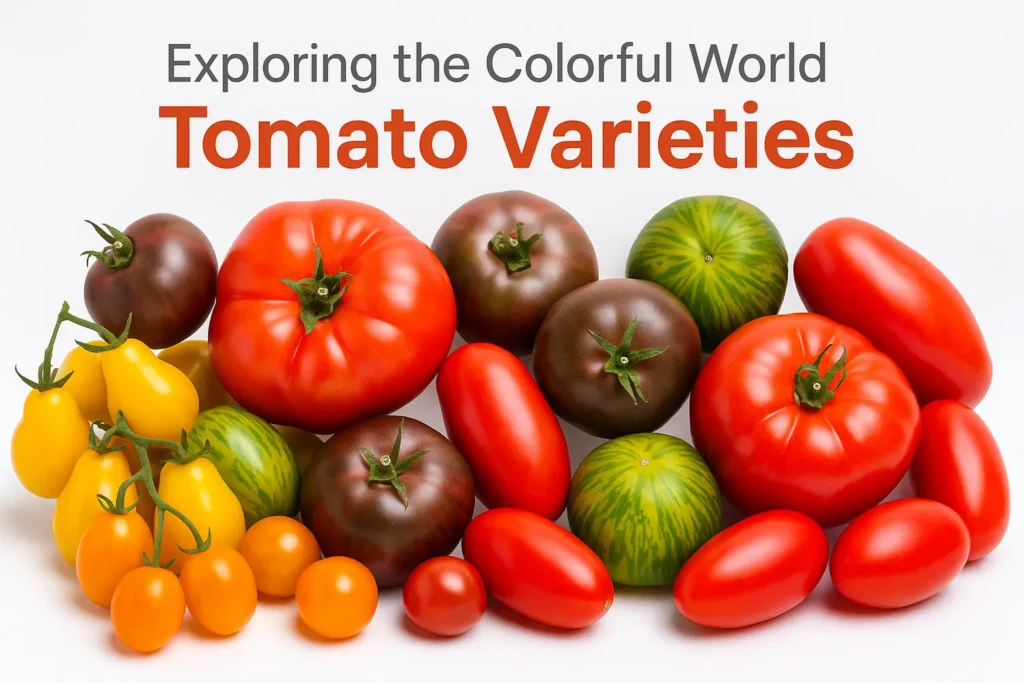
Tomatoes different types you need to grow in 2026 range from small, sweet cherry varieties to large, juicy beefsteaks—and each serves a different purpose in the kitchen.
If you love snacking, cherry or grape tomatoes are perfect.
For sandwiches, beefsteak tomatoes deliver thick, meaty slices.
Roma tomatoes are ideal for sauces because they’re firm and less watery.
Choosing the right type depends on how you plan to use them, not just how they look in the garden.
Have you ever stood in front of a farmers’ market display, mesmerized by the kaleidoscope of tomatoes in various shapes, sizes, and colors?
From the classic red globes we have all come to recognize to peculiar purple heirlooms with green shoulders and tiny yellow pear-shaped gems, the world of tomatoes is far more diverse than what most supermarkets would have us believe.
As I ran my fingers over the rainbow of tomatoes at my local market last weekend, I realized how little I knew about this fruit that has become a cornerstone of cuisines worldwide.
The tomato, once feared as poisonous in early European culture, has evolved from a suspicious newcomer to one of the most widely grown and consumed fruits on the planet.
With climate-smart agriculture and a renewed interest in biodiversity, tomato cultivation has reached new heights of variety and innovation.
Whether you’re a home gardener, a culinary enthusiast, or simply curious about the food on your plate, understanding the rich diversity of tomatoes can transform your cooking and growing experiences.
Key Takeaways
- There are over 10,000 tomato varieties globally, categorized by size, shape, color, growth habit, and intended use.
- Heirloom tomatoes offer superior flavor and genetic diversity but require more care than modern hybrids, which provide disease resistance and consistency.
- Tomato colors range from classic red to purple, black, green, yellow, orange, white, and striped varieties, with each color offering different nutritional compounds.
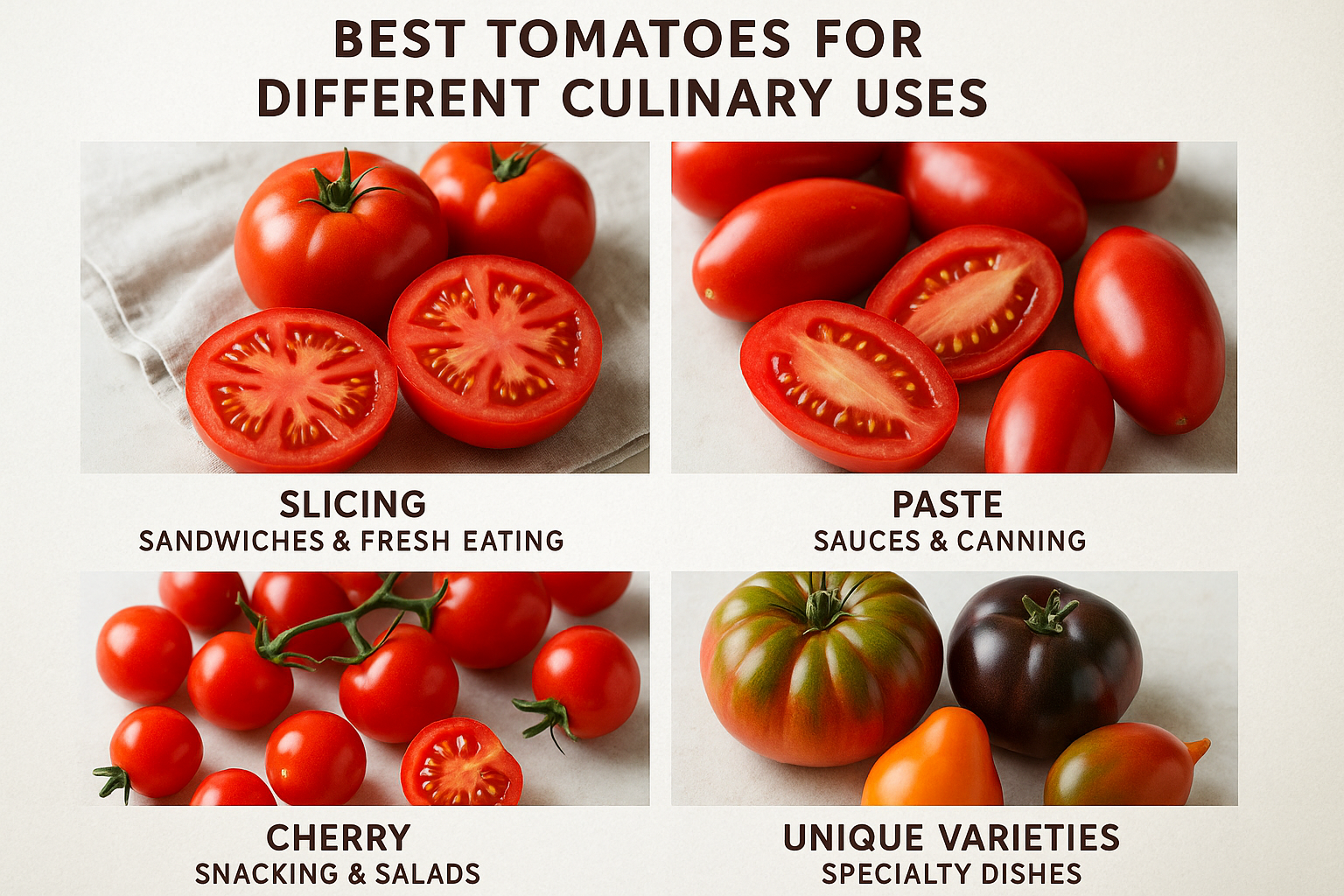
- Different tomato types have specific culinary applications: paste tomatoes for sauces, beefsteaks for sandwiches, cherry tomatoes for snacking, and specialty varieties for unique dishes.
- Climate conditions, growing season length, and available space should guide your tomato variety selection for successful home cultivation.
Understanding Tomato Classifications
Navigating the world of tomatoes can initially seem overwhelming.
With thousands of varieties available, how do we make sense of them all?
Let’s break down the primary ways tomatoes are classified to build a foundation for our exploration.
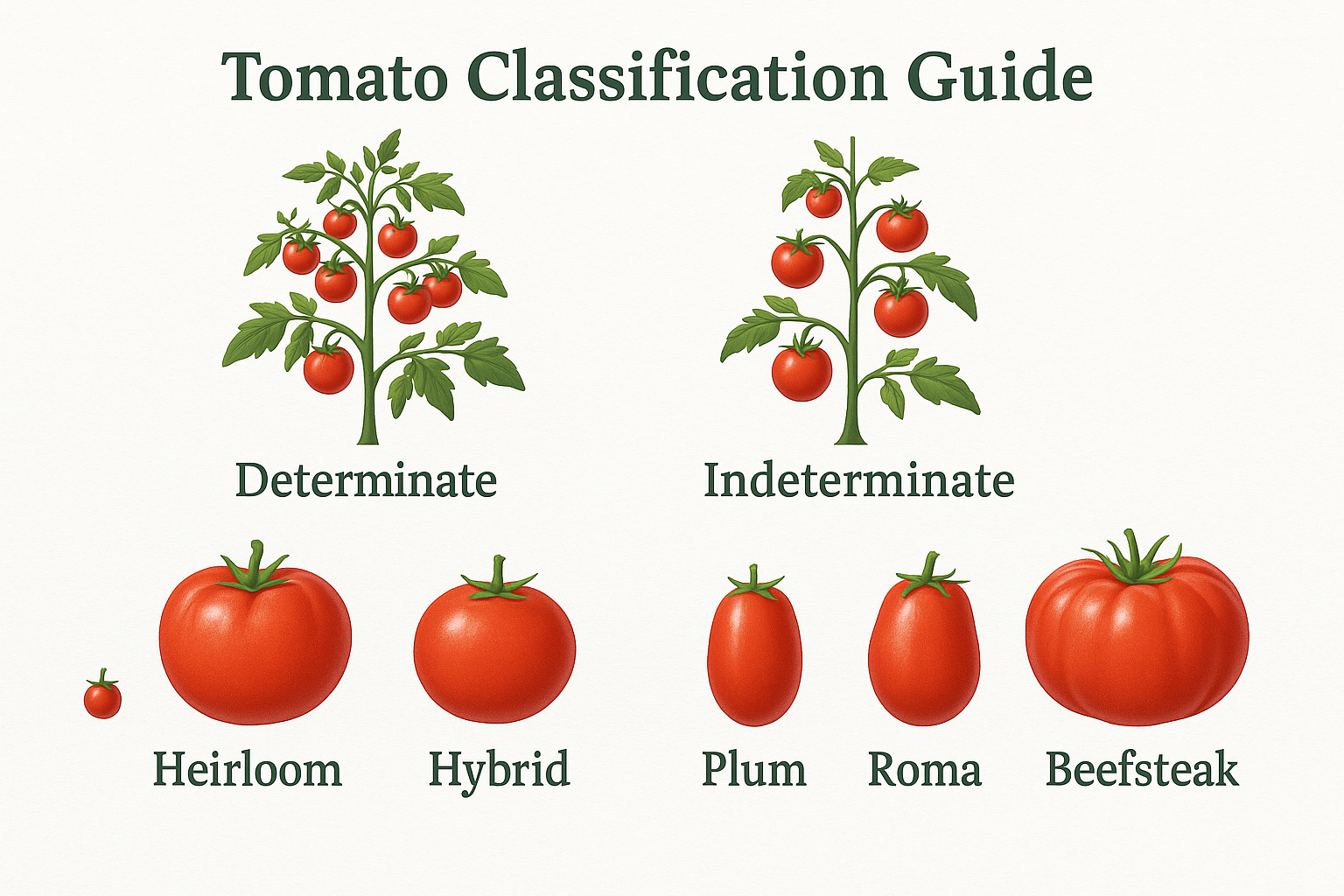
By Growth Habit: Determinate vs. Indeterminate
One of the most fundamental distinctions in tomato varieties relates to their growth pattern, which has significant implications for both gardeners and commercial growers.
Determinate Tomatoes (also called “bush” tomatoes) grow to a predetermined height, typically 3-4 feet.
They produce most of their fruit within a concentrated 4-6 week period and then decline. This growth habit makes them ideal for:
- Container gardening and small spaces
- Gardeners wanting a single large harvest for canning or preserving
- Commercial production where mechanical harvesting is preferred
Popular determinate varieties include ‘Roma,’ ‘Celebrity,’ and ‘Early Girl.’
Indeterminate Tomatoes continue growing and producing fruit throughout the growing season until killed by frost or disease. These varieties:
- Can reach heights of 6-10 feet or more
- Require substantial staking, caging, or trellising
- Provide a steady harvest over a longer period
- Are preferred by gardeners wanting fresh tomatoes throughout the season
Beloved indeterminate varieties include ‘Brandywine,’ ‘Cherokee Purple,’ and ‘Sun Gold.’
Semi-Determinate Tomatoes represent a middle ground, with more controlled growth than indeterminates but a longer production period than determinates.
‘Celebrity’ is a well-known example that offers the best of both worlds.
By Genetic Heritage: Heirloom vs. Hybrid
The genetic background of tomatoes significantly influences their characteristics and has become increasingly important to both growers and consumers.
Heirloom Tomatoes
Heirloom tomatoes are open-pollinated varieties that have been passed down through generations, typically for 50 years or more.
With growing concerns about biodiversity loss, these genetic treasures have gained tremendous popularity.
Characteristics of heirloom tomatoes include:
- Exceptional flavor complexity often lacking in commercial varieties
- Unique appearances with irregular shapes and vibrant colors
- Seeds that can be saved and will grow “true to type” the following season
- Generally less disease resistance than modern hybrids
- Often lower yields than hybrids
Some legendary heirloom varieties include ‘Brandywine’ (dating back to the 1880s), ‘Cherokee Purple’ (an indigenous variety), and ‘Green Zebra’ (a more recent heirloom developed in the 1980s).
“When you grow an heirloom tomato, you’re not just growing food—you’re preserving history and protecting genetic diversity for future generations.”
Hybrid Tomatoes
Hybrid tomatoes are created by deliberately cross-pollinating two different parent varieties to combine desirable traits.
Modern hybrids dominate commercial production and many home gardens.
Key features of hybrid tomatoes:
- Enhanced disease resistance to common tomato pathogens
- Higher yields and more uniform production
- Consistent size, appearance, and ripening time
- Seeds won’t produce plants identical to the parent
- Often bred for shipping durability rather than flavor
Popular hybrid varieties include ‘Better Boy,’ ‘Early Girl,’ and ‘Sun Gold.’
By Size and Shape
Tomatoes come in a remarkable array of sizes and shapes, each suited to different culinary applications.
Beefsteak Tomatoes: These giants can weigh up to 2 pounds each, with a diameter of 4-6 inches.
Their meaty texture makes them perfect for sandwiches and burgers.
Examples include ‘Mortgage Lifter’ and ‘Big Beef.’
Medium-Sized Slicing Tomatoes: The standard round tomatoes weighing 4-8 ounces that most people envision when thinking of tomatoes. ‘Celebrity’ and ‘Early Girl’ fall into this category.
Plum or Roma Tomatoes: Egg-shaped tomatoes with thick walls, fewer seeds, and less juice, making them ideal for sauces, pastes, and canning. ‘San Marzano’ and ‘Amish Paste’ are prized examples.
Cherry Tomatoes: Small, round fruits typically 1-2 inches in diameter that are perfect for snacking and salads. ‘Sun Gold’ and ‘Sweet 100’ are beloved varieties.
Grape Tomatoes: Oblong, bite-sized tomatoes slightly larger than currants but smaller than cherry tomatoes.
They typically have a lower water content and sweeter flavor than cherry varieties.
‘Juliet’ is a popular example.
Currant Tomatoes: The tiniest tomatoes, about the size of peas, often growing in clusters.
These include varieties like ‘Sweet Pea’ and ‘Red Currant.’
Oxheart Tomatoes: Heart-shaped fruits with thick walls and few seeds. ‘Hungarian Heart’ and ‘Japanese Oxheart’ are notable varieties.
Pear Tomatoes: Small, pear-shaped fruits often used in salads or for preserves. ‘Yellow Pear’ is a classic heirloom variety dating back to the 1700s.
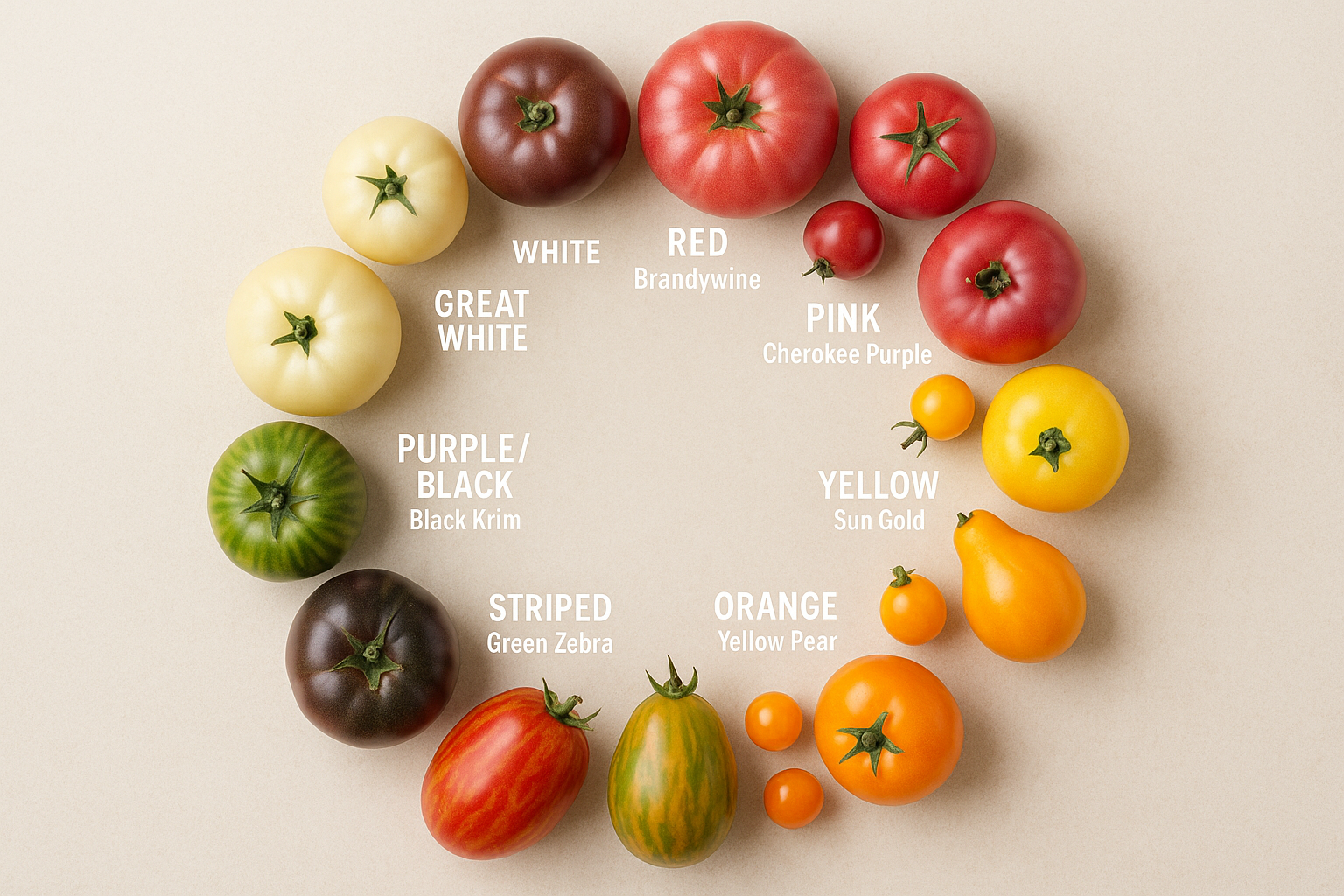
The Rainbow of Tomato Colors
One of the most visually striking aspects of tomato diversity is the incredible range of colors available.
Each color doesn’t just offer aesthetic appeal—it represents different flavor profiles and nutritional compounds.
Classic Red Tomatoes
Red tomatoes get their color from lycopene, a powerful antioxidant linked to heart health and cancer prevention.
These familiar varieties typically offer the balanced sweet-acid flavor most associated with tomatoes.
Popular red varieties include:
- ‘Rutgers’ – A classic garden variety with excellent flavor
- ‘Better Boy’ – A reliable hybrid with good disease resistance
- ‘Mortgage Lifter’ – A legendary beefsteak with a fascinating origin story
Yellow and Orange Tomatoes
Yellow and orange tomatoes contain higher levels of beta-carotene and lower acidity than red varieties, resulting in a milder, sweeter flavor that many people find appealing.
Standout yellow and orange varieties:
- ‘Sun Gold’ – Often rated the sweetest cherry tomato
- ‘Kellogg’s Breakfast’ – A large orange beefsteak with tropical fruit notes
- ‘Yellow Pear’ – A prolific, bite-sized heirloom with mild flavor
Green Tomatoes
Green tomatoes fall into two categories: those harvested before ripening and those that remain green when fully ripe.
Ripe green tomatoes offer a tangy, sometimes spicy flavor profile with hints of citrus.
Notable green varieties:
- ‘Green Zebra’ – A striped green-yellow tomato with bright, zesty flavor
- ‘Aunt Ruby’s German Green’ – A large beefsteak with sweet, spicy notes
- ‘Green Grape’ – Cherry-sized fruits with a juicy, sweet-tart taste
Purple and Black Tomatoes
These dramatically colored varieties contain anthocyanins—the same antioxidants found in blueberries and blackberries.
They typically offer complex, rich flavors with sweet and smoky notes.
Remarkable purple and black varieties:
- ‘Cherokee Purple’ – An indigenous heirloom with deep, wine-like flavor
- ‘Black Krim’ – A Russian variety with intense, smoky sweetness
- ‘Indigo Rose’ – A modern variety with striking purple-black skin
White and Pink Tomatoes
White tomatoes contain less acidity than other colors, resulting in a very mild, sweet flavor.
Pink tomatoes often strike a perfect balance between sweetness and acidity.
Exceptional white and pink varieties:
- ‘Great White’ – A large, creamy-colored beefsteak with tropical fruit notes
- ‘Brandywine Pink’ – Often considered the gold standard for tomato flavor
- ‘White Beauty’ – A pale yellow-white tomato with delicate sweetness
Striped and Bicolor Tomatoes
These visually stunning varieties feature contrasting colors in patterns of stripes, splashes, or marbling.
They often offer complex flavor profiles that reflect their mixed heritage.
Eye-catching striped varieties:
- ‘Mr. Stripey’ (also called ‘Tigerella’) – Red fruit with orange stripes
- ‘Berkeley Tie-Dye’ – A psychedelic mix of green, red, and yellow
- ‘Pineapple’ – A yellow beefsteak marbled with red streaks
Popular Tomato Varieties by Category
Now that we understand the classification systems, let’s explore some of the most beloved and widely grown tomato varieties in each major category.
These selections represent the diversity available to both home gardeners and commercial growers.
Beefsteak Tomatoes
Beefsteaks are the giants of the tomato world, prized for their size and meaty texture.
-
Brandywine (Heirloom, Indeterminate)
- Dating back to the 1800s
- Large pink fruits weighing 1-2 pounds
- Rich, balanced flavor often described as “perfect”
- 80-100 days to maturity
-
Mortgage Lifter (Heirloom, Indeterminate)
- Developed by M.C. “Radiator Charlie” Byles in the 1930s
- Massive pink-red fruits up to 2 pounds
- Sweet, rich flavor with few seeds
- 80-85 days to maturity
-
Big Beef (Hybrid, Indeterminate)
- All-America Selections winner
- 12-16 ounce red fruits
- Excellent disease resistance
- 73 days to maturity
Paste Tomatoes
These varieties have meaty flesh, fewer seeds, and less juice, making them ideal for sauces, pastes, and canning.
-
San Marzano (Heirloom, Indeterminate)
- The legendary Italian sauce tomato
- Elongated 4-5 inch fruits
- Rich flavor that intensifies when cooked
- 80 days to maturity
-
Roma (Open-pollinated, Determinate)
- The standard paste tomato in many regions
- Egg-shaped 3-inch fruits
- Heavy producer on compact plants
- 75 days to maturity
-
Amish Paste (Heirloom, Indeterminate)
- Originated with the Amish in Wisconsin
- Large for a paste tomato (8-12 ounces)
- Versatile for both fresh eating and processing
- 85 days to maturity
Cherry and Grape Tomatoes
Small-fruited varieties perfect for snacking, salads, and container growing.
-
Sun Gold (Hybrid, Indeterminate)
- Intensely sweet orange cherry tomatoes
- Grows in long clusters
- Crack-resistant and highly productive
- 57 days to maturity
-
Black Cherry (Heirloom, Indeterminate)
- Deep purple-black 1-inch fruits
- Rich, complex flavor with smoky notes
- Extremely productive
- 65 days to maturity
-
Juliet (Hybrid, Indeterminate)
- Slightly larger than typical grape tomatoes
- Crack-resistant and disease-resistant
- Sweet flavor and good shelf life
- 60 days to maturity
All-Purpose Slicing Tomatoes
Medium-sized varieties versatile enough for multiple uses.
-
Celebrity (Hybrid, Semi-determinate)
- All-America Selections winner
- 7-8 ounce red, globe-shaped fruits
- Excellent disease resistance
- 70 days to maturity
-
Early Girl (Hybrid, Indeterminate)
- Early producer of 4-6 ounce fruits
- Balanced flavor
- Reliable in various climates
- 50-60 days to maturity
-
Rutgers (Open-pollinated, Determinate)
- Developed for commercial canning in 1934
- 6-8 ounce red fruits
- Tangy, old-fashioned tomato flavor
- 75 days to maturity
Unique and Specialty Tomatoes
These distinctive varieties offer unusual colors, shapes, or flavor profiles.
-
Green Zebra (Open-pollinated, Indeterminate)
- 2-4 ounce fruits with green and yellow stripes
- Bright, tangy flavor
- Developed by tomato breeder Tom Wagner
- 75 days to maturity
-
Pineapple (Heirloom, Indeterminate)
- Large yellow beefsteaks with red marbling
- Sweet, fruity flavor with low acidity
- Can reach 1-2 pounds
- 85-90 days to maturity
-
Paul Robeson (Heirloom, Indeterminate)
- Named for the famous singer and activist
- Dark red-black 8-12 ounce fruits
- Complex, smoky-sweet flavor
- 80-90 days to maturity
Tomato Varieties for Different Culinary Uses
The type of tomato you choose can make or break a dish.
Let’s explore the best varieties for specific culinary applications, helping you select the perfect tomato for every recipe.
Best Tomatoes for Fresh Eating
When eating tomatoes raw in salads or sandwiches, flavor is paramount.
These varieties shine without cooking:
- Brandywine: The gold standard for tomato sandwiches
- Cherokee Purple: Complex flavor that stands on its own
- Sun Gold: Sweet enough to eat like candy
- Green Zebra: Bright, zesty flavor that wakes up any salad
Chef’s Tip: For the ultimate tomato sandwich, layer thick slices of Brandywine on good bread with just a touch of mayonnaise, salt, and pepper.
The simplicity allows the tomato’s flavor to take center stage.
Ideal Tomatoes for Sauces and Pastes
The best sauce tomatoes have thick flesh, few seeds, and concentrated flavor:
- San Marzano: The classic Italian sauce tomato
- Roma: Readily available and reliable
- Amish Paste: Excellent flavor and good yield
- Opalka: A Polish heirloom with few seeds and rich taste
For the best tomato sauce, I combine several varieties.
Last summer, I created a “marriage sauce” using equal parts San Marzano, Amish Paste, and a few Cherokee Purples thrown in for depth.
The resulting sauce had complexity that a single variety couldn’t achieve.
Perfect Tomatoes for Canning and Preserving
Canning tomatoes should be meaty, flavorful, and preferably high in acid (for safety):
- Roma: The standard for canning
- Rutgers: Developed specifically for commercial canning
- San Marzano: Worth the extra effort for superior flavor
- Heinz Classic: Bred for consistent processing quality
Tomatoes for Drying
The best tomatoes for drying have high sugar content and relatively low moisture:
- Principe Borghese: The traditional Italian drying tomato
- Juliet: Grape tomato that dries beautifully
- Roma: Versatile for multiple preservation methods
- Amish Paste: Creates rich, flavorful dried tomatoes
Tomatoes for Container Growing
Limited space doesn’t mean limited tomato options. These varieties thrive in containers:
- Tiny Tim: Ultra-compact plants producing cherry tomatoes
- Patio F: Specifically bred for container culture
- Tumbling Tom: Perfect for hanging baskets
- Bush Early Girl: Compact version of the popular Early Girl
Regional Adaptations and Specialty Tomatoes
Different climates and growing conditions have led to the development of tomatoes adapted to specific regions and challenges.
Understanding these adaptations can help you select varieties most likely to succeed in your area.
Cold-Climate Tomatoes
For gardeners in northern regions with short growing seasons, these early-maturing varieties offer the best chance of success:
- Stupice: Czech variety ready in just 52-55 days
- Sub-Arctic Plenty: Can set fruit at temperatures as low as 45°F
- Manitoba: Developed for the Canadian prairies
- Polar Baby: Alaska-developed variety for extreme northern gardens
Heat-Tolerant Tomatoes
As climate change continues to bring hotter summers to many regions, these heat-loving varieties become increasingly valuable:
- Solar Fire: Sets fruit even in high temperatures
- Heatmaster: Resistant to blossom drop in heat
- Arkansas Traveler: Southern heirloom that thrives in hot, humid conditions
- Phoenix: Developed for desert Southwest conditions
Drought-Tolerant Tomatoes
Water conservation is a growing concern in many areas.
These varieties require less irrigation:
- Punta Banda: Mexican variety adapted to arid conditions
- Porter: Texas-developed variety for hot, dry climates
- Thessaloniki: Greek variety accustomed to Mediterranean drought
- Sioux: Maintains production during dry spells
Disease-Resistant Varieties
Disease pressure varies by region, but these tomatoes offer broad resistance to common problems:
- Iron Lady: Triple resistance to late blight, early blight, and septoria
- Defiant PhR: Late blight resistant hybrid
- Mountain Magic: Resistant to multiple diseases including fusarium and verticillium
- Jasper: Cherry tomato with exceptional disease package
Tomatoes with Unique Characteristics
Some tomatoes have been developed with special traits for specific purposes:
- Garden Gem: University-developed variety with balanced sugar/acid
- Indigo Rose: High in anthocyanins for enhanced nutrition
- Reisetomate: “Traveler tomato” that can be broken off segment by segment
- Sweet Aperitif: Exceptionally high in natural sugar (12° Brix)
Growing Different Tomato Types: Tips and Challenges
Each tomato type presents unique growing challenges and requirements.
Here’s how to succeed with various tomato categories in your garden.
Supporting Different Growth Habits
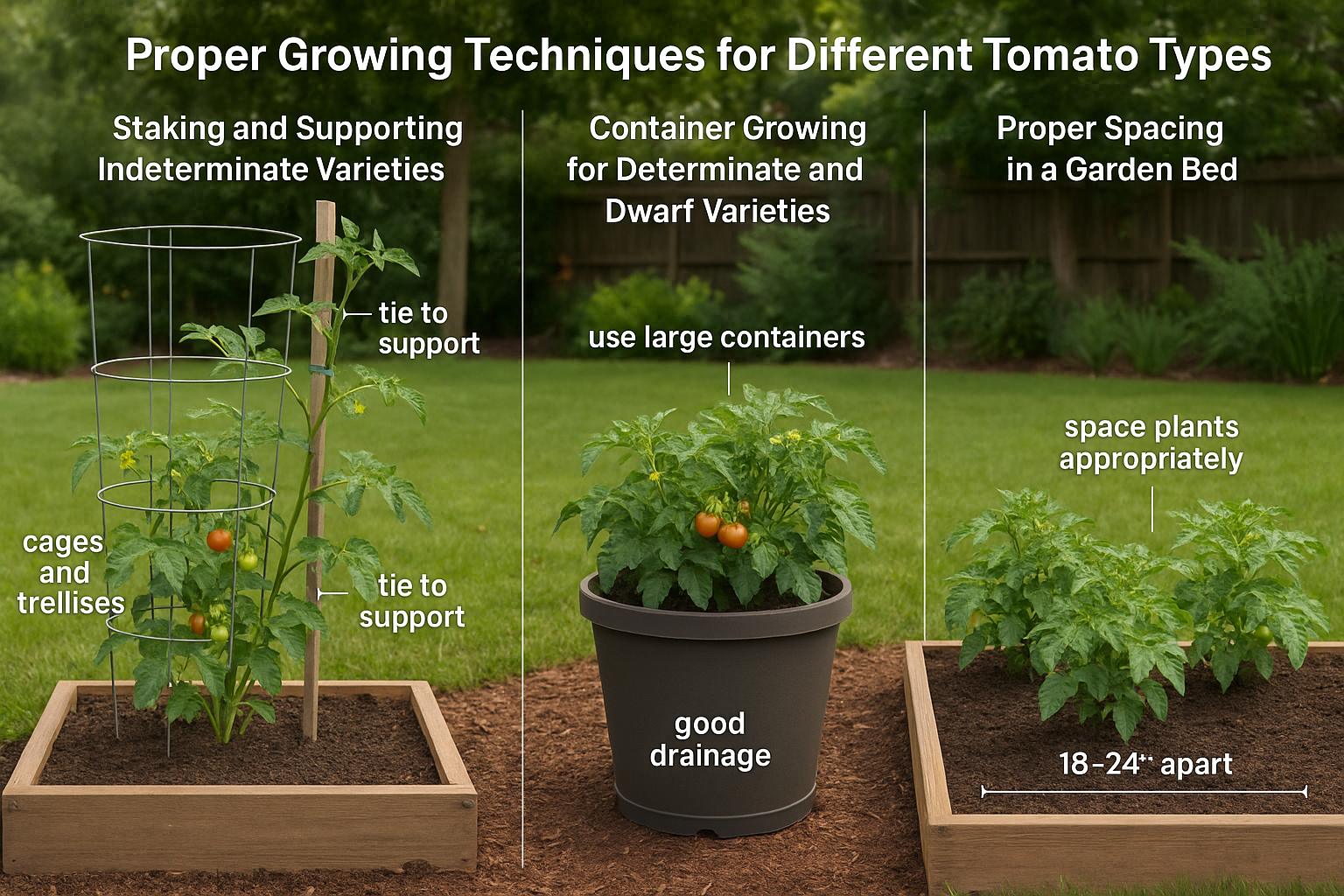
For Indeterminate Varieties:
- Use sturdy cages at least 5-6 feet tall
- Consider the Florida weave system for multiple plants
- Prune to 2-3 main stems for best airflow and fruit quality
- Continue adjusting supports throughout the season
For Determinate Varieties:
- Smaller cages (3-4 feet) are usually sufficient
- Minimal pruning is needed
- Focus support on fruit-bearing branches
Spacing Requirements
Different tomato types require different spacing for optimal growth:
| Tomato Type | Plant Spacing | Row Spacing | Container Size |
|---|---|---|---|
| Indeterminate | 24-36″ | 48-60″ | Minimum 10 gallon |
| Determinate | 18-24″ | 36-48″ | 5-7 gallon |
| Dwarf/Patio | 12-18″ | 24-30″ | 3-5 gallon |
| Cherry types | 18-24″ | 36″ | 5 gallon |
Special Considerations for Heirlooms
Heirloom tomatoes often require extra care compared to modern hybrids:
-
Disease management is critical as most lack modern resistance
- Use preventative measures like copper or sulfur sprays
- Practice strict crop rotation
- Consider grafting onto resistant rootstock
-
Irregular fruit set may occur
- Hand pollination can help during temperature extremes
- Provide shade during extreme heat
-
Cracking and cat-facing are common in heirlooms
- Maintain consistent soil moisture
- Harvest slightly before full ripeness during rainy periods
Container Growing Strategies
Growing tomatoes in containers presents unique challenges:
-
Choose appropriate varieties
- Determinate, dwarf, or patio types work best
- Cherry tomatoes are more forgiving in containers
-
Use sufficient container size
- Minimum 5 gallons for most varieties
- Ensure adequate drainage
-
Watering is critical
- May need daily watering during hot weather
- Consider self-watering containers
- Mulch the soil surface to reduce evaporation
-
Fertilize more frequently
- Container soil nutrients deplete faster
- Use liquid fertilizer at half-strength weekly
Tomato Flavor Profiles and Tasting Notes
The flavor of a tomato is a complex interplay of sugars, acids, and volatile compounds.
Understanding these profiles can help you select varieties that match your taste preferences.
Understanding Tomato Flavor Components
Tomato flavor is determined by several factors:
- Sugar content (measured in Brix): Ranges from 4-12° Brix
- Acid levels: Primarily citric and malic acids
- Volatile compounds: Over 400 aromatics contribute to flavor
- Umami compounds: Glutamates that create savory notes
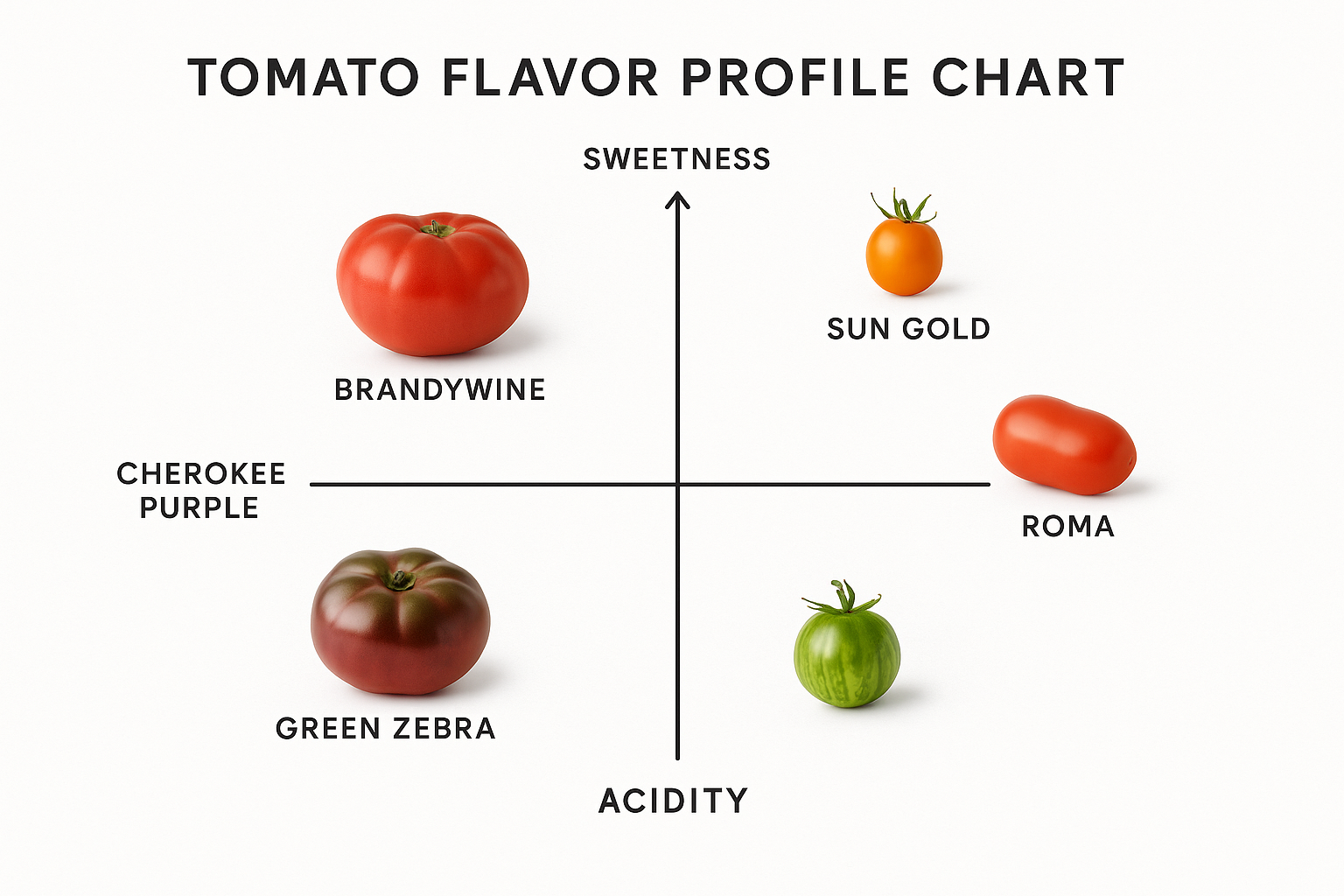
Flavor Profiles by Color
Different colored tomatoes tend toward distinct flavor profiles:
Red Tomatoes: Classic balanced flavor with good acid-to-sugar ratio. Examples: ‘Rutgers’, ‘Better Boy’
Pink Tomatoes: Often sweeter than reds with complex flavor. Examples: ‘Brandywine’, ‘German Johnson’
Yellow/Orange Tomatoes: Lower acid, fruity sweetness, sometimes with tropical notes. Examples: ‘Sun Gold’, ‘Kellogg’s Breakfast’
Black/Purple Tomatoes: Rich, smoky, complex flavors with wine-like qualities. Examples: ‘Black Krim’, ‘Cherokee Purple’
Green Tomatoes: Bright, tangy, sometimes spicy notes. Examples: ‘Green Zebra’, ‘Aunt Ruby’s German Green’
White Tomatoes: Mild, sweet, low-acid flavor. Examples: ‘Great White’, ‘White Beauty’
Conducting a Tomato Tasting
To truly appreciate tomato diversity, try conducting a structured tasting:
- Select diverse varieties: Include different colors, sizes, and types
- Serve at room temperature: Cold dulls flavor
- Cut into bite-sized pieces: Sample the same part of each tomato
- Cleanse the palate: Use water or bland crackers between samples
- Take notes: Record impressions of sweetness, acidity, complexity
- Compare preferences: Different people often prefer different profiles
Last summer, I hosted a tomato tasting party featuring 12 varieties from my garden.
The results were fascinating—while ‘Brandywine’ was the overall favorite, individual preferences varied widely.
One guest raved about ‘Green Zebra’ while another couldn’t get enough of ‘Black Krim.’
The experience highlighted how subjective tomato preferences can be.
Preserving Tomato Genetic Diversity
The rich diversity of tomatoes we enjoy today is the result of centuries of careful selection and breeding.
Preserving this genetic heritage is crucial for food security, especially as climate change presents new challenges.
The Importance of Seed Saving
Seed saving is more than a hobby—it’s a way to:
- Preserve rare varieties that might otherwise disappear
- Adapt varieties to your local growing conditions
- Reduce dependence on commercial seed sources
- Connect with the long tradition of agricultural heritage
How to Save Tomato Seeds
Saving tomato seeds is relatively simple:
- Select fully ripe, disease-free fruits from your best plants
- Scoop seeds and gel into a container
- Ferment for 2-3 days until a white mold forms on top
- Rinse thoroughly to remove gel and floating seeds
- Dry completely on coffee filters or paper plates
- Store in cool, dry conditions in labeled paper envelopes
Seed Libraries and Exchanges
Community resources for preserving tomato diversity include:
- Seed Savers Exchange: The largest non-governmental seed bank in the U.S.
- Local seed libraries: Often hosted by public libraries or garden clubs
- Seed swaps: Community events for exchanging saved seeds
- Online seed exchange communities: Connecting gardeners globally
Participatory Breeding Projects
In 2025, citizen science approaches to tomato breeding have gained momentum:
- Open Source Seed Initiative: Developing varieties free from restrictive patents
- Collaborative breeding networks: Gardeners testing varieties across different regions
- University partnerships: Connecting home gardeners with professional breeders
- Climate adaptation projects: Developing varieties for changing conditions
Nutritional Differences Between Tomato Types
Tomatoes are nutritional powerhouses, but their nutritional content varies significantly between types and colors.
Lycopene Content
Lycopene is a powerful antioxidant associated with reduced risk of certain cancers and heart disease.
- Red tomatoes contain the highest lycopene levels
- Processing increases bioavailability (cooked tomatoes provide more accessible lycopene)
- Small-fruited varieties often contain more lycopene per weight
- High-lycopene varieties include ‘Health Kick’, ‘Carmello’, and ‘Heinz 1439’
Antioxidant Profiles by Color
Different colored tomatoes contain different beneficial compounds:
- Red/Pink: High in lycopene
- Orange/Yellow: Rich in beta-carotene
- Purple/Black: Contain anthocyanins (similar to blueberries)
- Green: Provide chlorophyll and unique phenolic compounds
Low-Acid Tomatoes
For those with dietary restrictions or acid sensitivity:
- Yellow varieties like ‘Carolina Gold’ and ‘Lemon Boy’ are naturally lower in acid
- White tomatoes such as ‘White Beauty’ have the lowest acid levels
- Pink varieties often provide a good balance of flavor with moderate acidity
Breeding for Enhanced Nutrition
Recent breeding efforts have focused on developing tomatoes with enhanced nutritional profiles:
- High-lycopene varieties with up to 3x standard lycopene content
- Purple tomatoes engineered to produce anthocyanins throughout the fruit
- Enhanced vitamin C varieties developed for improved nutritional value
- Golden tomatoes with increased provitamin A content
The Future of Tomato Diversity
As we look ahead, several trends are shaping the future of tomato diversity and cultivation.
Climate-Resilient Varieties
With climate change accelerating, breeders are focusing on:
- Heat-set capability to produce fruit during temperature extremes
- Drought tolerance for water conservation
- Disease resistance as pest patterns shift with climate
- Earlier maturity for regions with shifting growing seasons
Urban Farming Adaptations
As urban agriculture expands, tomato varieties specifically suited to city environments are gaining popularity:
- Compact determinate varieties for small spaces
- Container-specific breeding optimized for terrace and balcony growing
- Pollution-tolerant types that thrive despite urban air quality issues
- Low-maintenance varieties for busy urban gardeners
Emerging Breeding Technologies
New approaches to tomato breeding are expanding possibilities:
- CRISPR gene editing creating non-GMO varieties with beneficial traits
- Marker-assisted selection speeding traditional breeding
- Participatory breeding networks involving gardeners in selection
- Wild tomato gene incorporation for stress tolerance and flavor
Consumer Trends Driving Development
Consumer preferences are increasingly influencing tomato breeding priorities:
- Flavor-focused breeding responding to demand for better taste
- Unusual colors and shapes for visual appeal and culinary diversity
- Snacking varieties for convenient healthy eating
- Extended shelf life without sacrificing flavor
How to Choose the Right Tomato Varieties for Your Garden
With thousands of options available, selecting the right tomatoes for your garden can be overwhelming.
Here’s a systematic approach to narrowing your choices.
Assess Your Growing Conditions
Start by evaluating your garden’s specific characteristics:
- Growing season length: How many frost-free days do you have?
- Temperature patterns: Do you have cool nights or extreme heat?
- Space limitations: Container garden or open ground?
- Sun exposure: Full sun (8+ hours) or partial shade?
- Disease pressure: What problems are common in your area?
Match Varieties to Your Culinary Preferences
Consider how you’ll use your harvest:
- Fresh eating: Focus on flavor-forward varieties
- Sauce and canning: Choose paste types with dense flesh
- Salads: Cherry and cocktail varieties shine here
- Sandwiches: Beefsteaks provide the perfect slice
Diversify Your Selection
I’ve found that growing a mix of varieties provides insurance against problems and extends the harvest:
- Include early, mid, and late-season varieties
- Mix determinate and indeterminate types
- Choose varieties with different disease resistance packages
- Experiment with at least one new variety each year
Start Small and Expand
If you’re new to growing tomatoes:
- Begin with 3-4 reliable varieties
- Include at least one cherry type (generally easiest to grow)
- Try one heirloom and one hybrid to compare
- Keep good records of performance to guide future selections
Conclusion:
Embracing Tomato Diversity in Your Kitchen and Garden
The world of tomatoes extends far beyond the uniform red globes found in supermarkets.
With thousands of varieties offering a spectrum of colors, shapes, sizes, and flavors, tomatoes represent one of our most diverse food crops—a living testament to generations of careful selection and breeding.
In my own garden journey, I’ve progressed from growing basic hybrid varieties to exploring the rich heritage of heirlooms and specialty types.
Each season brings new discoveries: the smoky complexity of ‘Black Krim,’ the tropical sweetness of ‘Kellogg’s Breakfast,’ the perfect balance of ‘Brandywine.’
These experiences have transformed not just my gardening practice but my entire relationship with food.
As we navigate the challenges of climate change and food security, preserving and expanding tomato diversity becomes increasingly important.
Each variety represents unique genetic traits that may prove crucial for adaptation to changing conditions.
By growing diverse tomatoes in our gardens, saving seeds, and supporting breeding programs that prioritize flavor and resilience over uniformity, we participate in securing this diversity for future generations.
Whether you’re a dedicated gardener with acres of land or an apartment dweller with a single pot on a sunny windowsill, I encourage you to explore beyond the familiar.
Grow something unusual, visit farmers’ markets to taste rare varieties, or simply choose different tomatoes at the grocery store.
Each step into tomato diversity opens new culinary possibilities and connects us to the rich agricultural heritage that has sustained humanity for centuries.
The humble tomato, once feared as poisonous, now stands as one of our most beloved and diverse foods—a living palette of flavors, colors, and possibilities waiting to be explored.
What new variety will you discover next?