How to water a vegetable garden correctly starts with understanding that plants don’t just need water — they need the right amount at the right time.
Too little water slows growth, and too much can cause root rot.
The correct way to water a vegetable garden is to water deeply and less often — soaking the soil thoroughly to a depth of at least 8 to 10 inches and then leaving it until the top 2 inches feel dry again before watering once more.
Most vegetable gardens need around one inch of water per week from rain and watering combined. In hot summer weather that rises to two inches.
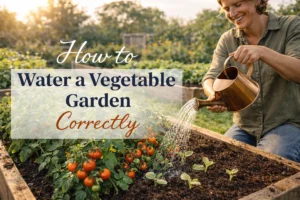
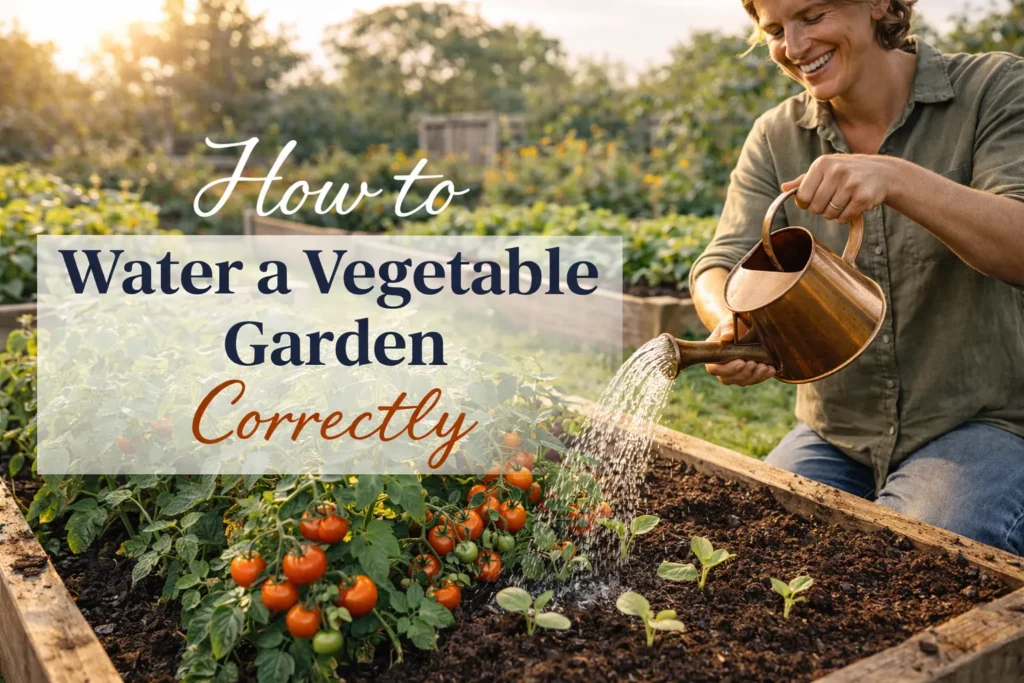
Water in the morning at the base of plants, not over the leaves.
That single change fixes most of the watering problems we see in beginner vegetable gardens.
What Does It Mean to Water a Vegetable Garden Correctly?
Watering a vegetable garden correctly means giving plants the right amount of water at the right time and in the right place.
Too much water drowns roots, encourages fungal disease, and washes nutrients out of the soil before plants can use them.
Too little water stresses plants, slows growth, reduces fruit production, and causes quality problems like split tomatoes and bitter lettuce.
The goal is consistent soil moisture — not wet, not bone dry, but reliably moist in the root zone where plants actually drink from.
Key Facts About Watering a Vegetable GardenMost vegetables need around one inch of water per week from rain and irrigation combined. (University of Minnesota Extension) If the soil is dry two inches below the surface it is time to water. (University of Minnesota Extension) Watering in the morning between 4 and 6am is the best time — foliage dries before nightfall and water loss from evaporation is lowest. (University of Florida IFAS) A 100 square foot vegetable garden needs 62 gallons of water to receive one inch of rainfall equivalent. (University of Minnesota Extension) Mulching with 2 to 3 inches of straw or shredded leaves can cut watering frequency significantly by reducing evaporation from the soil surface. (MSU Extension) |
Quick Summary
How much: Around one inch of water per week — rising to two inches in hot summer weather.
How often: Water deeply once or twice a week rather than a little every single day.
When: Early morning is best — between 4 and 8am if possible.
Where: Always water at the base of the plant, never over the leaves.
How to check: Push your finger 2 inches into the soil. Dry means water. Moist means wait.
Why Watering a Vegetable Garden Correctly Changes Everything
More vegetable gardens fail from bad watering than from any other single cause — bad soil, bad weather, or bad seed included.
The reason is simple.
Vegetables are made up of 70 to 95 percent water.
Every process inside a plant — moving nutrients from roots to leaves, producing flowers, swelling fruit — depends on a consistent supply of moisture in the soil.
Get the watering right and even average soil in a mediocre location can produce a genuinely impressive harvest.
Get it wrong and even perfect soil in full sun will let you down.
Soil and plant scientists at University of Minnesota Extension make it clear: a lack of water can have major impacts on plants even if the dry spell lasts only a few days.
Plants draw nutrients through their roots in a water solution — so insufficient water means insufficient nutrients regardless of what the soil contains.
That is why watering correctly is not just about keeping plants alive.
It is about giving them everything they need to grow and produce at their best throughout the whole season.
| The Scale of What One Inch of Water Really Means
One inch of water across a 100 square foot vegetable garden is 62 gallons. Across a 4×8 foot raised bed that is around 20 gallons. These numbers help explain why a light sprinkle with a hose for two minutes is almost never enough to properly water a vegetable garden — no matter how often you do it. |
How Much Water Does a Vegetable Garden Actually Need?
The standard guideline for watering a vegetable garden is one inch of water per week — from rain and irrigation combined.
In cool spring and autumn weather that one inch is usually enough.
In the heat of summer — especially during dry spells above 30 degrees Celsius — that rises to closer to two inches per week.
The honest truth is that no fixed amount works perfectly for every garden.
Soil type, bed depth, mulch coverage, local climate, and the specific crops you are growing all affect how much water your vegetable garden actually needs.
How Soil Type Affects Watering a Vegetable Garden
| Soil Type | How It Affects How You Water a Vegetable Garden |
| Sandy soil | Drains very quickly — may need watering twice a week even in mild weather |
| Clay soil | Holds moisture longer — once a week is usually sufficient in normal conditions |
| Loam or compost-rich soil | The ideal balance — holds moisture well but still drains freely after rain |
| Raised bed with fresh compost mix | Dries out faster than in-ground beds — check moisture every 1 to 2 days in summer |
| Container or pot | Dries fastest of all — check every morning and water whenever the top 2cm feels dry |
A simple rain gauge placed in your vegetable garden takes all the guesswork out of how much natural rainfall your plot is actually receiving each week.
They cost a few pounds and are one of the most useful tools any beginner gardener can own.
The Finger Test — The Easiest Way to Know When to Water a Vegetable Garden
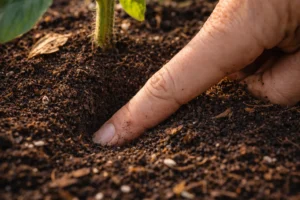
Forget watering schedules.
The single most reliable way to know when your vegetable garden needs water is the finger test.
Push your index finger 2 inches straight down into the soil at the base of a plant.
Leave it there for a second and pay attention to what you feel.
- Feels cool and moist at the fingertip — the soil still has enough moisture. Leave it and check again tomorrow.
- Feels dry and warm at the fingertip — water now, slowly and thoroughly at the base of the plants.
- Feels soaking wet or muddy — the soil has too much water. Do not add more until it begins to dry out.
This test takes five seconds and is more accurate than any timer or schedule you could set.
Every gardener who has ever used it regularly says the same thing — it becomes second nature within a week.
When to Check Soil Moisture in a Vegetable Garden
- Check every morning during the growing season. Morning is when you catch dryness before the heat of the day makes it worse.
- Always check before watering — never water out of habit or on a fixed timetable without checking first.
- Check more frequently during heatwaves, windy days, and the weeks when tomatoes and cucumbers are actively fruiting.
- Check containers and raised beds daily in summer. They dry out significantly faster than in-ground beds.
When Is the Best Time of Day to Water a Vegetable Garden?
The best time to water a vegetable garden is early in the morning — between 4 and 8am if possible.
Morning watering gives your plants moisture to draw on through the warmest part of the day.
Any water that lands on the leaves has time to dry completely before nightfall, which dramatically reduces the risk of fungal diseases like blight on tomatoes and powdery mildew on zucchini.
Water loss from evaporation is also lowest in the morning.
The same amount of water applied at 6am reaches far more of the root zone than the same amount applied at 2pm in full summer sun.
Morning vs Evening — When to Water Your Vegetable Garden
| Time of Day | How It Affects Watering a Vegetable Garden |
| Early morning — 4 to 8am | Best choice. Lowest evaporation. Leaves dry before nightfall. Reduces disease risk. |
| Mid morning — 8 to 10am | Still good. Most of the benefits of early morning watering with less effort for light sleepers. |
| Midday — 10am to 3pm | Worst choice. High evaporation means up to half the water you apply never reaches the roots. |
| Evening — after 5pm | Acceptable if morning is impossible. Soil stays moist overnight but wet leaves increase disease risk. |
| Night watering | Avoid. Wet foliage overnight is the number one cause of fungal disease in a vegetable garden. |
If your schedule makes morning watering difficult, evening is still far better than not watering at all.
Just focus the water at the base of the plants and keep the leaves as dry as possible.
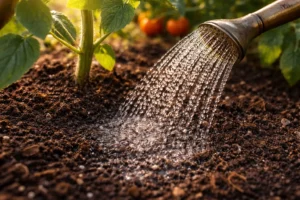
This is the most important watering technique any beginner can learn.
Water deeply and less often rather than a little bit every day.
When you water shallowly, moisture only penetrates the top inch or two of soil.
Plant roots follow the moisture and stay shallow.
Shallow roots dry out in hours and the plant becomes dependent on daily watering to survive.
When you water deeply, moisture reaches 8 to 10 inches down into the soil.
Roots follow it downward and grow strong and deep.
Deep roots can access moisture even through several dry days without any signs of stress.
How to Water a Vegetable Garden Deeply — Step by Step
- Water slowly at the base of each plant. Fast water from a strong hose runs off the surface before it can soak in.
- Keep watering until you see moisture beginning to pool slightly on the surface — this means the soil below is saturated.
- Dig a small hole 8 to 10 inches deep beside a plant after watering to check how far moisture has penetrated.
- If the soil is still dry at 6 inches depth, water for longer next time.
- Once the soil is wet to full depth, leave it until the top 2 inches feel dry again before watering once more.
In practice, a good deep watering of a 4×8 raised bed takes around 10 to 15 minutes with a gentle hose or watering can.
Twice a week in normal summer weather is usually sufficient for most crops.
| Deep Roots vs Shallow Roots in a Vegetable Garden
Plants with deep roots grown through consistent deep watering are significantly more drought-tolerant than plants with shallow roots from daily light watering. MSU Extension confirms that deep, infrequent irrigation is the single most effective watering technique for producing healthy, productive vegetables. |
The Best Watering Methods for a Beginner Vegetable Garden
There is no single best method for watering a vegetable garden.
The right choice depends on the size of your garden, your budget, and how much time you want to spend on watering each week.
| Watering Method | How Well It Works for a Vegetable Garden |
| Watering can | Excellent for small beds and containers. Gives full control over where the water goes. Gentle on seedlings. |
| Garden hose with rose or diffuser head | Good for most beginner vegetable gardens. Delivers water gently without disturbing soil. |
| Soaker hose | Very good. Delivers water slowly directly to the root zone. Keeps leaves dry. Reduces disease. |
| Drip irrigation with timer | Excellent for raised beds. Delivers consistent moisture automatically. Saves time and water. |
| Overhead sprinkler | Less ideal. Wets foliage which increases disease risk. Loses water to evaporation. Not recommended. |
| Hand watering with open hose | Least effective. Water flow is faster than soil can absorb. Leads to runoff and uneven watering. |
If you are gardening in a raised bed, a soaker hose or simple drip irrigation kit is the single best upgrade you can make after your first season.
They cost between 20 and 50 pounds, deliver water directly to where plants need it, and take the daily watering task almost completely off your plate.
Researchers at MSU Extension confirm that focusing water during morning hours and avoiding overhead irrigation significantly reduces the potential for disease infections — one of the most practical improvements any beginner gardener can make to their watering routine.
How to Water Seedlings vs Established Plants in a Vegetable Garden
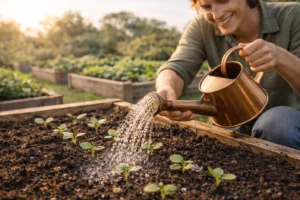
Seedlings and newly transplanted crops have a completely different watering need to established plants.
Getting this wrong is one of the most common causes of early crop failure in a beginner vegetable garden.
How to Water Seedlings in a Vegetable Garden
- Water seeds and fresh seedlings every day to keep the soil consistently moist during germination.
- Use a gentle rose head on your watering can. A strong flow washes seeds out of the soil and knocks fragile seedlings flat.
- Keep the top inch of soil moist at all times for the first two weeks after sowing.
- Once seedlings have their first true leaves, start reducing frequency gradually to encourage roots to grow deeper.
How to Water Established Plants in a Vegetable Garden
- Water deeply once or twice a week rather than every day.
- Always check the soil with the finger test before watering. Never water if the soil still feels moist at 2 inches depth.
- Focus water at the base of each plant. Direct the flow toward the roots not the stem and not the leaves.
- Increase frequency during hot weather, flowering, and fruiting — these are the periods when plants need the most consistent moisture.
Critical Watering Times in the Life of a Vegetable Garden Crop
| Growth Stage | Why Water a Vegetable Garden Carefully at This Stage |
| Germination — seeds just sown | Soil must stay consistently moist or seeds will not sprout |
| Seedling stage — first 2 weeks | Daily moisture needed while roots are small and shallow |
| Transplanting — moving to final spot | Water in generously and check daily for the first week |
| Flowering — first blooms appearing | Consistent moisture prevents flowers dropping before setting fruit |
| Fruiting — tomatoes, cucumbers swelling | Critical period — irregular watering causes split tomatoes and bitter cucumbers |
| Harvest — picking begins | Maintain regular watering to keep new fruits forming all season |
How to Water a Vegetable Garden in Hot Weather and Drought
Hot summer weather changes everything about how you water a vegetable garden.
Evaporation increases, plants lose moisture faster, and the gap between adequate watering and drought stress narrows very quickly.
The general rule is this: for every 10 degrees Fahrenheit the average temperature rises above 60 degrees, your vegetable garden will likely need an extra half inch of water that week.
In practical terms, a vegetable garden that needs one inch of water per week in mild weather may need two inches or more during a July heatwave.
Hot Weather Watering Tips for a Vegetable Garden
- Check soil moisture every morning without exception during heatwaves. Do not rely on your normal schedule.
- Water early — before 8am — to reduce evaporation loss and give plants moisture through the hottest part of the day.
- Do not panic if plants droop slightly in the afternoon heat. This is a normal response to heat, not a sign of drought stress. Check again in the evening — if they recover, they are fine.
- Mulch the soil surface with 2 to 3 inches of straw or shredded leaves. This alone can cut watering frequency by up to half during a dry spell.
- Water deeply and slowly during droughts. A long slow soaking reaches much further into the root zone than several quick light waterings.
Mulching to Reduce Watering in a Vegetable Garden
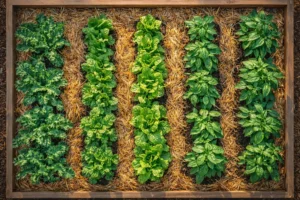
Mulch is the single most effective way to reduce how often you need to water a vegetable garden — and it costs almost nothing if you use straw, shredded leaves, or grass clippings.
A 2 to 3 inch layer of mulch spread across the soil surface around your plants reduces water evaporation from the soil, keeps the root zone cooler in hot weather, suppresses weeds that compete for moisture, and breaks down over time to improve soil structure.
In my experience, a well-mulched vegetable garden in summer needs watering roughly half as often as the same garden with bare exposed soil between the plants.
Best Mulch Options for a Vegetable Garden
| Mulch Type | How It Helps Water a Vegetable Garden |
| Straw or seedless hay | Excellent moisture retention. Light, easy to apply, breaks down over winter. |
| Shredded autumn leaves | Free if you have trees. Great moisture retention once shredded down to small pieces. |
| Grass clippings | Free from your lawn. Thin layers work well — thick layers can mat and block water penetration. |
| Compost as mulch | Feeds the soil while retaining moisture. The best dual-purpose mulch for any vegetable garden. |
| Coco coir | Good moisture retention. Often sold in compressed bricks. Sustainable and long-lasting. |
| The Mulch Moisture Advantage
MSU Extension confirms that organic mulch applied 1 to 3 inches deep between rows significantly reduces moisture evaporation from the soil surface — keeping the root zone cooler and extending the time between necessary waterings, especially during the driest summer weeks. |
Signs of Overwatering and Underwatering in a Vegetable Garden
Learning to read the signs in your vegetable garden tells you far more than any schedule ever could.
| Sign | What It Means for Your Vegetable Garden |
| Yellow leaves on lower stems | Often overwatering — roots sitting in wet soil cannot absorb oxygen |
| Wilting in morning cool — not just afternoon heat | Underwatering — the plant is genuinely short of moisture |
| Soft mushy stem base | Overwatering — root rot has begun. Reduce watering immediately. |
| Dry cracked soil surface | Underwatering — the bed needs a thorough deep soaking |
| Mould or fungus on soil surface | Overwatering — the surface is staying wet for too long |
| Split tomato fruits | Irregular watering — dry spell followed by sudden heavy watering causes splitting |
| Bitter or bolting lettuce | Underwatering combined with heat — water more consistently and provide afternoon shade |
| Slow stunted growth | Often underwatering — plants are conserving energy rather than producing |
| Key Takeaways — How to Water a Vegetable Garden Correctly
1. Water deeply once or twice a week — not a little every single day. 2. Use the finger test every morning. Two inches dry means water. Still moist means wait. 3. Water in the morning between 4 and 8am for the best results and least disease risk. 4. Always water at the base of plants. Wet leaves invite fungal disease. 5. Mulch the soil surface with 2 to 3 inches of straw. It cuts your watering workload significantly. 6. Seedlings need daily moisture. Established plants need deep infrequent soaking. 7. One inch of water per week in mild weather — two inches in hot summer conditions. |
Water Your Vegetable Garden Well and It Will Reward You All Season
You now know exactly how to water a vegetable garden correctly — how much, how often, what time of day, how deep, and how to read your plants and soil for the signs that tell you everything you need to know.
Good watering is not complicated.
It is consistent, attentive, and responsive. Check the soil every morning.
Water deeply when it needs it. Mulch the surface to hold moisture in. And let your plants tell you when they are thirsty.
Get this one skill right and your vegetable garden will produce better results with less effort from the very first season.
Take action today: Go to your vegetable garden right now and do the finger test on every bed.
Note which ones feel dry below 2 inches. Water those ones slowly and deeply at the base of the plants.
That is correct watering — and now you know exactly how it feels.
Frequently Asked Questions
| Q: How often should I water a vegetable garden?
A: Most vegetable gardens need the equivalent of one inch of water per week from rain and irrigation combined. In normal summer weather that usually means watering deeply once or twice a week. In hot weather above 30 degrees Celsius it rises to twice a week or more. University of Minnesota Extension recommends using the finger test rather than a fixed schedule — push your finger 2 inches into the soil and water only when it feels dry at that depth. Sandy soil may need twice-weekly watering. Clay or compost-rich soil often does well with once a week. |
| Q: What is the best time of day to water a vegetable garden?
A: The best time to water a vegetable garden is early in the morning between 4 and 8am. Morning watering gives plants moisture to draw on through the hottest part of the day, allows any water on the foliage to dry before nightfall, and loses the least amount of water to evaporation. University of Florida IFAS confirms that watering between 4 and 6am is ideal. Evening watering is acceptable as a second choice but wet foliage overnight significantly increases the risk of fungal diseases like blight and mildew. |
| Q: Should I water my vegetable garden every day?
A: No. Watering a vegetable garden every day with small amounts of water is one of the most common beginner mistakes. Frequent shallow watering encourages roots to stay near the surface where they dry out quickly and become dependent on daily moisture. Deep infrequent watering — thoroughly soaking the soil to 8 to 10 inches once or twice a week — encourages roots to grow deep where they find moisture independently. The exception is seedlings and freshly sown seeds, which do need daily moisture until they are established. |
| Q: How do I know if I am overwatering my vegetable garden?
A: The most common signs of overwatering a vegetable garden are yellowing leaves on the lower stems, soft or mushy stem bases, mould or fungus growing on the soil surface, and plants that wilt even though the soil feels wet. MSU Extension notes that long periods of leaf wetness can also lead to fungal disease infections. If you see these signs, stop watering and let the soil dry out until the finger test shows dry soil at 2 inches depth before watering again. |
| Q: Does mulch really reduce how much I need to water a vegetable garden?
A: Yes — significantly. A 2 to 3 inch layer of mulch such as straw, shredded leaves, or grass clippings across the soil surface reduces water evaporation, keeps the root zone cooler in hot weather, and extends the time between necessary waterings. In our experience a well-mulched vegetable garden in summer needs watering roughly half as often as a bare-soil garden in the same conditions. MSU Extension recommends applying mulch in early summer once the soil has warmed, and renewing it each season. |