Starting a vegetable garden for beginners is much simpler than most people expect.
Pick a sunny spot, start with a small bed, improve your soil with compost, choose easy crops, plant at the right time of year, and water when the soil feels dry.
That is the whole plan. No expensive equipment, no years of experience, and no perfect conditions required.
| What Is a Beginner Vegetable Garden? — Definition
A vegetable garden is any dedicated growing space used to produce food at home. It can be a raised bed in a backyard, a few containers on a balcony, a window box on a flat, or a full in-ground plot. Even a single large pot of tomatoes on a sunny doorstep counts as a vegetable garden. The size does not matter. What matters is the sunlight, the soil, and the crops you choose to grow. |
| Key Facts About Vegetable Gardening for Beginners
33% of UK adults now grow their own fruit, vegetables, or herbs at home. (Horticultural Trades Association 2024) 28% of UK adults with a garden have a dedicated vegetable patch. (Statista 2021) 42% of the UK population enjoy gardening as a regular hobby — around 27 million people. (Hillarys Garden Statistics 2025) 84% of British adults believe gardens and green spaces benefit their state of mind. (HTA Industry Statistics) Most vegetables need at least 6 to 8 hours of direct sunlight each day to produce a good harvest. (NC State Extension) |
| Quick Summary — How to Start a Vegetable Garden for Beginners
The best starter size is a 4×4 or 4×8 foot raised bed — small enough to manage in 10 minutes a day. The easiest first crops are radishes, lettuce, cherry tomatoes, courgette, and green beans. Compost is the single most important thing you can add to your soil before planting. Cool-season crops go in early spring. Warm-season crops wait until after your last frost date. Check the soil before watering — push your finger 2cm in and water only if it feels dry. |
Why a Vegetable Garden for Beginners Is Easier Than You Think
A lot of people put off starting a vegetable garden because they think they need a big space, great soil, or years of experience behind them.
None of that is true. We have seen people grow a full tray of radishes on a flat windowsill and get more joy from it than any shop-bought bag of salad ever gave them.
The honest reality is that vegetables want to grow. Give them sunlight, decent soil, and water at the right time and most of them will do the hard work themselves.
Horticulture specialists at NC State Extension put it simply: vegetable gardening does not take a lot of money, time, or talent. With a little patience and practice, the skills improve every single season.
The most important step is always the first one. Once you have something growing, everything else falls into place naturally.
Step 1: Choose the Right Spot for Your Vegetable Garden
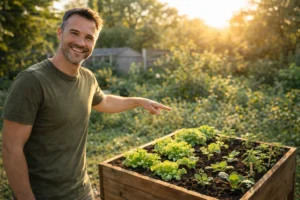
Sunlight is the one thing you cannot fix once your vegetable garden is planted.
Get this right first and everything else becomes much easier.
Most vegetables need at least 6 to 8 hours of direct sun each day.
Fruit-producing crops like tomatoes, cucumbers, and courgette do even better with 10 hours.
Before you choose your spot, spend one full day watching where the sun falls in your outdoor space.
The patch that stays brightest for the longest is your vegetable garden location.
How Much Sun Does a Beginner Vegetable Garden Need?
- Most food crops need 6 to 8 hours of direct sun every day for a good harvest.
- Tomatoes, cucumbers, peppers, and courgette all do best with closer to 10 hours of sun.
- Lettuce and spinach can manage with around 5 to 6 hours — ideal for slightly shadier spots.
- Morning sun is slightly better than afternoon sun because it dries the leaves faster and reduces disease risk.
A word of warning — do not pick a spot just because it looks convenient or is easiest to set up.
Shade is the number one reason beginner vegetable gardens fail in the first season.
Other Location Tips for Starting a Vegetable Garden for Beginners
- Good drainage matters. Any area where water pools after rain will cause root rot in most crops.
- Close to the house is always better. Gardens you can see from your kitchen window get visited far more often.
- Away from large trees. Tree roots compete quietly but aggressively for water and nutrients.
- Near a water source. The closer your bed is to a tap, the more consistently it gets watered.
Step 2: Choose the Best Size for a Beginner Vegetable Garden
The biggest mistake most beginners make is starting too big.
It feels exciting in spring but by July a large plot can feel like a second job.
Start with a 4×4 foot raised bed or a 4×8 foot bed if you want a little more room.
That is the ideal size for a first vegetable garden for beginners.
In our experience, a small well-tended bed produces far more food and far more satisfaction than a large bed that gets on top of you halfway through the season.
Best Starter Sizes for a Beginner Vegetable Garden
| Garden Type | Recommended Starter Size |
| Raised bed | 4 feet wide by 4 to 8 feet long — the most manageable first vegetable garden bed |
| In-ground plot | 10 feet by 10 feet — good for open spaces with decent existing soil |
| Containers on a patio | 3 to 5 large pots at least 30cm wide and deep |
| Balcony or windowsill | Window boxes and grow bags work brilliantly for salad leaves and herbs |
| Worth Remembering
Start with what you can manage comfortably in 10 minutes a day. You can always add more beds next season. You cannot undo an overwhelming first year. |
Step 3: Preparing Soil for Your Vegetable Garden for Beginners
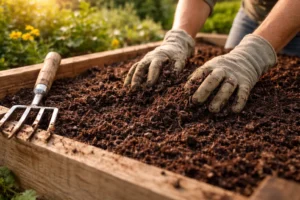
Soil is where most beginner vegetable gardens either succeed or struggle.
This is the step that makes the biggest difference and the one most people rush past.
The honest truth is that no amount of sunshine or careful watering can make up for poor soil.
If the ground is compacted, nutrient-poor, or full of clay, your crops will tell you within the first two weeks.
The fix is simple: add compost.
One good bag of compost mixed into the top layer of your bed before planting makes more difference to your harvest than almost anything else you can do.
How to Prepare Soil in a Beginner Vegetable Garden
- Clear the area of weeds, old roots, and any large stones or debris.
- Loosen the top 20 to 30cm of soil with a garden fork to break up compacted layers.
- Spread a 5 to 8cm layer of good quality compost or well-rotted organic matter across the surface.
- Mix the compost into the top layer of soil using the fork.
- Rake the surface level and smooth. Your vegetable garden bed is now ready to plant into.
If you are starting on a lawn or patch of grass, you do not need to dig it all up.
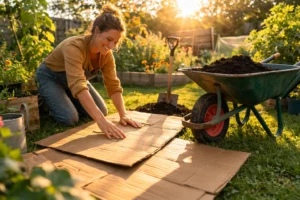
Lay flat cardboard over the ground, wet it, and cover with 10 to 15cm of compost.
This is the no dig method and it works brilliantly for beginners.
Quick Soil Check Before You Plant in Your Beginner Vegetable Garden
Grab a handful of your soil and squeeze it.
Good vegetable garden soil should hold its shape briefly and then crumble apart easily when you open your hand.
If it stays in a solid lump it has too much clay and needs more compost.
If it falls apart in dry dusty pieces it is too sandy and also needs compost. Compost fixes both problems every time.
Step 4: Best Vegetables to Grow in a Beginner Vegetable Garden
If we had to give one piece of advice to every person starting a vegetable garden for beginners, it would be this: choose crops that grow fast and reward you often.
Slow crops with long growing times are a motivation killer in year one. Stick to fast growers that give you something to check, pick, and eat every few days.
Top Crops for a Beginner Vegetable Garden
| Vegetable | Days to Harvest | Why It Works for Beginners |
| Radishes | 21 to 30 days | Fastest result in any vegetable garden. Hard to get wrong and very satisfying to pull. |
| Lettuce | 21 to 45 days | Pick leaves as they grow. One planting gives you weeks of fresh salad. |
| Spinach | 20 to 50 days | Baby leaves ready fast. Grows back quickly after you pick it. |
| Green beans | 50 to 60 days | Very productive. Bush varieties need no staking and no fuss. |
| Cherry tomatoes | 55 to 70 days | The most exciting crop. Watch fruits change colour and pick daily in summer. |
| Courgette | 45 to 60 days | One plant produces all summer. Check it every two days or it turns into a marrow. |
| Cucumbers | 50 to 65 days | Grows fast in warm weather. Very productive once it gets going. |
| Herbs | 30 to 45 days | Useful in the kitchen, easy to grow, and thrive in small beginner vegetable garden spaces. |
Crops Worth Avoiding in Your First Vegetable Garden for Beginners
- Sweetcorn needs a large open space and several plants close together to pollinate properly. Leave it for year two.
- Cauliflower and celery are fussy about conditions and harder to grow well than most guides admit.
- Pumpkins and large squash take up an enormous amount of space for a single harvest at the end of the season.
- Asparagus takes two to three years before it produces anything. Not a first season crop for any beginner.
Step 5: When to Plant in a Beginner Vegetable Garden
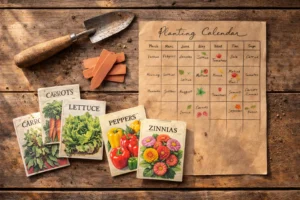
Timing is everything in a vegetable garden for beginners.
Plant too early and a late frost kills your seedlings overnight.
Plant too late and your crops may not have enough warm weeks to ripen before autumn.
The key rule is simple. Cool-season crops like lettuce, spinach, peas, and radishes go in early spring.
Warm-season crops like tomatoes, beans, cucumbers, and courgette must wait until after your last frost date.
The Old Farmer’s Almanac frost date tool lets you enter your location and find your exact last spring frost date.
This is the most important date in any beginner vegetable garden calendar.
Planting Times for a Beginner Vegetable Garden — US and UK
| Crop Type | When to Plant |
| Cool-season crops — lettuce, spinach, radishes, peas | US: March to April | UK: February to April |
| Warm-season crops — tomatoes, cucumbers, beans, courgette | US: After last frost May to June | UK: May to June outdoors |
| Autumn crops — kale, chard, winter salad | US: August to September | UK: July to September |
| Herbs — chives, parsley, mint, basil | US and UK: Spring through summer in most climates |
A good tip here — sow warm-season crops like tomatoes and cucumbers indoors on a sunny windowsill 6 to 8 weeks before your last frost date.
Then move them outside once the risk of frost has fully passed.
Step 6: How to Water Your Vegetable Garden for Beginners
More beginner vegetable gardens are lost to bad watering than any other single cause.
Either too much, too little, or watering at the wrong time of day.
The simple rule is this: water deeply and less often rather than a small amount every day.
\Deep watering encourages roots to grow down into the soil where they find moisture even on dry days.
Before every watering session, push your finger 2cm into the soil.
If it feels moist, leave it. If it feels dry, water slowly and thoroughly at the base of the plants.
Watering Tips Every Beginner Vegetable Garden Needs
- Water in the morning where possible. This gives plants moisture through the day and reduces fungal disease risk overnight.
- Water the soil, not the leaves. Wet foliage invites disease, especially on tomatoes and courgette.
- Young seedlings need more frequent checking than established plants. Check them every morning for the first two weeks.
- A good soaking twice a week is almost always better than a light sprinkle every single day.
If you want to take the guesswork out of watering completely, a simple drip irrigation timer costs around 20 pounds and delivers consistent water to your raised bed automatically.
Tools You Need to Start a Vegetable Garden for Beginners
You do not need a shed full of equipment.
In fact, starting with fewer tools is usually better — you learn what you actually need rather than buying things that never get used.
Here is the honest short list of what actually gets used every week in a beginner vegetable garden:
| Tool | Why You Actually Need It |
| Hand trowel | For planting seedlings and digging small holes in compost |
| Watering can or hose with gentle rose head | The most-used tool in any vegetable garden. Buy a good one. |
| Garden gloves | For planting, weeding, and harvesting without wrecking your hands |
| Garden fork or spade | For loosening soil and mixing compost into your bed before planting |
| Plant labels and waterproof marker | So you never lose track of what you planted and when |
| Kneeling pad | Optional but genuinely useful for long planting sessions close to the ground |
Common Mistakes in a First Vegetable Garden for Beginners
Every gardener makes mistakes in their first season.
Here are the ones I see most often — and exactly how to avoid them from the start.
| Common Mistake | What to Do Instead |
| Starting too big | Begin with a 4×4 foot bed. Add more space next year when you are ready. |
| Choosing a shady spot | Always check for at least 6 hours of direct sun before you plant anything. |
| Skipping soil preparation | Mix compost into your soil before planting. This single step changes everything. |
| Not labelling what you planted | Label every crop on the day you plant it with name and date. |
| Watering on a fixed daily schedule | Check the soil first every time. Only water when the top 2cm feels dry. |
| Planting too many different crops | Start with 3 to 4 crops. Add more in year two once you know what you enjoy growing. |
| Giving up after one failure | Every gardener loses plants. Plant something new and keep going. |
A Simple Weekly Routine to Keep Your Vegetable Garden Going
Horticulture experts at University of Maryland Extension highlight that the easier a garden is to see and access from the house, the more likely it will be visited regularly — and regular visits are the single most important habit in any beginner vegetable garden.
- Check soil moisture every morning. Water thoroughly only when the top 2cm feels dry.
- Pick any vegetables that are ready. Regular harvesting keeps plants producing more all season.
- Pull weeds when they are small. Five minutes once a week prevents hours of work later.
- Remove dead or yellowing leaves. This keeps air moving freely around your plants.
- Give plants a liquid feed every two weeks once crops start forming.
Do not try to do everything in one session.
Ten minutes every day is worth far more than two hours once a week.
Your Vegetable Garden for Beginners Starts Today
You now know exactly how to start a vegetable garden for beginners from the very first step all the way through to your first harvest.
Find your sunniest spot. Start small. Add compost to your soil.
Choose fast easy crops. Plant at the right time. Water when the soil is dry.
That is the whole plan. And it works every single time you follow it.
Find the sunniest patch in your garden or on your balcony.
Measure a 4×4 foot area or find two large pots. Order one bag of compost and three seed packets — radishes, lettuce, and cherry tomatoes.
That is your first vegetable garden for beginners ready to grow.
FAQs
| Q: How do I start a vegetable garden for beginners with no experience at all?
A: Start with a small sunny spot — even a large pot on a balcony works perfectly well. Fill it with good quality compost, push in three radish seeds, water it, and put it somewhere that gets at least 6 hours of sun each day. That is all it takes to get going. Radishes are ready in 21 to 30 days, they are almost impossible to kill, and pulling your first homegrown vegetable from the soil is one of the best feelings gardening has to offer. Once you have done it once, everything else feels possible. |
| Q: What is the best size for a beginner vegetable garden?
A: Start with a 4×4 foot raised bed or two to three large containers. University of Maryland Extension recommends 50 to 75 square feet as the ideal starter size — large enough to grow a good variety of crops but small enough to manage comfortably in 10 minutes a day. A small well-kept vegetable garden for beginners produces more food and more joy than a large neglected one every single time. |
| Q: What are the easiest vegetables to grow for beginners?
A: Radishes are the single easiest crop for any beginner vegetable garden — ready in 21 to 30 days and almost impossible to get wrong. After radishes, loose leaf lettuce is the next best step because you can start picking outer leaves in under three weeks. Cherry tomatoes, green beans, courgette, and spinach all round out a brilliant beginner crop list that gives you something to pick almost every day from early summer through to autumn. |
| Q: How much sun does a beginner vegetable garden need?
A: Most vegetables need at least 6 to 8 hours of direct sunlight every day. Fruit-producing crops like tomatoes, cucumbers, and courgette do best with closer to 10 hours. Leafy greens like lettuce and spinach can manage on 5 to 6 hours. The sunniest open spot available to you is always the right location for a vegetable garden for beginners. If your space is heavily shaded, containers on a sunny patio or balcony are a perfectly good alternative. |
| Q: Can I start a vegetable garden for beginners in pots and containers?
A: Yes, absolutely. Lettuce, radishes, cherry tomatoes, herbs, spring onions, spinach, and cucumbers all grow brilliantly in large containers. The key is choosing pots at least 30cm wide and deep, filling them with quality compost rather than garden soil, and placing them somewhere that gets strong direct sunlight. Container growing is actually ideal for a beginner vegetable garden because each pot is its own small contained project — easy to water, easy to check, and easy to manage even in a very small outdoor space. |