The single most important thing you can do before planting a vegetable garden is prepare your soil properly.
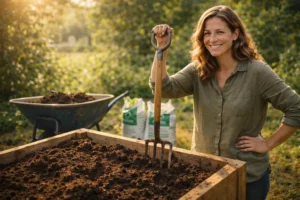
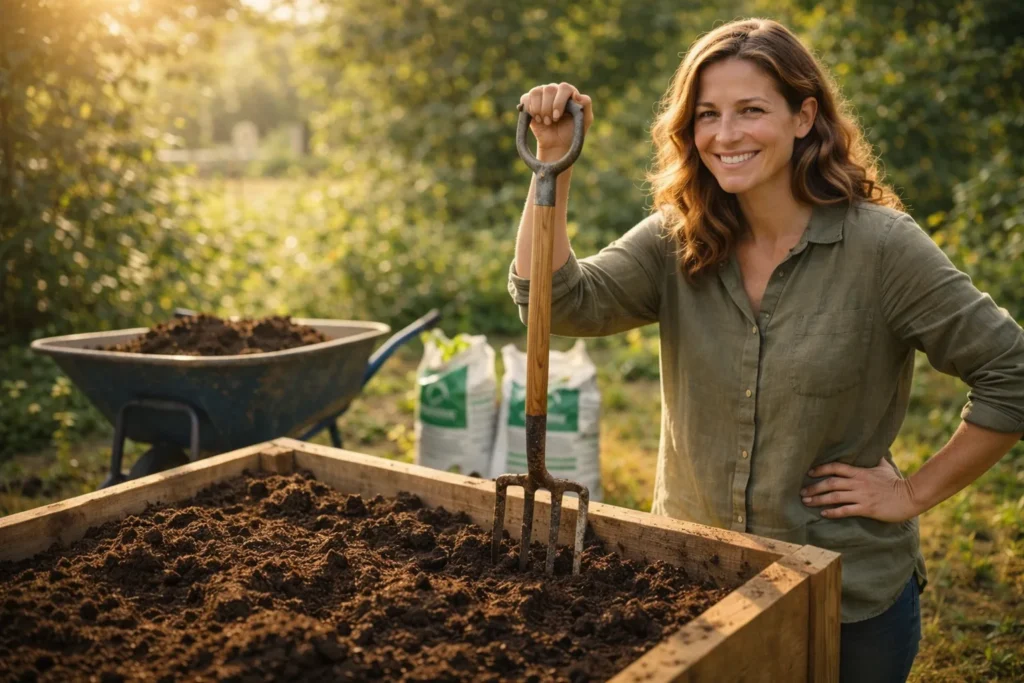
For a new in-ground bed, add 3 to 4 inches of compost and mix it into the top 8 to 12 inches of soil.
For a raised bed, fill with 40% compost, 40% topsoil, and 20% perlite or vermiculite.
Get this right and your vegetables grow faster, produce more, and need far less attention through the whole season.
What Is Soil Preparation for a Vegetable Garden?
Soil preparation is the process of improving your growing ground before you plant anything into it.
It involves clearing weeds, loosening compacted soil, and adding compost and organic matter to create the right conditions for roots to grow deep and strong.
Well-prepared vegetable garden soil drains properly after rain, holds moisture during dry spells, and delivers the nutrients vegetables need from seedling right through to harvest.
You only need to do a full preparation once for a new bed. After that, a simple annual top-dress of compost keeps the soil in great shape year after year.
| Key Facts About Preparing Soil for a Vegetable Garden
For new vegetable beds, add 3 to 4 inches of compost and mix it into the top 8 to 12 inches of soil. (OSU Extension) The ideal soil pH for most vegetables is between 6.2 and 6.8. (University of Maryland Extension) Compost-enriched soil holds up to 20% more moisture than unprepared soil during dry weather. (USDA) The best raised bed soil mix is 40% compost, 40% topsoil, and 20% perlite or vermiculite. (Homegrown Garden) Adding organic matter improves drainage in clay and moisture retention in sandy soils at the same time. (The Old Farmer’s Almanac) |
| Quick Summary — How to Prepare Soil for a Vegetable Garden
New in-ground bed: Add 3 to 4 inches of compost and mix into the top 8 to 12 inches. New raised bed: Fill with 40% compost, 40% topsoil, and 20% perlite or vermiculite. Existing bed: Top-dress with 1 to 2 inches of fresh compost each spring. Target soil pH: 6.2 to 6.8 for most vegetables. Squeeze test: Good vegetable garden soil holds shape briefly then crumbles apart cleanly in your hand. |
Why Preparing Soil Makes or Breaks a Vegetable Garden
I have seen it happen more times than we can count.
Someone plants a beautiful raised bed, gives it full sun, waters it carefully — and the vegetables just sit there yellow and struggling.
Nine times out of ten the problem is the soil.
Either it was never properly prepared or the wrong mix was used from the very start.
Vegetables are heavy feeders.
They pull nutrients, moisture, and oxygen from the soil constantly throughout the growing season.
If the soil cannot supply what they need, no amount of sunshine or water will make up for it.
Experts put it clearly: fertile soil is the key to lush plants and productive harvests.
The three nutrients every vegetable garden soil needs are nitrogen for leaf growth, phosphorus for roots and flowers, and potassium for disease resistance and flavour.
Get those three things right through proper soil preparation and your vegetable garden will practically take care of itself.
| Worth Knowing: The Compost Moisture Advantage
Compost-enriched soil holds up to 20% more moisture than unprepared ground according to USDA research. In a dry summer that difference means the gap between a thriving vegetable garden and one that struggles through every dry week. |
What Good Vegetable Garden Soil Looks Like
Before you prepare soil for a vegetable garden you need to know what you are aiming for.
Good vegetable garden soil is dark in colour, has a rich earthy smell, crumbles easily in your hand, and is full of visible worm activity.
It drains freely after heavy rain but holds enough moisture to feed plants between waterings.
The gold standard soil type for any vegetable garden is called loam — a natural balance of clay, sand, and silt particles that holds nutrients and moisture while still draining freely after rain.
The Squeeze Test Every Beginner Needs Before Preparing Vegetable Garden Soil
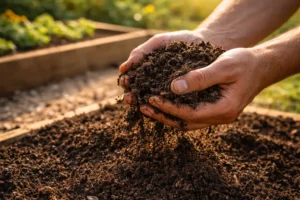
Pick up a handful of your soil and squeeze it firmly in your fist for a few seconds.
Then open your hand and watch what happens.
- Holds shape briefly then crumbles apart cleanly — your soil is already in good condition for a vegetable garden.
- Stays in a hard solid lump that does not break apart — clay-heavy soil that needs organic matter added.
- Falls apart immediately in dry dusty pieces — sandy soil that also needs compost to bind it together.
Here is the reassuring part: both clay and sandy soil are fixed the same way.
Add compost. Organic matter improves every soil type it touches.
How to Test Your Soil Before Preparing a Vegetable Garden
A basic soil test is one of the best things a beginner can do before they prepare soil for a vegetable garden.
It tells you the soil pH — how acidic or alkaline it is — and whether it is short on any of the key nutrients your vegetables need to thrive.
Soil scientists at University of Maryland Extension recommend testing soil pH before planting.
The ideal range for most annual vegetables is 6.2 to 6.8.
Simple home pH test kits are available at any garden centre for a few pounds and give a reliable enough reading for any beginner vegetable garden.
How to Adjust Soil pH in a Vegetable Garden
- Too acidic — pH below 6.0: Add garden lime to raise the pH. Spread evenly and mix into the top layer a few weeks before planting.
- Too alkaline — pH above 7.0: Add garden sulphur to lower the pH. Work it in before planting.
- Most raised beds filled with quality compost naturally sit within the correct pH range without any adjustment needed at all.
The Best Soil Mix to Prepare a Raised Bed Vegetable Garden
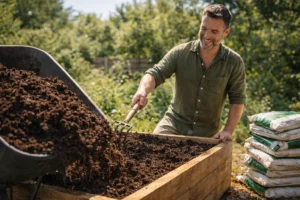
If you are preparing soil for a raised bed vegetable garden you have a real advantage over in-ground growers.
You start completely fresh and get to choose exactly what goes into your bed.
Get the mix right and you will have the best possible growing conditions from the very first day you plant.
Proven Soil Mix for a Raised Bed Vegetable Garden
| Ingredient | Amount and Purpose |
| High quality compost | 40% of the total volume — adds nutrients, improves drainage, feeds soil life |
| Screened topsoil | 40% of the total volume — gives structure and body to the mix |
| Perlite or vermiculite | 20% of the total volume — improves aeration and prevents compaction |
| Optional: slow release organic fertiliser | Mix into the top 4 inches at planting for an extra nutritional boost |
This is the raised bed premium mix used by experienced growers across the US and UK.
It balances drainage, moisture retention, and long-term fertility from the very first season.
Alternative Mix for Deep Raised Bed Vegetable Gardens
For raised beds deeper than 40cm, University of Maryland Extension recommends a 1:1 ratio of compost and soilless growing mix, with topsoil making up around 20% of the total volume.
This lighter mix allows roots to grow deep without resistance and works especially well for tomatoes, cucumbers, and squash that send roots down a long way.
| Never Do This in a Raised Bed
Never fill a raised bed vegetable garden with straight garden soil from the ground. It compacts heavily in a contained bed, drains poorly, and brings weed seeds straight into your clean growing space. Always use a mixed compost-based blend. |
How to Prepare Soil in an In-Ground Vegetable Garden
Preparing soil in an in-ground vegetable garden takes a little more effort than filling a raised bed but the results are just as good and the cost is considerably lower.
The key is to loosen the existing ground, clear weeds, and add enough compost to transform even average garden soil into productive vegetable growing ground.
Step by Step: How to Prepare In-Ground Vegetable Garden Soil
- Mark out your bed and remove all visible weeds, grass, and debris from the area.
- Use a garden fork to loosen the top 20 to 30cm of soil across the whole bed.
- Spread a 3 to 4 inch layer of good quality compost across the entire surface.
- Mix the compost thoroughly into the loosened soil using the garden fork.
- Add a balanced slow-release organic fertiliser and work it into the top 10cm.
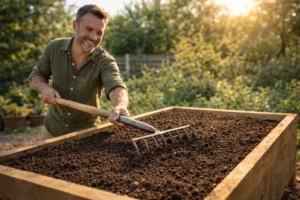
- Rake the surface smooth and level. Leave the bed to settle for one to two weeks.
- Water the prepared vegetable garden soil the day before planting to activate soil life.
Specialists confirm this approach: spread compost to the recommended depth, add any amendments your soil test indicates, then incorporate everything into the top 8 to 12 inches using a digging fork or spade.
How to Fix Clay and Sandy Soil in a Vegetable Garden
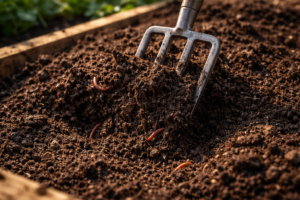
Two of the most common soil problems in any vegetable garden are clay-heavy soil that waterloggs after rain and sandy soil that drains so fast it leaves plants permanently hungry and thirsty.
Both are fixed the same way. And both improve steadily over two or three seasons of consistent organic matter additions.
How to Fix Clay Soil When You Prepare a Vegetable Garden
Clay soil is actually very nutrient-rich. The problem is the structure — fine particles stick together, block drainage, and make it very hard for roots to push through.
- Add large amounts of compost and work it thoroughly into the top 20 to 30cm of soil.
- Never add sand to clay soil. The combination creates a concrete-like mixture that makes drainage even worse.
- Consider building a raised bed if your clay is very heavy — it avoids the problem entirely and gives you full soil control from day one.
- Repeat compost additions every season. Clay soil improves steadily over two to three years of consistent care.
How to Fix Sandy Soil When You Prepare a Vegetable Garden
Sandy soil drains too fast, losing both moisture and nutrients before plant roots can reach them.
- Add generous amounts of compost to bind sandy particles together and hold more moisture.
- Coconut coir can also be added to improve water-holding ability in very sandy soils.
- Mulch the surface after planting to slow evaporation between waterings.
- Like clay soil, sandy soil improves steadily with regular compost additions over time.
| The One Universal Soil Fix for Any Vegetable Garden
Compost improves every soil type without exception. It adds nutrients to poor soil, improves drainage in clay, adds moisture retention to sand, and feeds the worms and microbes that keep your vegetable garden soil healthy year after year. If you only do one thing to prepare your soil — make it compost. |
How to Prepare Soil for a Vegetable Garden Without Digging
If the idea of heavy digging puts you off, the no dig method lets you prepare vegetable garden soil without turning a single spade of earth.
It works brilliantly on grass, weedy ground, and compacted soil — and it actually produces better long-term results than digging in most cases because it leaves soil structure and worm channels completely undisturbed.
The No Dig Method for Preparing Vegetable Garden Soil
- Lay flat cardboard directly over the area where your vegetable garden will be. Wet it thoroughly.
- Overlap the cardboard edges by at least 15cm so weeds cannot push up through the gaps.
- Spread a 10 to 15cm layer of high quality compost directly on top of the wet cardboard.
- Leave it for two to four weeks if time allows. The cardboard smothers weeds and begins to break down.
- Plant directly into the compost layer. Roots push through the softening cardboard into the improving soil below.
Each following year, simply add 1 to 2 inches of fresh compost on top of the existing bed.
No digging needed. Worms pull the compost down through the layers and improve the soil structure naturally over time.
Seasonal Soil Preparation Guide for a Vegetable Garden
| Season | What to Do With Your Vegetable Garden Soil |
| Autumn — after harvest | Clear finished crops. Spread a 2 to 3 inch compost layer across the whole bed. Leave over winter. |
| Late winter or early spring | Test pH if needed. Adjust with lime or sulphur. Rake the surface smooth. |
| Spring — two weeks before planting | Add a slow-release organic fertiliser. Water the bed to activate soil life. Leave to settle. |
| During the growing season | Top-dress around plants with a thin compost layer every 4 to 6 weeks. |
| After each crop is harvested | Add a handful of compost to the hole before the next crop goes in. |
Common Soil Preparation Mistakes in a Vegetable Garden
| Mistake | How to Fix It |
| Using straight garden soil in a raised bed | Replace with the proper 40/40/20 compost, topsoil, and perlite mix |
| Not adding compost before planting | Add 3 to 4 inches of compost and mix into the top 20 to 30cm before next planting |
| Working wet soil in spring | Wait until a squeezed handful crumbles cleanly before digging or planting |
| Walking on and compacting the bed | Work from outside the bed only. Never step inside the growing area |
| Ignoring soil pH | A test kit costs a few pounds and removes all guesswork from soil preparation |
| Adding too much compost at once | Keep additions to 4 inches maximum at a time — about 25% of the total soil blend |
| Key Takeaways — How to Prepare Soil for a Vegetable Garden
1. New in-ground bed: Add 3 to 4 inches of compost and mix into the top 8 to 12 inches of soil. 2. New raised bed: Fill with 40% compost, 40% topsoil, and 20% perlite or vermiculite. 3. Target soil pH: 6.2 to 6.8 for most vegetables. 4. Compost is the one universal fix for both clay and sandy soil. 5. Refresh every bed each spring with 1 to 2 inches of fresh compost on top. 6. Good soil preparation is the single biggest investment you make in your vegetable garden — and it pays back every season. |
Your Vegetable Garden Soil Is Ready — What Comes Next
You now know exactly how to prepare soil for a vegetable garden from scratch — whether you are building a new raised bed, improving an in-ground plot, or starting no dig on a patch of lawn.
The time you put into your soil before planting is the investment that pays back through every crop, every season, for as long as you grow.
Prepare it well once. Refresh it simply every spring. Your vegetable garden soil will only get better and more productive year after year.
Order one large bag of good quality compost.
Spread it across your vegetable garden bed and mix it into the top layer before you plant anything.
That single step makes more difference to your harvest than almost anything else you can do.
| Up Next in This Series
Now that your soil is prepared and ready to grow, the next article covers the best layout ideas for a beginner vegetable garden — how to arrange your beds, make the most of a small space, and plan a productive plot from the very start. Read next: Vegetable Garden Layout Ideas for Small Spaces. |
Frequently Asked Questions
| Q: How do I prepare soil for a vegetable garden as a complete beginner?
A: Clear the area of weeds and debris. Use a garden fork to loosen the top 20 to 30cm of soil. Spread 3 to 4 inches of good quality compost across the surface and mix it in thoroughly. Rake the bed level and leave it to settle for one to two weeks before planting. For a raised bed, fill with 40% compost, 40% topsoil, and 20% perlite. OSU Extension confirms this approach gives new vegetable garden beds the nutrients, drainage, and structure they need from the very first planting. |
| Q: What is the best soil mix for a raised bed vegetable garden?
A: The best soil mix for a raised bed vegetable garden is 40% high quality compost, 40% screened topsoil, and 20% perlite or vermiculite. This mix drains well, holds enough moisture, and delivers the nutrients vegetables need throughout the season. Never fill a raised bed with straight garden soil — it compacts in a contained space and drains very poorly. For deep beds over 40cm, University of Maryland Extension recommends a 1:1 compost to soilless growing mix ratio with topsoil added up to 20% of total volume. |
| Q: What soil pH does a vegetable garden need?
A: Most vegetable gardens need a soil pH between 6.2 and 6.8. This slightly acidic to neutral range makes nutrients most available to plant roots. Test your soil with a simple kit from any garden centre before you plant. If pH is below 6.0 add garden lime to raise it. If it is above 7.0 add garden sulphur to lower it. Raised beds filled with quality compost usually fall naturally within the correct range without any adjustment needed. |
| Q: How often should I add compost to my vegetable garden soil?
A: Add 3 to 4 inches of compost to new vegetable garden beds before the first planting. For established beds, top-dress with 1 to 2 inches of fresh compost each spring. OSU Extension also recommends adding a small handful of compost to each planting hole when you put in new crops during the season. For existing no dig beds, you do not need to dig the compost in — worms and soil life pull it down naturally over time. |
| Q: Can I prepare vegetable garden soil without digging?
A: Yes. The no dig method is one of the best ways to prepare vegetable garden soil with almost no effort. Lay flat cardboard over the existing ground, wet it thoroughly, and spread 10 to 15cm of compost on top. Leave for two to four weeks then plant directly into the compost layer. Add 1 to 2 inches of fresh compost to the surface each spring to refresh it. No digging is ever needed. Worms do all the soil improvement work naturally underneath. |