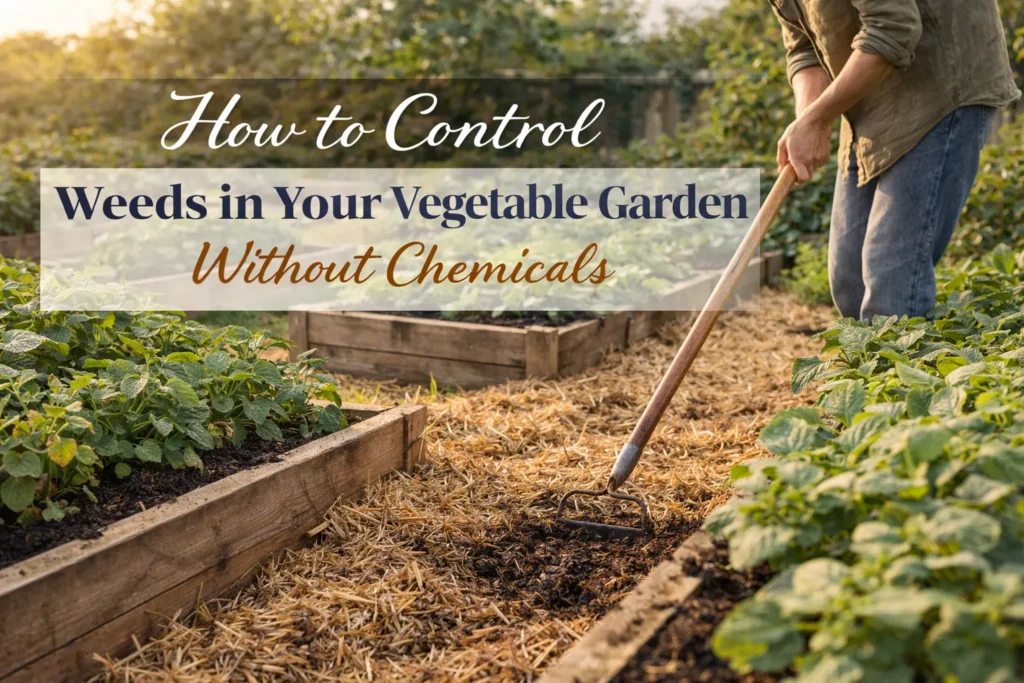
The most effective way on how to control weeds in a vegetable garden is to combine mulching with regular shallow hoeing — suppressing new weed seeds before they germinate and removing any that do appear before they get big enough to cause serious problems.
The honest truth about weeds is this: you will never eliminate them completely.
But you can reduce them to the point where they take up five minutes of your week rather than an entire afternoon.
This guide covers seven proven methods for controlling weeds in a vegetable garden — from the simple and free to the slightly more involved — with honest advice on which ones work best and when to use them.
What Are Weeds in a Vegetable Garden?
A weed is any plant growing where you do not want it to grow.
In a vegetable garden, weeds compete directly with your crops for water, nutrients, sunlight, and growing space.
They grow fast, seed prolifically, and — if left unchecked — can overwhelm young vegetable seedlings within a few weeks.
Annual weeds complete their life cycle in one season and spread by seed.
Perennial weeds come back from their roots year after year and are significantly harder to remove permanently.
The most common vegetable garden weeds include chickweed, bindweed, dandelion, annual meadow grass, hairy bittercress, and couch grass.
KEY FACTS — Controlling Weeds in a Vegetable Garden
Weeds compete with vegetables for water, nutrients, and light — and also provide a hiding place for pests and disease. (Clemson Extension)
Eliminating weeds in the first four weeks of growth stops them from setting seed and multiplying your weed problem for years ahead. (The Old Farmer’s Almanac)
A single annual weed like chickweed can produce up to 15,000 seeds before it dies — each one capable of lying dormant in the soil for years. (Iowa State University Extension)
A 2 to 3 inch layer of organic mulch is one of the most effective and lowest-effort ways to control weeds in a vegetable garden. (Clemson Extension)
Disturbing the soil by deep digging or rototilling brings dormant weed seeds to the surface where they germinate within days. (University of Georgia CAES Extension)
How to Control Weeds in a Vegetable Garden
Best prevention: Lay 2 to 3 inches of organic mulch across every bare patch of soil in your vegetable garden.
Best active control: Hoe shallowly once a week when weeds are tiny. Five minutes with a stirrup hoe beats an hour of hand pulling every time.
Best for new beds: Cardboard or newspaper layered under mulch smothers existing weeds without any digging.
Best long term: The no dig method — never disturb the soil surface and top-dress with compost each year instead.
Golden rule: Never let a weed flower and set seed. One weed going to seed creates thousands of future problems.
Why Weeds in a Vegetable Garden Are Such a Serious Problem
Weeds are not just untidy. In a vegetable garden they are active competitors that take resources directly from your crops.
A weed growing beside a young lettuce seedling is not sharing the space — it is taking the water, the nutrients, and the sunlight that your lettuce needs to grow.
In the first weeks after planting, when vegetable seedlings are at their most vulnerable, weeds can genuinely determine whether a crop succeeds or fails.
They also create problems that go beyond the plants they are growing next to. Weeds provide shelter for slugs, aphids, and other pests.
They can harbour fungal diseases.
And if you allow any of them to flower and set seed, you are creating a weed problem that will get worse every single year rather than better.
Horticulture specialists at Clemson Extension are clear on this point: weeds compete with vegetables for water, nutrients, and light — and they also harbour insects and diseases which may then spread to your vegetable crops.
Dealing with weeds early in the season significantly reduces the time and effort required later on.
The good news is that once you have a vegetable garden established and properly mulched, the weed problem reduces dramatically year on year.
The first season is always the hardest.
WORTH KNOWING
The Old Farmer’s Almanac confirms that eliminating weeds in the first four weeks of their growth stops them from setting seed and creating a much larger weed problem for years ahead.
Acting early and acting small is always more effective than waiting until weeds are large and established.
The Golden Rule of Weed Control in a Vegetable Garden
Everything about controlling weeds in a vegetable garden comes back to one rule: deal with them when they are small.
A weed that is two centimetres tall takes two seconds to remove.
A weed that is thirty centimetres tall and has started to set seed takes ten minutes and leaves behind thousands of future problems in your soil.
Five minutes in your vegetable garden every day or every other day — scanning for new weeds and removing them immediately — is worth more than an hour of intensive weeding once a fortnight.
Consistency beats effort every single time.
When Is the Best Time to Weed a Vegetable Garden?
- Weed after rain when the soil is damp. Wet soil releases roots far more easily than dry compacted ground.
- Weed in the morning. The day ahead allows pulled weeds to dry out and die on the surface rather than re-rooting in overnight moisture.
- Weed before any weed flowers or sets a seed head. This is the single most important timing decision in vegetable garden weed control.
- Weed before planting day. A weed-free bed at planting gives your seedlings the best possible start without competition.
Method 1 — Mulching to Suppress Weeds in a Vegetable Garden
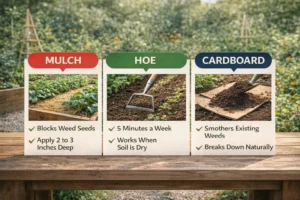
Mulching is the single most effective and lowest-effort method of weed control in any vegetable garden.
A layer of mulch blocks the sunlight that weed seeds need to germinate — and most weed seeds that cannot reach light simply never sprout.
Apply a 2 to 3 inch layer of organic mulch across all the bare soil between your vegetable plants.
Keep it a few inches away from the base of each stem to avoid rot and slug shelter at ground level.
Best Mulch Types for Weed Control in a Vegetable Garden
| Mulch Type | How Well It Controls Weeds in a Vegetable Garden |
| Straw or seedless hay | Excellent. Light, easy to apply, suppresses most annual weeds. Breaks down over winter. |
| Shredded autumn leaves | Very good. Free if you have trees. Shred finely for best coverage and weed suppression. |
| Wood chips | Excellent for pathways between beds. Too heavy for use directly around seedlings. |
| Grass clippings | Good in thin layers. Thick layers mat together and can prevent water penetrating to roots. |
| Compost as mulch | Good weed suppression and feeds the soil at the same time. Best all-round mulch choice. |
| Cardboard under straw | Outstanding for new beds or heavily weeded areas. Completely smothers existing weeds. |
One important tip — do not use grass clippings from a lawn that has been treated with a broadleaf herbicide like 2,4-D.
Tomatoes, peppers, and most other vegetables are very sensitive to this chemical and can absorb harmful residues from treated clippings.
WORTH KNOWING
Clemson Extension confirms that mulch is often the easiest and most effective way to control annual weeds in a vegetable garden.
Mulch works by preventing sunlight from reaching the soil surface — and since light is required for the germination of most weed seeds, cutting off that light source stops most weeds before they even begin.
Method 2 — Hoeing to Control Weeds in a Vegetable Garden Quickly
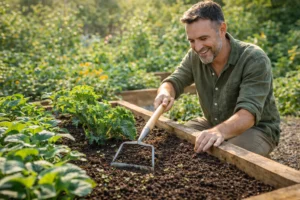
A sharp hoe used correctly is the fastest and most satisfying weed control tool in any vegetable garden.
Five minutes of shallow hoeing once a week keeps most annual weeds completely under control with almost no physical effort.
The technique is important. You are not digging — you are slicing.
Draw the hoe blade just below the soil surface, cutting weed stems from their roots.
The disturbed weeds dry out and die on the surface within hours on a dry day.
How to Hoe Weeds in a Vegetable Garden Correctly
- Use a sharp hoe. A blunt blade pushes weeds rather than cutting them. Sharpen your hoe at the start of each season.
- Work when the soil is dry if possible. Weeds cut on a dry sunny day die on the surface within hours. Weeds cut on wet soil can re-root overnight.
- Keep the blade shallow — no deeper than 2 to 3cm below the surface. Deep hoeing brings buried weed seeds up to where they can germinate.
- Hoe in the morning. The day’s sun and wind dries the cut weeds quickly and cleanly.
- Work backwards so you are always stepping onto unweeded ground. This way you never walk over freshly cut weeds and accidentally press them back into the soil.
Best Hoe Types for Weed Control in a Vegetable Garden
| Hoe Type | Best Use in a Vegetable Garden |
| Stirrup hoe — also called oscillating hoe | Cuts on both push and pull stroke. Fastest and most efficient for weeding between rows. |
| Dutch hoe | Good for open areas. Pushes soil forward to cut weeds just below the surface. |
| Hand hoe — short handled | Best for working close to plants where a long handle would cause damage. |
| Draw hoe | Good for earthing up potatoes and making planting furrows as well as weeding. |
The stirrup hoe is our honest recommendation for any beginner vegetable garden.
The back and forth cutting action on both strokes means you cover ground twice as fast with half the effort of a standard hoe.
Method 3 — Hand Pulling Weeds in a Vegetable Garden
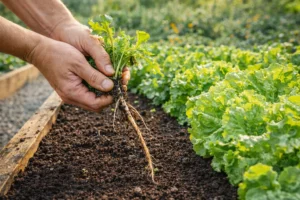
Hand pulling is the most precise method of weed control in a vegetable garden and the best choice for removing weeds growing close to your vegetable plants where a hoe would cause damage.
The key is to remove the whole root.
Many common weeds — especially perennial ones like dandelion and bindweed — will regrow from even a small fragment of root left in the soil.
How to Hand Pull Weeds in a Vegetable Garden Properly
- Pull when the soil is damp. Roots release far more cleanly from wet soil than from dry compacted ground.
- Grip the weed at the very base of the stem as close to the soil as possible and pull slowly and steadily.
- Twist gently as you pull to help dislodge deep roots without snapping them off below the surface.
- Use a hand fork or trowel to loosen deep-rooted perennial weeds before pulling. Never yank at a deep root — you will just snap it.
- Remove pulled weeds from the bed completely. Left on the surface in wet weather, many weeds can re-root within a day.
- Do not compost weeds that have already flowered or set seed. Bin them or let them dry completely in the sun first.
Method 4 — Cardboard and Newspaper to Control Weeds in a Vegetable Garden
Cardboard and newspaper are two of the most effective and completely free weed control tools available to any beginner vegetable garden grower.
Laid directly on the soil surface and covered with mulch or compost, they block all light from reaching weed seeds below — smothering existing weeds and preventing new ones from germinating for weeks or months.
How to Use Cardboard for Weed Control in a Vegetable Garden
- Collect plain brown cardboard boxes. Remove all tape, staples, and any glossy printed sections.
- Lay the cardboard directly on the bare soil between your vegetable beds or over a new bed area.
- Overlap all edges by at least 15cm. Any gap lets light through and gives weeds a way up.
- Wet the cardboard thoroughly. This helps it conform to the soil surface and begins breaking down.
- Cover with 3 to 5 inches of straw, wood chips, or compost. This holds the cardboard down and adds a second layer of weed suppression.
- Plant through the cardboard by cutting small holes or X shapes at planting points.
Cardboard breaks down naturally over 3 to 6 months, improving the soil below as it decomposes.
It is the backbone of the no dig method and one of the most powerful weed control tools any beginner can use from day one.
Method 5 — Landscape Fabric in a Vegetable Garden
Landscape fabric — also called weed control fabric or weed membrane — is a permeable textile laid over the soil to block weed growth while still allowing water and air to pass through.
It works well for permanent pathways between raised beds and for areas where you plant transplants rather than direct sowing seeds.
It is less useful in beds where you sow crops directly into the ground because the fabric prevents that.
University of Georgia CAES Extension note that landscape fabric can last anywhere from one to multiple seasons depending on quality — and lasts significantly longer when it is removed at the end of the season, folded, and stored away from direct sunlight.
Tips for Using Landscape Fabric to Control Weeds in a Vegetable Garden
- Use quality fabric — cheap thin fabric tears within one season and lets weeds through within months.
- Pin the edges down firmly with landscape staples. Wind gets under loose edges and lifts the whole sheet.
- Cut X shapes rather than round holes for planting. X shapes lie flat and close around the plant stem better.
- Cover fabric with a light layer of mulch or gravel in pathways. Uncovered fabric degrades faster in UV light.
- Check under the fabric regularly. Some persistent weeds push up through the planting holes and need removing by hand.
Method 6 — The No Dig Method for Long Term Weed Control in a Vegetable Garden
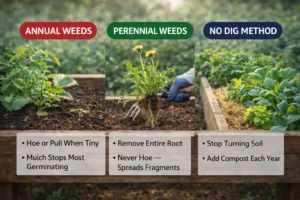
The no dig method is the single most effective long-term strategy for reducing weeds in a vegetable garden — and it requires less physical effort than any other approach.
The principle is simple.
Every time you dig or till the soil you bring dormant weed seeds from deep underground up to the surface where they get the light and moisture they need to germinate.
Stop digging and you stop feeding the weed seed bank with fresh opportunities to grow.
Instead of digging, add a 1 to 2 inch layer of fresh compost on top of your beds each year.
Worms pull it down.
Soil life improves.
And weed pressure reduces steadily and significantly with each passing season.
WORTH KNOWING
University of Georgia CAES Extension confirms that after solarising a vegetable bed or applying a weed suppression method, gardeners should avoid re-tilling the area as doing so brings up viable weed seeds from below the treated zone — exactly the same principle that makes no dig such an effective long-term weed management strategy.
Method 7 — Dense Planting to Crowd Out Weeds in a Vegetable Garden
One of the simplest and most overlooked weed control methods in any vegetable garden is dense planting — spacing your crops close enough together that their leaves cover the soil surface as they grow, shading out weeds naturally.
Weeds need light to germinate and grow.
A canopy of vegetable leaves that closes over the soil by midsummer denies that light to any weed seeds waiting in the surface layer.
- Use square foot gardening spacing rather than traditional wide row spacing. Closer plants mean a faster closing canopy and less bare soil for weeds.
- Interplant fast-growing crops like lettuce and radishes between slower crops like courgette and tomatoes. The fast crops cover the soil while the slower ones grow to full size.
- Do not leave large patches of bare soil between plants. Any bare soil is an open invitation for weeds.
- In gaps between crops add a thick layer of mulch immediately after harvesting and before the next crop goes in.
Annual Weeds vs Perennial Weeds in a Vegetable Garden — Why It Matters
Not all weeds behave the same way and not all of them need the same response.
| Weed Type | How to Control It in a Vegetable Garden |
| Annual weeds — chickweed, hairy bittercress, annual meadow grass | Hoe or pull when tiny before they set seed. Mulching prevents most from germinating at all. |
| Biennial weeds — foxglove, hogweed | Remove in first year before they flower and set seed in their second year. |
| Perennial weeds — dandelion, bindweed, couch grass, dock | Must be removed root and all. Never hoe perennial weeds — hoeing spreads root fragments. |
| Weeds with seeds already set | Remove by hand and bin — never compost. Hoeing spreads ripe seeds across the bed. |
| Weeds in pathways | Cardboard, wood chips, or landscape fabric. Flame weeding also works well on pathways away from crops. |
The most important thing to know about perennial weeds is that you must remove the entire root system.
Dandelion, bindweed, and dock all regrow vigorously from even small root fragments.
Take your time, use a hand fork, and get every piece out of the ground.
| Key Takeaways — How to Control Weeds in a Vegetable Garden
1. Mulch every bare patch of soil with 2 to 3 inches of straw, wood chips, or compost. This is your best first line of defence. 2. Hoe shallowly once a week when weeds are tiny. A stirrup hoe used for five minutes beats an hour of hand pulling. 3. Never let a weed flower and set seed. One weed going to seed creates thousands of future problems. 4. Use cardboard under mulch for new beds or heavily weeded areas — it smothers existing weeds completely. 5. The no dig method reduces weed pressure steadily every season. Stop turning soil and stop bringing dormant seeds to the surface. 6. Annual weeds respond to hoeing and mulching. Perennial weeds must be removed root and all by hand. 7. Dense planting closes the leaf canopy over the soil and naturally shades out most annual weeds by midsummer. |
Control Weeds in Your Vegetable Garden and Take Back Your Time
You now know exactly how to control weeds in a vegetable garden — from the fastest active methods to the most effective long-term prevention strategies.
Mulch every bare patch of soil.
Hoe shallowly and often.
Deal with weeds when they are small.
Never let anything go to seed.
Use cardboard on new beds and switch to no dig as quickly as you can.
Follow those steps consistently and your vegetable garden weed problem will get smaller every single season — not bigger.
Walk your vegetable garden today and look for any weeds that are starting to flower or set seed.
Remove every single one immediately and bin them.
Then spread a fresh layer of straw or compost mulch over every patch of bare soil you can see.
That one action today saves hours of work over the rest of this season.
FAQs
Q: What is the best way to control weeds in a vegetable garden?
A: The best approach for controlling weeds in a vegetable garden is to combine two methods: lay 2 to 3 inches of organic mulch across all bare soil to prevent new weeds germinating, and hoe shallowly once a week to remove any that do appear while they are still tiny. Clemson Extension confirms that using a combination of methods together produces the best results. Mulch and a regular shallow hoe is the most practical and lowest-effort combination for most beginner vegetable gardens.
Q: How do I stop weeds growing in my vegetable garden without chemicals?
A: The most effective chemical-free ways to stop weeds in a vegetable garden are mulching with straw, wood chips, or compost to block light from weed seeds, using cardboard under mulch to smother existing weeds in new beds, hoeing shallowly every week before weeds grow large, and switching to the no dig method to stop bringing dormant weed seeds to the surface. University of Georgia CAES Extension confirms that preventing weeds from entering the garden in the first place is always easier than removing them once they are established.
Q: How often should I weed my vegetable garden?
A: A quick check every two to three days and a light hoeing once a week is ideal for most vegetable gardens during the growing season. Five minutes of shallow hoeing when weeds are at the seedling stage is worth far more than an hour of hard work once they are large and established. The frequency matters most in the first four to six weeks after planting when vegetable seedlings are at their most vulnerable to weed competition.
Q: Why do weeds keep coming back in my vegetable garden?
A: Weeds keep coming back in a vegetable garden for two main reasons. First, the soil contains a seed bank of dormant weed seeds that can remain viable for years — and every time you dig or till, you bring a fresh batch of those seeds to the surface where they germinate. Second, any weed that is allowed to flower and set seed adds thousands more seeds to that bank. Switching to the no dig method and preventing any weed from setting seed are the two most effective ways to reduce the weed problem year on year.
Q: Can I use landscape fabric to control weeds in my vegetable garden?
A: Yes — landscape fabric works well for controlling weeds in a vegetable garden, particularly in pathways between raised beds and in areas where you plant transplants rather than sowing seeds directly. University of Georgia CAES Extension notes that quality fabric can last multiple seasons if it is removed at the end of each season and stored away from direct sunlight. It is less useful in beds where you sow crops directly into the soil as the fabric prevents germination of both weeds and your vegetable seeds.