Every vegetable garden will have pests at some point. That is not a failure — it is just gardening.
The seven most common vegetable garden pests are aphids, slugs and snails, caterpillars, whitefly, spider mites, cutworms, and flea beetles.
Each one has clear signs to look for and straightforward organic methods to deal with it.
The key principle is always the same: check your plants regularly, catch problems early, and respond with the simplest effective method first before moving to anything more involved.
What Are Vegetable Garden Pests?
Vegetable garden pests are insects, molluscs, and other creatures that feed on your crops — damaging leaves, stems, roots, and fruit and reducing both the quality and quantity of your harvest.
Pests fall into two main groups: chewing pests like caterpillars and beetles that tear plant tissue and leave visible holes, and sucking pests like aphids, whitefly, and spider mites that pierce the plant and draw out sap, causing distorted or yellowing growth.
Not every insect in your vegetable garden is a pest.
Many — ladybirds, lacewings, ground beetles, hoverflies — are beneficial predators that actively hunt and eat the pests you want gone.
Preserving those beneficial insects is one of the most powerful pest management tools you have.
KEY FACTS — Vegetable Garden Pests
Inspect your vegetable garden at least twice a week during the growing season.
Catching pest problems at an early stage prevents much larger damage later. (Rutgers NJAES Extension)
The most effective long-term strategy against vegetable garden pests is crop rotation — moving plant families to different beds each year prevents pest populations from building up in one location. (Oklahoma State University Extension)
Healthy, well-fed plants grown in good soil are significantly more resistant to pest damage than stressed, nutrient-deficient plants. (Mississippi State University Extension)
Beneficial insects including ladybirds, lacewings, and parasitic wasps naturally control many of the most common vegetable garden pests — and unnecessary pesticide use destroys these beneficial populations. (Oklahoma State University Extension)
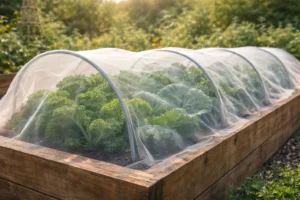
Row covers — fine mesh or fleece laid over crops — are the single most effective physical barrier against flying and crawling vegetable garden pests. (Savvy Gardening)
Common Vegetable Garden Pests at a Glance
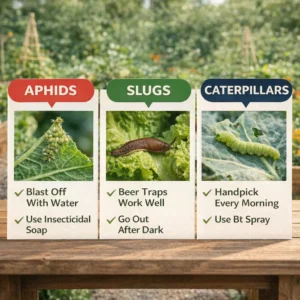
Aphids: Clusters of tiny soft-bodied insects on new growth and leaf undersides. Blast off with water or use insecticidal soap.
Slugs and snails: Irregular holes in leaves, slime trails visible at night. Use copper tape, beer traps, or grit barriers.
Caterpillars: Holes in leaves, frass visible on stems. Handpick or use Bacillus thuringiensis — spray.
Whitefly: Tiny white flying insects under leaves, sticky honeydew residue. Use yellow sticky traps and insecticidal soap.
Spider mites: Fine webbing on leaf undersides, yellowing mottled leaves. Increase humidity and spray with water or neem oil.
Cutworms: Young plants cut off cleanly at soil level overnight. Use cardboard collars around seedling stems.
Flea beetles: Tiny round holes in leaves of brassicas and leafy greens. Use row covers and sticky traps.
Why Every Vegetable Garden Will Have Pests
A vegetable garden is a concentrated source of exactly what insects and other creatures need — tender young leaves, sugary sap, ripening fruit, and moist sheltered soil.
Expecting no pests in a vegetable garden is like expecting no rain in a British summer.
It is not going to happen. What matters is not whether pests arrive but how quickly you spot them and how calmly and effectively you respond.
Entomologists at Mississippi State University Extension make an important and reassuring point: even though many different pest species can occur in a home vegetable garden, they do not usually all occur at the same time, and you do not have to spend the summer spraying for insects to grow a successful and productive crop.
Most pest problems in a beginner vegetable garden are small, manageable, and completely solvable with simple organic methods.
The gardeners who struggle most are usually those who either do not check regularly enough or who react with heavy-handed pesticide use that destroys the beneficial insects doing the work for them.
WORTH KNOWING
Oklahoma State University Extension confirms that biological control — the activity of beneficial predatory insects like ladybirds, lacewings, and spiders naturally hunting pest species — is the single most important pest control method in a home vegetable garden.
Supporting and preserving those beneficial insects is more effective than any spray.
How to Spot Vegetable Garden Pest Damage Early
The single most useful habit any vegetable garden grower can develop is checking their plants carefully at least twice a week throughout the growing season.
You are looking for changes — holes in leaves that were not there yesterday, wilting that does not recover after watering, discolouration that is spreading, or unusual sticky residue on leaves or stems.
| Sign of Damage | Likely Vegetable Garden Pest |
| Ragged irregular holes in leaves — especially at night | Slugs or snails — check for slime trails after dark |
| Clean round holes in brassica and leafy green leaves | Flea beetles — tiny dark jumping beetles |
| Leaves curling, yellowing, sticky residue present | Aphids — check leaf undersides and growing tips |
| Seedlings cut off cleanly at soil level overnight | Cutworms — check just below soil surface |
| Fine webbing on leaf undersides — leaves yellowing | Spider mites — most common in hot dry weather |
| Tiny white insects flying up when plant is disturbed | Whitefly — check leaf undersides for eggs and nymphs |
| Large irregular holes, frass visible on stems and leaves | Caterpillars — check under leaves and on stems |
Always check both the top and the underside of leaves.
Most sucking insects — aphids, whitefly, spider mites — congregate on the undersides where they are protected from rain and predators.
If you only ever look at the tops of leaves you will miss most infestations until they are already well established.
Vegetable Garden Pest 1: Aphids
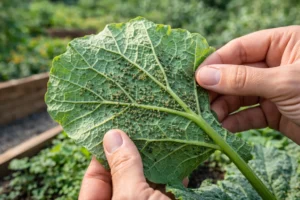
Aphids are the most common vegetable garden pest in the world and the one most beginner growers will encounter first.
They are tiny — 1 to 3mm long — soft-bodied insects that cluster in large numbers on the growing tips and leaf undersides of vegetables.
They suck plant sap, causing distorted curling growth, yellowing leaves, and a sticky residue called honeydew that attracts ants and encourages sooty mould.
How to Deal With Aphids in a Vegetable Garden
- Blast aphids off plants with a firm jet of water from a hose. Do this in the morning so the plants dry before nightfall.
- Squish small colonies by hand. It is unpleasant for about three seconds but completely effective on minor infestations.
- Apply insecticidal soap spray directly to the aphids. It must make contact to work — spray both sides of affected leaves.
- Encourage natural predators. Ladybirds, lacewings, and hoverfly larvae eat aphids voraciously. Plant marigolds and flowering herbs nearby to attract them.
- For persistent infestations use a neem oil spray applied in the evening to avoid harming pollinators.
| Aphid Warning
Never spray anything — including insecticidal soap or neem oil — on open flowers or in full sun during peak pollinator hours. Always spray in the early morning or evening and target only the affected areas rather than the whole plant. |
Vegetable Garden Pest 2 : Slugs and Snails
Slugs and snails are the number one pest complaint from beginner vegetable garden growers in the UK and across much of the northern US — and for good reason.
A single slug can eat an entire lettuce seedling overnight. They are most active after rain and after dark, leaving behind irregular ragged holes in leaves and the glistening slime trails that confirm their identity.
How to Deal With Slugs and Snails in a Vegetable Garden
- Go out after dark with a torch and handpick slugs from the soil surface and undersides of leaves. Drop them into a bucket of salty water.
- Apply a ring of grit, crushed eggshells, or sharp sand around vulnerable plants. Slugs dislike crossing rough abrasive surfaces.
- Use copper tape around raised bed edges and individual containers. Slugs receive a mild deterrent from the copper surface.
- Set beer traps — bury small containers with beer at soil level. Slugs are attracted to the yeast and drown. Empty and refill every two to three days.
- Apply organic slug pellets containing iron phosphate around vulnerable crops. These are safe for wildlife, pets, and children unlike traditional metaldehyde pellets.
- Encourage natural predators — hedgehogs, frogs, toads, and ground beetles all eat large numbers of slugs. A shallow wildlife pond nearby makes a real difference.
WORTH KNOWING
Slugs are most destructive in the first two to three weeks after planting — when seedlings are at their smallest and most vulnerable.
Protecting young plants through that critical window with physical barriers and regular evening checks dramatically reduces overall slug damage through the rest of the season.
Vegetable Garden Pest 3: Caterpillars and Cabbage White Butterfly
Caterpillars are the larvae of butterflies and moths and some of them cause serious damage to vegetable garden crops — particularly brassicas like cabbage, kale, broccoli, and Brussels sprouts.
The cabbage white butterfly is the most common offender in UK and US vegetable gardens.
The adult butterfly lays pale yellow eggs on the undersides of brassica leaves.
The caterpillars hatch pale green with a faint yellow stripe and immediately begin eating — voraciously and constantly.
How to Deal With Caterpillars in a Vegetable Garden
- Check the underside of every brassica leaf regularly — at least twice a week from late spring onwards. Look for pale yellow egg clusters and remove them immediately.
- Handpick caterpillars from plants every morning. Drop them into soapy water. It takes five minutes and is highly effective on small infestations.
- Cover brassica crops with fine mesh row covers from planting to harvest. This is the most reliable long-term prevention method.
- Apply Bacillus thuringiensis — known as Bt — spray to affected plants. Bt is a naturally occurring soil bacteria that is lethal to caterpillars but completely harmless to humans, pets, birds, and beneficial insects.
- Plant nasturtiums nearby as a sacrificial trap crop. Caterpillars are strongly attracted to nasturtiums and will often colonise them instead of your vegetables.
Vegetable Garden Pest 4: Whitefly
Whitefly are tiny white flying insects — about 1 to 2mm long — that cluster on the undersides of leaves and suck plant sap.
They are most common on tomatoes, cucumbers, peppers, and courgette in a vegetable garden.
The first sign is usually a cloud of tiny white insects rising from the plant when you disturb it.
Look underneath the leaves and you will find the flat oval nymphs and small white adults coating the leaf surface and leaving a sticky honeydew residue.
How to Deal With Whitefly in a Vegetable Garden
- Hang yellow sticky traps above affected plants. Whitefly are strongly attracted to yellow and get caught on the sticky surface. Replace traps every two weeks.
- Apply insecticidal soap spray directly to leaf undersides where whitefly congregate. Repeat every three to four days for two weeks.
- Introduce Encarsia formosa — a tiny parasitic wasp that lays its eggs inside whitefly nymphs. Available by mail order. Highly effective in greenhouse and polytunnel vegetable gardens.
- Plant French marigolds nearby. They repel whitefly and attract beneficial predatory insects at the same time.
Vegetable Garden Pest 5: Spider Mites
Spider mites are not insects — they are arachnids, related to spiders.
They are extremely small and barely visible to the naked eye but the damage they cause is very distinctive.
Look for a fine silky webbing on the undersides of leaves and a yellow mottled or bronzed appearance on the leaf surface.
Spider mites thrive in hot dry conditions and are most common in greenhouse vegetable gardens and during summer heatwaves.
How to Deal With Spider Mites in a Vegetable Garden
- Increase humidity around affected plants. Spider mites hate moisture. Mist the undersides of leaves with water daily during hot dry spells.
- Blast mite colonies off with a strong water spray directed at the leaf undersides.
- Apply neem oil spray to affected plants in the evening. Neem disrupts the spider mite life cycle effectively over two to three treatments.
- Introduce Phytoseiulus persimilis — a predatory mite that feeds exclusively on spider mites. Highly effective in enclosed spaces like greenhouses.
Vegetable Garden Pest 6: Cutworms
Cutworms are the soil-dwelling larvae of certain moth species.
They feed at night on plant stems at or just below the soil surface — cutting through young seedling stems cleanly, exactly as if someone had snipped them with scissors.
If you walk into your vegetable garden in the morning and find young plants lying flat with clean-cut bases, cutworms are almost certainly the cause.
How to Deal With Cutworms in a Vegetable Garden
- Make cardboard collars — cut a strip of cardboard 5 to 8cm wide, form it into a circle around each seedling stem, and push it 2 to 3cm into the soil. This physical barrier stops cutworms reaching the stem.
- Dig carefully around the base of affected plants to find and remove cutworm larvae from the top few centimetres of soil.
- Apply Steinernema carpocapsae — beneficial nematodes — to the soil around affected plants. These microscopic organisms infect and kill cutworm larvae in the soil.
- Remove any plant debris and weeds from the bed before planting. Cutworm moths prefer to lay eggs in rough grassy ground near vegetable gardens.
Vegetable Garden Pest 7: Flea Beetles
Flea beetles are tiny dark jumping beetles — about 2 to 3mm long — that chew small round holes through the leaves of brassicas, radishes, turnips, and leafy greens.
Heavy flea beetle damage makes leaves look like they have been peppered with a tiny hole punch.
Young seedlings are most vulnerable.
Established plants usually outgrow light flea beetle damage without serious impact on harvest.
How to Deal With Flea Beetles in a Vegetable Garden
- Cover vulnerable crops with fine mesh row covers from the moment of planting. Flea beetles cannot get through the mesh.
- Hang yellow sticky traps just above the crop canopy. Flea beetles are attracted to yellow and get caught on the surface.
- Water plants consistently and keep them growing vigorously. Healthy fast-growing plants outgrow flea beetle damage much more easily than stressed slow-growing ones.
- Sow fast-growing crops like rocket and radish slightly later in the season when flea beetle populations naturally drop off in early summer.
How to Prevent Vegetable Garden Pests Before They Arrive

Prevention is always easier than cure with vegetable garden pests.
A few consistent habits reduce pest pressure dramatically and mean you spend far less time dealing with active infestations.
Pest management specialists at Oklahoma State University Extension recommend inspecting your vegetable garden at least twice weekly throughout the season.
Checking from the growing tip to the soil level, including both upper and lower leaf surfaces — so that pest problems are caught at the earliest possible stage before populations build to damaging levels.
| Prevention Method | How It Reduces Vegetable Garden Pest Pressure |
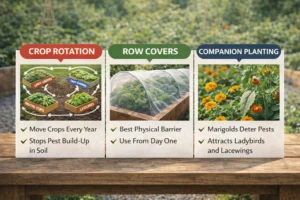
| Crop rotation every season | Prevents pest populations from building up in the soil around their favourite host crops |
| Row covers and mesh barriers | Physical barrier that stops flying and crawling pests reaching crops at all |
| Companion planting with marigolds and herbs | Deters pests and attracts beneficial predatory insects that hunt them |
| Removing plant debris after harvest | Eliminates overwintering sites for pest eggs and larvae in the soil |
| Healthy soil and regular feeding | Strong well-fed plants resist pest damage far better than stressed nutrient-deficient ones |
| Encouraging beneficial insects | Ladybirds, lacewings, and ground beetles provide free natural pest control all season |
| Checking plants twice a week | Catches problems at the seedling stage when they are still small and easily managed |
WORTH KNOWING
Mississippi State University Extension confirms that a healthy plant is often able to outgrow insect and disease attack that would devastate a stressed or poorly fed plant.
Maintaining healthy soil, proper watering, and a consistent fertiliser routine is pest prevention in the most fundamental sense.
| Common Vegetable Garden Pests and How to Deal With Them
1. Check your vegetable garden plants at least twice a week — both tops and undersides of leaves. Early detection makes everything easier. 2. Aphids, slugs, and caterpillars are the three most common pests. All three respond well to simple organic methods. 3. Row covers are the single most effective physical pest barrier for any vegetable garden crop. 4. Never use broad pesticide sprays unnecessarily. They kill the beneficial insects that do your pest control for free. 5. Healthy well-fed plants in good soil resist pest damage far better than stressed, underfed ones. 6. Crop rotation every season prevents soil-dwelling pests from building up around their favourite host crops. 7. Pests are a normal part of vegetable gardening. Calm, early, targeted responses always work better than panicked heavy-handed reactions. |
Stay Ahead of Vegetable Garden Pests and Protect Your Harvest
You now know how to identify and deal with the seven most common vegetable garden pests — what each one looks like, what damage it causes, and exactly what to do about it without reaching for a chemical spray.
Check your plants regularly.
Respond early and simply.
Support your beneficial insects.
Keep your plants healthy and well fed.
Follow those four principles and your vegetable garden will produce a strong and largely pest-free harvest season after season.
Walk your vegetable garden today and check every plant — tops and undersides of leaves, growing tips, stems at soil level.
Note anything unusual.
Deal with anything you find immediately using the simplest method from this guide.
Then set a reminder to do the same check again in three days.
FAQs
Q: What are the most common vegetable garden pests?
A: The seven most common are aphids, slugs, caterpillars, whitefly, spider mites, cutworms, and flea beetles. Most respond well to simple organic methods like handpicking, insecticidal soap, and row covers.
Q: How do I get rid of aphids on my vegetable garden plants?
A: Blast them off with a firm jet of water first — this removes most of an infestation immediately. For persistent aphids apply insecticidal soap directly to the leaf undersides or use neem oil spray in the evening.
Q: How do I protect my vegetable garden from slugs and snails?
A: Use copper tape or grit barriers around vulnerable plants, set beer traps at soil level, and go out after dark to handpick. The first two to three weeks after planting are the critical window — protect seedlings hard during that period.
Q: Are there any pesticides that are safe to use on a vegetable garden?
A: Yes — insecticidal soap, neem oil, and Bacillus thuringiensis — are all considered safe organic options. Always apply directly to the affected area only and follow label directions carefully.
Q: How do I prevent pests in my vegetable garden organically?
A: Rotate crops every season, cover vulnerable plants with fine mesh row covers, and plant marigolds nearby to attract beneficial insects. Healthy well-fed plants in good soil resist pest damage far better than stressed ones.