
The best fertilizer for vegetable gardens is a balanced organic granular feed with an NPK ratio of around 5-5-5 or 10-10-10, applied to the soil before planting and again mid-season when crops are actively growing.
For leafy crops like lettuce and spinach, a nitrogen-rich liquid feed like fish emulsion gives the best results.
For fruiting crops like tomatoes and cucumbers, switch to a low-nitrogen high-potassium tomato feed once the first flowers appear.
This guide covers everything a beginner needs to know about fertilizing a vegetable garden — what NPK means, which feeds work best for which crops, when to apply them, and the most common mistakes to avoid.
What Is a Fertilizer for a Vegetable Garden?
A vegetable garden fertilizer is any substance applied to the soil or to plant leaves to supply nutrients that vegetables need to grow, produce flowers, and deliver a harvest.
The three main nutrients in any fertilizer are nitrogen for leaf and stem growth, phosphorus for root development and flowering, and potassium for fruit quality and disease resistance.
Fertilizers come in organic forms — compost, fish emulsion, seaweed, blood meal, and bone meal — and in synthetic granular or liquid forms with concentrated NPK ratios.
Think of fertilizer as food for your vegetable garden. Compost builds the foundation.
Fertilizer fills the nutritional gaps when plants need an extra push.
KEY FACTS — Fertilizing a Vegetable Garden
Vegetables are heavy feeders that deplete soil nutrients significantly faster than most garden plants. (Penn State Extension)
The best all-round fertilizer for most vegetable gardens is a balanced granular feed with an NPK ratio of 5-5-5 or 10-10-10. (Colorado State University Extension)
Too much nitrogen before fruiting begins causes lush leafy growth but dramatically reduces tomato, pepper, and cucumber yields. (Texas A&M AgriLife Extension)
Organic slow-release granular fertilizers feed the soil and plants for 3 to 4 months from a single application. (Gardener’s Path)
Leafy greens like lettuce, spinach, and kale need significantly more nitrogen than beans, peas, and root vegetables. (Penn State Extension)
QUICK SUMMARY — Best Fertilizer for a Vegetable Garden
Best all-round choice: Balanced organic granular fertilizer — NPK 5-5-5 or 10-10-10 — applied before planting and again mid-season.
Best for leafy greens: Nitrogen-rich liquid fish emulsion — NPK 5-1-1 — applied every 2 to 3 weeks through the growing season.
Best for tomatoes and fruiting crops: Low-nitrogen high-potassium tomato feed once flowering begins.
Best for raised beds and containers: Slow-release organic granules mixed into compost at planting time.
Easiest method: Mix balanced granular fertilizer into the top 2 to 4 inches of soil a week before planting. Feed again mid-season with a liquid feed.
Why Fertilizer Makes Such a Difference in a Vegetable Garden
Vegetables grow fast, produce heavily, and demand a lot from the soil they grow in.
Unlike trees or shrubs that grow slowly over many years, your vegetable garden asks a lot from the same patch of ground season after season.
Even well-prepared soil with good compost starts running low on key nutrients by midsummer.
That is when growth slows, leaves yellow, and fruit production drops off — often without any obvious cause.
In our experience, the difference between a vegetable garden that produces well through August and one that runs out of steam by July is almost always fertilizer.
Plant experts say vegetables need a lot of nutrients to grow strong and healthy.
That’s why you should add fertilizer before planting and again during the growing season, because soil alone is often not enough.
Fertilizing does not have to be complicated or expensive.
A basic organic granular feed applied twice a season and a simple liquid feed every two weeks during fruiting is all most beginner vegetable gardens need.
WORTH KNOWING
Texas A&M AgriLife Extension confirms that applying too much nitrogen before fruiting begins causes excessive leafy growth and delayed flowering — reducing yields in tomatoes, peppers, and cucumbers.
Timing matters as much as the amount you apply.
Understanding NPK — What the Three Numbers Mean in a Vegetable Garden Fertilizer
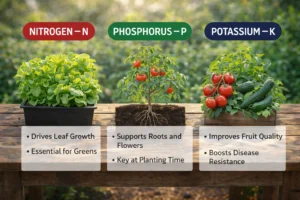
Every fertilizer bag, bottle, or box has three numbers printed on the label.
These numbers are the NPK ratio and they tell you exactly what is in the product.
The first number is nitrogen. The second is phosphorus. The third is potassium.
A fertilizer labelled 10-10-10 contains equal amounts of all three.
A fertilizer labelled 5-1-1 is high in nitrogen and low in the others.
What Each NPK Nutrient Does in a Vegetable Garden
| Nutrient | What It Does in a Vegetable Garden |
| Nitrogen (N) — first number | Drives leaf and stem growth. Essential for leafy greens. Too much delays fruiting in tomatoes. |
| Phosphorus (P) — second number | Supports root development, flowering, and fruit set. Important at planting and during flowering. |
| Potassium (K) — third number | Improves fruit quality, flavour, and disease resistance. Most important during fruiting. |
| Calcium | Prevents blossom end rot in tomatoes. Often found in specialist tomato feeds. |
| Magnesium | Supports chlorophyll production. Deficiency shows as yellowing between leaf veins. |
| Micronutrients — iron, boron, zinc | Needed in small amounts. A balanced organic fertiliser usually supplies enough. |
For a beginner vegetable garden, a balanced NPK of 5-5-5 or 10-10-10 is the safest and most practical starting point.
It covers all three main nutrients without the risk of overdoing any one of them.
Organic vs Synthetic Fertilizer for a Vegetable Garden
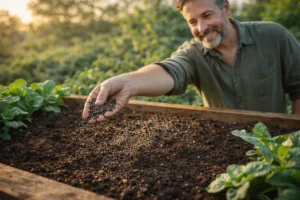
Both organic and synthetic fertilizers work.
The choice comes down to how quickly you need results, how much you want to spend, and how you prefer to manage your vegetable garden.
| Type | How It Works in a Vegetable Garden |
| Organic granular fertilizer | Slow release over 3 to 4 months. Feeds the soil and the plant. Safe and forgiving for beginners. |
| Organic liquid fertilizer — fish emulsion, seaweed | Fast acting. Plants absorb it within days. Apply every 2 to 3 weeks through the growing season. |
| Synthetic granular fertilizer | Fast release. Delivers nutrients quickly. Risk of over-fertilizing if amounts are misjudged. |
| Synthetic liquid fertilizer | Fastest acting. Good for quick correction of deficiencies. Needs careful measuring. |
| Compost as fertilizer | The foundation of any vegetable garden. Slow release, improves soil structure, costs almost nothing. |
| Worm castings | Gentle, balanced, and full of micronutrients. Excellent for containers and seedling beds. |
Our honest recommendation for beginners is organic.
Organic fertilizers release nutrients slowly and steadily, are very hard to over-apply, and improve your soil at the same time they feed your crops.
The results are slightly slower than synthetic feeds but the long-term benefit to the soil is significant.
WORTH KNOWING
Organic materials provide nutrients as they decompose, and the resulting soil organic matter holds and slowly releases nutrients over time, according to University of Minnesota Extension.
A vegetable garden fed consistently with organic fertilizer gets measurably easier to manage with each passing season.
The Best Fertilizer Types for a Beginner Vegetable Garden
Here is an honest rundown of the most useful fertilizers for a beginner vegetable garden — what each one does, when to use it, and which crops benefit most.
Balanced Granular Organic Fertilizer — Best All-Round Fertilizer for a Vegetable Garden
A balanced granular organic fertilizer with an NPK of 5-5-5 or 10-10-10 is the single best starting point for any beginner vegetable garden.
Mix it into the top 2 to 4 inches of soil a week before planting.
It releases slowly over 3 to 4 months and provides a steady background supply of all three main nutrients through most of the growing season.
- Best for: All crops at the start of the season before planting.
- Application: Mix 1 pound per 10 square feet into the top layer of soil before planting.
- How often: Once at the start of season. Top-dress with a second application mid-season.
Fish Emulsion — Best Nitrogen-Rich Fertilizer for Leafy Vegetable Crops
Fish emulsion is a liquid organic fertilizer with an NPK of around 5-1-1. The high nitrogen content makes it the best feed for lettuce, spinach, kale, chard, and any crop where you are eating the leaves.
Apply it diluted in water every two to three weeks throughout the growing season.
It smells strongly when you first apply it but the smell fades within a day.
- Best for: Lettuce, spinach, kale, chard, herbs, and all leafy green crops.
- Application: Dilute 1 to 2 tablespoons per gallon of water. Apply at the base of plants.
- How often: Every 2 to 3 weeks through the growing season.
Tomato Feed — Best Fertilizer for Fruiting Crops in a Vegetable Garden
A specialist tomato feed is high in potassium and usually contains added calcium — the exact combination that fruiting crops like tomatoes, cucumbers, peppers, and courgette need most.
The key rule: do not start using it too early. Use your balanced granular feed first to establish the plants.
Switch to tomato feed only once the first flowers appear.
- Best for: Tomatoes, cucumbers, peppers, courgette, and all fruiting crops.
- When to start: Only after the first flowers open — not before.
- How often: Every 1 to 2 weeks from first flower to end of harvest.
Seaweed Liquid Feed — Best Gentle All-Round Fertilizer for a Vegetable Garden
Seaweed liquid feed is one of the most useful and versatile fertilizers any beginner vegetable garden can use.
It is gentle enough for seedlings, broad enough in its nutrient range to benefit almost every crop, and inexpensive.
It contains a wide range of micronutrients — magnesium, calcium, iron, and trace elements — that most other fertilizers leave out. Use it as a weekly background feed alongside your main feeding routine.
- Best for: All crops, especially seedlings and young transplants that need gentle feeding.
- Application: Dilute according to label directions. Apply as a soil drench or gentle foliar spray.
- How often: Weekly as a gentle background feed throughout the season.
How to Fertilize Different Vegetable Crops in Your Garden
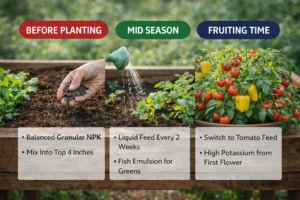
Not all vegetables need the same fertilizer at the same time. Getting this right makes a real difference to what your vegetable garden produces.
| Crop Type | Best Fertilizer Approach for This Vegetable Garden Crop |
| Tomatoes | Balanced granular at planting. Switch to high-potassium tomato feed from first flower. Feed every 1 to 2 weeks. |
| Cucumbers and courgette | Balanced granular before planting. Tomato feed once flowering begins. Feed every 2 weeks. |
| Peppers | Balanced granular at planting. Tomato feed after first fruits set. Consistent regular feeding. |
| Lettuce and leafy greens | High-nitrogen liquid fish emulsion every 2 to 3 weeks. Stop if plants bolt in heat. |
| Spinach and kale | Fish emulsion or seaweed feed every 2 to 3 weeks for strong leaf production. |
| Green beans and peas | Minimal fertilizer needed — they fix their own nitrogen. Balanced granular at planting only. |
| Radishes and carrots | Light balanced granular before planting. No additional feeding needed. |
| Herbs | Seaweed feed every 3 to 4 weeks. Avoid heavy nitrogen feeds — they reduce flavour intensity. |
Specialists at Texas A&M AgriLife Extension confirm that fertilizer needs vary significantly between crops.
Leafy greens require more nitrogen than beans and peas, and fruiting crops like peppers and tomatoes benefit most from fertilizer after first fruit sets rather than earlier in the season.
When and How to Apply Fertilizer to a Vegetable Garden
Timing your fertilizer applications correctly is just as important as choosing the right product.
Too early and the nutrients wash away before plants need them.
Too late and the plant has already been stressed trying to produce without support.
The Simple Fertilizer Schedule for a Beginner Vegetable Garden
| When | What to Do With Your Vegetable Garden Fertilizer |
| 2 weeks before planting | Mix balanced organic granular fertilizer into the top 2 to 4 inches of soil across the whole bed. |
| At planting — transplants | Water in with a diluted liquid fertilizer to help roots establish in their new location. |
| 2 to 4 weeks after planting | Begin liquid feeding — fish emulsion for leafy crops, seaweed for everything else. |
| When first flowers appear | Switch fruiting crops to high-potassium tomato feed. Continue every 1 to 2 weeks. |
| Mid-season top-dress | Sprinkle a light application of granular fertiliser around established plants and water in. |
| Late season | Stop feeding 4 weeks before first expected frost to avoid encouraging soft new growth. |
How to Apply Fertilizer to Your Vegetable Garden Without Damaging Plants
- Never apply dry granular fertilizer directly against plant stems. Always keep granules at least 6 inches away from the main stem.
- Always water in dry fertilizer after applying. Granules sitting dry on the surface do nothing until moisture activates them.
- Do not fertilize dry, stressed plants. Water the garden first, let it drain, then fertilize the following morning.
- Never fertilize if heavy rain is expected within 24 hours. Rain washes nutrients away before plants can absorb them.
- Follow label directions carefully. More is not better with fertilizer. Over-application causes leaf scorch and can kill plants.
WORTH KNOWING
Colorado State University Extension found that when phosphorus is applied but not actually needed by plants, it can kill off the beneficial mycorrhizal fungi in the soil that help vegetable roots absorb iron and other micronutrients — a reminder that more fertilizer is not always better.
How to Fertilize a Vegetable Garden Grown in Containers
Container vegetable gardens need more frequent feeding than in-ground or raised bed gardens — for one simple reason. Every time you water a pot, a small amount of nutrient-rich water drains out through the base.
Over a few weeks those repeated small losses add up to a genuine nutrient shortage that shows up as slow growth, yellowing leaves, and disappointing harvests.
- Start with a slow-release organic granular fertilizer mixed into the compost when you fill each container.
- Begin liquid feeding with a diluted seaweed or fish emulsion feed 3 to 4 weeks after planting.
- Feed container vegetables every 10 to 14 days through the growing season rather than every 3 to 4 weeks.
- Tomatoes and cucumbers in large pots are the heaviest feeders — switch them to tomato feed from first flower and do not miss a week.
- Worm castings mixed into the top layer of compost mid-season give containers a gentle nutritional boost without any risk of over-feeding.
Signs Your Vegetable Garden Needs Fertilizer
Your vegetable garden tells you when it is running short of nutrients.
Knowing what to look for saves a lot of guesswork.
| Sign | What It Usually Means for a Vegetable Garden |
| Yellow leaves on lower stems | Nitrogen deficiency — the plant cannot produce enough chlorophyll for new growth |
| Reddish-purple tint on leaves | Phosphorus deficiency — often seen in cool spring conditions when roots are slow |
| Brown scorched edges on leaves | Potassium deficiency — starts on older lower leaves and works upward |
| Blossom end rot on tomatoes | Calcium deficiency or irregular watering preventing calcium uptake |
| Slow stunted growth overall | General nutrient shortage — time for a balanced feed and a soil check |
| Very dark green lush leaves but no fruit | Too much nitrogen — stop feeding and wait for fruiting to catch up |
| Pale washed-out leaf colour | Multiple deficiencies — consider a seaweed feed for broad micronutrient coverage |
Fertilizer Mistakes That Harm a Vegetable Garden
Most fertilizer problems in a beginner vegetable garden come from one of these common errors.
Knowing about them before you start saves a lot of frustration.
- Using lawn fertilizer on a vegetable garden. Lawn feeds contain too much nitrogen and often include weed killers that can seriously damage or kill vegetables.
- Over-fertilizing with nitrogen. Lush green plants with no fruit are almost always nitrogen overload. Ease back on feeding and switch to a high-potassium feed.
- Fertilizing bone dry soil. Dry roots cannot absorb nutrients. Always water the garden first and fertilize the following morning.
- Applying fertilizer against plant stems. This causes chemical burn at the base of the stem. Always keep fertilizer granules at least 6 inches from the main stem.
- Feeding the same amount all season. Plants need different nutrients at different growth stages. Use balanced feeds early and high-potassium feeds during fruiting.
- Giving up on fertilizing mid-season. One missed application rarely matters but stopping altogether by July lets nutrient levels fall just as your crops are working hardest.
Key Takeaways — Best Fertilizer for a Vegetable Garden
|
Feed Your Vegetable Garden Well and It Will Reward You
You now know exactly which fertilizer works best for a vegetable garden, how to use it for different crops, when to apply it through the season, and what signs to look for when something is not right.
A good fertilizer routine does not have to take more than 10 minutes every two weeks.
Mix granular feed into your beds before planting.
Water in a liquid feed every couple of weeks.
Switch to tomato feed when your fruiting crops start to flower.
Do those three things consistently and your vegetable garden will keep producing well from early summer all the way through to the last harvest of the season.
Your this week: Order one bag of balanced organic granular fertilizer and one bottle of liquid seaweed feed.
Mix the granular feed into your beds before your next planting.
Start the liquid feed two weeks after planting.
That is your fertiliser routine set up for the whole season.
Frequently Asked Questions
| Q: What is the best fertilizer for a vegetable garden?
A: The best all-round fertilizer for a vegetable garden is a balanced organic granular feed with an NPK ratio of 5-5-5 or 10-10-10. Mix it into the top 2 to 4 inches of soil before planting for a slow steady nutrient release through most of the season. For leafy crops like lettuce and spinach, add a liquid fish emulsion feed every 2 to 3 weeks. For fruiting crops like tomatoes and cucumbers, switch to a high-potassium tomato feed from the moment the first flowers open. |
| Q: How often should I fertilize my vegetable garden?
A: Apply balanced granular fertilizer once before planting and again as a mid-season top dressing. Liquid feeds — fish emulsion, seaweed, or tomato feed — should be applied every 1 to 2 weeks during the active growing season. Container vegetable gardens need feeding more frequently than in-ground beds — every 10 to 14 days — because nutrients wash out through the base with every watering. Penn State Extension recommends fertilizing based on soil test results and plant growth stage rather than on a fixed rigid timetable. |
| Q: What does NPK mean on a vegetable garden fertilizer?
A: NPK stands for nitrogen, phosphorus, and potassium — the three main nutrients every plant needs. On a fertilizer label the numbers always appear in the same order. A bag labelled 10-10-10 contains equal amounts of all three. A bottle labelled 5-1-1 is high in nitrogen and low in the others. Nitrogen drives leaf growth. Phosphorus supports roots and flowers. Potassium improves fruit quality and disease resistance. For a beginner vegetable garden, a balanced NPK of 5-5-5 or 10-10-10 is the safest and most practical choice. |
| Q: Should I use organic or synthetic fertilizer in my vegetable garden?
A: For most beginners, organic fertilizer is the better choice. It releases nutrients slowly and steadily over months, is much harder to over-apply than synthetic feeds, and improves the long-term health and structure of your soil at the same time it feeds your crops. Synthetic fertilizers work faster and cost less but carry a higher risk of over-fertilizing if amounts are misjudged. Texas A&M AgriLife Extension recommends applying no more than half a pound of nitrogen per 100 square feet to avoid plant damage from excess fertilizer. |
| Q: Why are my vegetable plants yellow even though I have been fertilizing?
A: Yellow leaves on lower stems despite regular feeding usually indicate one of three things. Too much water is preventing roots from absorbing nutrients properly. The soil pH is outside the 5.5 to 7.0 range where most nutrients become available to plants. Or the fertilizer being used is too high in one nutrient and blocking the uptake of another — excessive phosphorus, for example, can prevent iron absorption. Check the soil moisture first with the finger test. Test the soil pH with a simple kit. Then reassess your fertilizer type and application rate. |