Knowing when to harvest vegetables makes the difference between a flavour-packed meal and a disappointing one. Pick too early and the taste is not there yet.
Leave it too long and the texture goes tough, the sweetness fades, or the plant stops producing altogether.
The good news is that each vegetable gives you clear signals when it is ready.
Once you know what to look for, harvest timing becomes one of the most useful skills in the vegetable garden.
This guide covers when and how to harvest vegetables for the best flavour — with exact signs to look for on each crop and the simple techniques that keep your plants producing all season long.
What Does It Mean to Harvest Vegetables at the Right Time?
Harvesting vegetables at the right time means picking each crop at the exact stage when its flavour, texture, and quality are at their best.
For some crops — like courgette, beans, and cucumbers — this means picking young and often.
For others — like pumpkins, onions, and potatoes — it means waiting for the plant to tell you it is done growing before you lift them.
Most vegetables are best when picked small and young, not large and mature.
The bigger a courgette gets, the less flavour it has. The longer a bean stays on the plant past its peak, the tougher and stringier it becomes.
The goal is the kitchen harvest — the point of best eating — not the botanical point of full maturity, which is often well past peak flavour.
Key Facts About Harvesting Vegetables
Vegetable quality is at its highest the moment it is picked and begins to fall straight away. The closer to mealtime you harvest, the better the flavour. (University of Georgia CAES Extension)
Many vegetables — courgette, cucumbers, beans — must be picked often or the plant stops making new fruit. Leaving ripe produce on the plant signals the plant that its work is done. (Illinois Extension)
The best time to harvest most vegetables is early morning after the dew has dried. This is when sugar levels are highest and the crop is at its crispest and most full of flavour. (Piedmont Master Gardeners)
Harvesting when the plant is wet spreads disease from plant to plant. Always wait until the foliage is dry. (University of Nebraska Extension)
Days to maturity on a seed packet is a guide — not a guarantee. Actual harvest time depends on weather, soil, and growing conditions in your specific garden. (Illinois Extension)
When to Harvest Key Vegetables
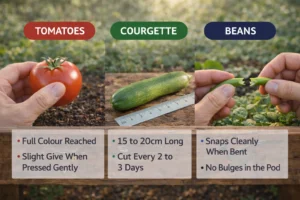
Tomatoes: Fully coloured and slightly soft when gently squeezed. Can ripen indoors if needed.
Courgette: 15 to 20cm long — do not let them swell into marrows. Pick every 2 to 3 days in summer.
Cucumbers: Firm, dark green, 15 to 20cm long. Harvest before the skin turns yellow.
Beans: Pods full but seeds not yet bulging. Snap cleanly when bent. Pick every 3 to 4 days.
Lettuce: Outer leaves at any size. Full heads when firm and compact — before the plant bolts.
Carrots: 1 to 2cm across at the shoulder. Taste one — sweetness tells you more than size.
Broccoli: Head dark green with tight closed buds. Cut before any bud turns yellow.
Why Harvest Timing Matters So Much in a Vegetable Garden
The vegetable garden rewards those who pay attention. Most crops have a window of peak quality that opens and closes faster than you might expect.
Sweet corn goes from perfect to starchy within 24 hours of reaching peak ripeness.
A courgette that was finger-length on Monday can be arm-length and flavourless by Friday.
Timing matters for the plant too, not just the cook. A vegetable left past its best is a wasted meal.
It also signals the plant that reproduction is done. Once that signal arrives, the plant cuts back on new flower production and slows down or stops making fruit entirely.
University of Georgia CAES Extension confirm that harvesting too late causes tough fibres and loss of sweetness — and can cause the plant to stop producing entirely.
Fully ripe vegetables left on the plant also draw more pests and disease.
The habit to build is simple: walk your vegetable garden every day or two and harvest anything that is ready.
Little and often beats leaving it all to a big weekend session every time.
WORTH KNOWING
Illinois Extension confirms that days to maturity printed on a seed packet is useful for planning but not for harvest decisions. Look at the plant — not the calendar. Signs of readiness on the crop itself are always more reliable than a date count from planting.
The Golden Rules of Harvesting Vegetables
Before we go crop by crop, these golden rules apply to every vegetable you grow.
- Harvest in the morning after the dew dries. Sugar levels are highest, the crop is crispest, and it will store and last longer after picking.
- Harvest when the plant is dry. Picking in wet conditions spreads fungal disease from plant to plant through your hands and tools.
- Use a sharp knife or clean scissors where cutting is needed. Pulling or twisting a vegetable from the plant can tear the stem and open a wound where disease gets in.
- Never tug hard. If a vegetable does not come away easily, it may not be ready — or it needs to be cut, not pulled.
- Handle harvested crops gently. Bruising starts rot. The less you knock and drop your harvest, the longer it lasts.
- Harvest often. The more you pick, the more the plant produces. This is especially true for beans, courgette, cucumbers, and tomatoes.
- Remove any overripe or rotting fruit from the plant right away. Left in place, it stops new fruit forming and spreads disease to healthy parts of the plant.
WORTH KNOWING
University of Nebraska Extension confirms that vegetable quality begins to fall the moment it is picked.
Harvest as close to mealtime as you can. If you must store, keep produce cool straight after picking to slow the quality decline.
When and How to Harvest Tomatoes
Tomatoes are one of the most satisfying crops to harvest — and one of the most commonly picked too early.
A truly ripe tomato picked warm from the vine on a sunny morning is one of the great pleasures of the vegetable garden.
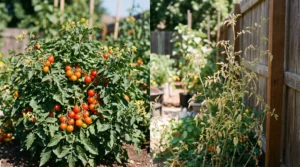
Pick a tomato when it has reached its full colour — red, orange, yellow, or whatever the variety produces — and gives slightly when pressed with your thumb.
A tomato that is still firm and has no give is not ready yet.
Signs a Tomato Is Ready to Harvest
- Full colour reached for that variety — red, yellow, orange, or striped depending on type.
- Slight give when pressed gently — not soft or squishy, just no longer rock hard.
- The tomato comes away from the stem with very little effort — a gentle twist is enough.
- For cherry tomatoes, the fruit will almost drop into your hand when ripe. Pick clusters at a time.
If a late cold spell threatens and you have tomatoes that are turning but not yet ripe, pick them and bring them inside.
They will ripen well at room temperature on a sunny windowsill. Never refrigerate unripe tomatoes — cold stops the ripening process and kills the flavour.
| Tomato Tip
Pick tomatoes regularly — every 2 to 3 days during peak season. Leaving ripe tomatoes on the plant in hot weather leads to splitting, rot, and the plant slowing its new fruit. |
When and How to Harvest Courgette and Cucumbers
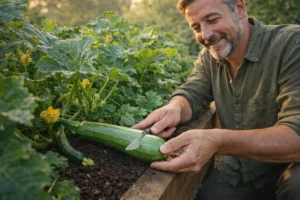
Courgette and cucumbers are fast-growing crops and two of the easiest to leave too long.
Both are best harvested young and small, when flavour and texture are at their peak.
Harvesting Courgette
Harvest courgette when they are 15 to 20cm long — roughly the size of a large banana.
At this size the skin is tender, the seeds are tiny, and the flavour is at its best.
Left on the plant, a courgette swells into a marrow within days.
A marrow is not a ruined courgette — but the flavour is much weaker and its size takes energy away from new fruit.
- Check courgette plants every 2 to 3 days in warm weather. Growth in peak summer is remarkable — a single plant can produce a courgette a day.
- Cut with a sharp knife rather than pulling. Leave a short stalk attached to the fruit.
- If you find a hidden marrow tucked under the leaves, remove it at once. It is taking energy from the plant and suppressing new fruit production.
Harvesting Cucumbers
Harvest cucumbers when they are firm, dark green, and around 15 to 20cm long for slicing types.
Pickling cucumbers are harvested smaller — between 5 and 10cm depending on the recipe.
The clearest sign that a cucumber has been left too long is a yellow tinge starting at the blossom end.
Yellow skin means the seeds have hardened and the flavour has gone. Pick well before that stage.
- Check cucumber plants every other day during the growing season. They grow very fast in warm weather.
- Cut from the vine with a sharp knife or scissors — never pull or twist.
- A cucumber with a dull skin rather than a bright sheen is past its best.
When and How to Harvest Beans and Peas
Beans and peas are peak-and-go crops. They have a brief window of perfect texture and sweetness and then move on quickly to something tougher and starchier.
The key is to pick them often and pick them young.
Harvesting Green Beans and Runner Beans
Green beans are ready when the pods are fully formed but the seeds inside have not yet started to swell.
Snap one — if it breaks cleanly with a crisp snap and shows no stringiness, it is ready.
If it bends rather than snaps, it is past its best.
- Pick every 3 to 4 days during the main cropping season. Beans left on the plant go tough within days.
- Hold the stem with one hand and pull the pod gently downward with the other to avoid tearing the plant.
- Never let beans go to seed on the plant. A plant that has been allowed to set seed stops making new pods for the season.
Harvesting Peas
Garden peas are ready when the pod is plump and round and the peas inside can be felt clearly through the pod.
Open one and taste it — a ripe pea is sweet and tender.
A pea left too long becomes starchy and floury.
Mangetout and sugar snap peas are picked earlier — when the pods are flat or just starting to fill and still tender enough to eat whole.
- Harvest peas every 2 to 3 days at peak season. They are one of the fastest-changing crops in the garden.
- Hold the stem with one hand and pick the pod with the other to avoid pulling the plant out of the ground.
- Eat or freeze peas the same day if possible. Sugar converts to starch within hours of picking.
WORTH KNOWING
Illinois Extension confirms that snap beans should be picked while the pods are fully grown but before the seeds start to fill out — there should be no visible bulges on the pod surface.
Picking at this stage gives the best flavour and keeps the plant producing new pods all season.
When and How to Harvest Leafy Greens and Lettuce
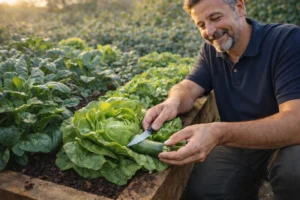
Leafy greens are some of the most forgiving crops in the vegetable garden.
Most can be harvested at almost any size — but they all have a sweet spot of flavour and tenderness that is worth aiming for.
Harvesting Lettuce
For loose-leaf lettuce, harvest outer leaves when they are large enough to use — usually from about 10cm long.
Always take the outer leaves first and leave the inner growing heart to keep producing.
A single plant harvested this way can give leaves for weeks.
For hearting lettuce — romaine, iceberg, butterhead — harvest the whole head when it is firm and compact when you press the top.
A lettuce that feels loose and open in the centre is heading toward bolting.
Harvest before it sends up a flower stalk.
- Check lettuce daily in warm weather. Once a lettuce bolts, the leaves turn bitter very quickly.
- Cut the whole head just above the soil with a sharp knife. Some varieties will re-sprout and give a second flush of leaves.
- Harvest lettuce in the morning. Leaves picked in the heat of the afternoon wilt almost straight away.
Harvesting Kale, Spinach, and Chard
Kale, spinach, and chard are all cut-and-come-again crops. Pick outer leaves regularly and the plant keeps growing from the centre.
Always leave at least 4 to 5 leaves on the plant after harvest.
- Pick spinach leaves young — around 5 to 8cm long for the best flavour. Older spinach leaves turn tough and bitter.
- Kale can be harvested from the bottom of the stalk upward. Leave the top growing tip untouched and new leaves will form below.
- Chard is very flexible — pick leaves at any size from small and tender to large and robust depending on how you want to cook them.
When and How to Harvest Root Vegetables
Root vegetables are the most patient crop in the vegetable garden.
Most can stay in the ground for weeks past their ideal harvest size without a major drop in quality — which makes them forgiving and flexible.
But there is still a best moment for each one.
Harvesting Carrots
Carrots are ready when they are around 1 to 2cm across at the shoulder — where the top of the root meets the soil.
The best way to check is to gently brush the soil away from the shoulder of one carrot to see its width.
Pull one and taste it.
A sweet, firm carrot is ready.
A bitter or woody one needs more time — or has been left too long and dried out.
- Harvest carrots in the morning after watering the night before. Damp soil releases roots much more cleanly than dry compacted ground.
- Grip the foliage low, close to the soil, and pull steadily. Twisting gently while pulling helps loosen roots without snapping them.
- Carrots left in the ground through a frost often taste sweeter — the cold converts starch to sugar. Leave maincrops in the ground until needed if your soil is not waterlogged.
Harvesting Beetroot
Beetroot is at its best when the roots are between 3 and 5cm across.
Larger than this and the flesh can become tough and fibrous. Small, young beetroot have the sweetest and most tender flesh.
- Twist off the foliage rather than cutting it. Cutting causes the root to bleed colour during cooking.
- Young beetroot leaves are edible and have a mild, slightly earthy flavour. Pick them as a bonus crop alongside the roots.
Harvesting Potatoes
New potatoes are ready about 10 to 12 weeks after planting, when the plants are in flower.
Carefully dig around one plant with a fork to check the size.
If the potatoes are the size of a large egg or bigger, they are ready to eat as new potatoes.
Maincrop potatoes are left in the ground until the foliage has died back completely and turned brown.
This tells you the skins have set and the potatoes will store well.
Wait at least two weeks after the foliage dies before lifting.
- Never use a spade to dig potatoes — use a fork. Spades slice through roots. Forks lift them.
- Lift potatoes on a dry day and leave them on the soil surface for a few hours to dry the skins before storing.
- Check every potato as you harvest. Any with green patches — caused by light exposure — should not be eaten. Green skin contains solanine, which is mildly toxic.
When and How to Harvest Brassicas
Brassicas — broccoli, cabbage, cauliflower, Brussels sprouts, and kale — all have their own harvest signals.
Getting the timing right matters most with broccoli and cauliflower, where the window between perfect and past is the narrowest.
Harvesting Broccoli
Harvest broccoli when the head is dark green and the buds are tight and closed.
This is the key signal.
Once the tiny buds start to loosen and open into yellow flowers, the eating quality drops sharply.
- Cut the main head with a sharp knife, leaving around 10cm of stem attached. Smaller side shoots will then form below the cut and can be harvested over the following weeks.
- Check broccoli daily once the head reaches full size. The window from tight buds to open flowers can be just 2 to 3 days in warm weather.
Harvesting Cabbage and Cauliflower
Cabbage is ready when the head is firm and solid when squeezed.
Cut at the base with a sharp knife. A loose, open head is heading toward bolting — harvest before that stage.
Cauliflower curds should be white, tight, and firm — roughly 15 to 20cm across depending on the variety.
Once the curd starts to open and separate, it is past its best.
Harvesting Brussels Sprouts
Brussels sprouts develop from the bottom of the stalk upward, so start harvesting the lowest ones first.
Pick sprouts when they are 2 to 3cm across and feel firm when squeezed.
Loose or open sprouts are past their best.
Brussels sprouts taste sweeter after a frost or two. If you can, leave them on the stalk through the first autumn frosts before harvesting — the cold improves the flavour a lot.
How to Store Vegetables After Harvest
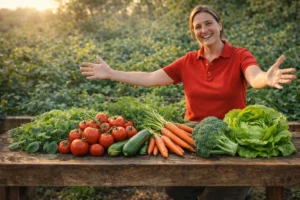
Good storage starts the moment you pick.
Handle everything gently, keep it cool straight away, and use it as fresh as you can.
Most vegetables start to lose quality within hours of picking — so the sooner they reach the plate, the better.
| Vegetable | How to Store After Harvest |
| Tomatoes | Room temperature only. Never refrigerate. Use within 3 to 5 days of picking. |
| Courgette and cucumbers | Cool spot in the kitchen or fridge. Use within 4 to 5 days. |
| Beans and peas | Fridge in a damp paper bag. Use within 3 to 4 days. Peas best eaten same day. |
| Lettuce and leafy greens | Fridge in a damp cloth or bag. Use within 3 to 5 days. |
| Carrots and beetroot | Remove tops. Store in fridge or cool dark place. Last 2 to 4 weeks. |
| Potatoes | Cool, dark, dry place — never the fridge. Last several months if stored well. |
| Broccoli and cauliflower | Fridge unwashed. Use within 3 to 5 days of harvest. |
| Onions and garlic | Dry and cure in sun for 1 to 2 weeks. Store in cool dry place. Last months. |
University of Minnesota Extension confirm that vegetables are still alive after picking — they breathe and need airflow. Store with ventilation.
Keep root crops away from apples and tomatoes — the ethylene gas they release speeds up decay in nearby produce.
| Key Takeaways — When and How to Harvest Vegetables
1. Harvest in the morning after the dew dries. Sugar levels are highest and crops stay crisp and fresh the longest. 2. Pick often. Beans, courgette, cucumbers, and tomatoes stop producing if ripe fruit is left on the plant. 3. Use a sharp knife or scissors for crops that need cutting. Pulling or twisting damages the plant and invites disease. 4. Most vegetables are best when harvested young and small — not large and fully mature. 5. Never refrigerate tomatoes. Room temperature is essential for flavour and ripening. 6. Taste as you go. A sweet carrot tells you more about readiness than any calendar date. 7. Harvest when the plant is dry. Picking in wet conditions spreads disease across your whole vegetable garden. |
Harvest Your Vegetable Garden at Its Best
You now know exactly when and how to harvest the most common vegetable garden crops — what to look for, when to pick, how to do it without damaging the plant, and how to store everything once it is in your hands.
The habit that makes the biggest difference is simply going out to your vegetable garden every day or two and looking closely.
Not to work hard — just to look. Check what is changing. Pick what is ready.
Remove anything past its best.
That daily walk is where the best meals come from.
That is when you find the courgette that doubled overnight, the beans that are just right today, and the tomato that finally gives a little under your thumb.
Walk your vegetable garden today and taste one of everything that looks close to ready.
Sweetness and tenderness are your best guides.
If it tastes good, it is ready. If it is woody or bland, give it more time — and check again in two days.
Frequently Asked Questions
| Q: How do I know when vegetables are ready to harvest?
A: Look at the plant — not the calendar. Each crop gives clear signs: full colour on tomatoes, a crisp snap on beans, tight closed buds on broccoli. Taste is your best guide for root crops like carrots. |
| Q: What is the best time of day to harvest vegetables?
A: Early morning after the dew dries is best. Sugar levels are at their highest and crops stay crisp far longer than those picked in the heat of the afternoon. |
| Q: Why has my courgette plant stopped producing fruit?
A: Almost always because ripe or overripe courgettes have been left on the plant too long. Harvest every 2 to 3 days and remove any large marrows you find hidden under the leaves — the plant will start producing again quickly. |
| Q: Can I pick tomatoes before they are fully ripe?
A: Yes — tomatoes picked when starting to colour will ripen well at room temperature indoors. Never refrigerate them at any stage. Cold kills the flavour and stops the ripening process completely. |
| Q: How often should I harvest beans and peas?
A: Every 3 to 4 days for beans and every 2 to 3 days for peas during the main season. Pods left on the plant go tough fast and signal the plant to stop producing. The more you pick, the more you get. |