
Most vegetable garden diseases have no cure. Once a plant is badly sick, the best you can do is stop the disease from spreading.
That means one thing matters most — prevention.
Good habits before disease strikes are worth far more than any spray or treatment after.
This guide covers seven common vegetable garden diseases.
You will learn how to spot each one early and what simple steps keep them out of your garden.
What Are Vegetable Garden Diseases?
A vegetable garden disease is any infection that harms your plants and reduces your harvest.
Most are caused by fungi. Others come from bacteria or viruses. Fungi spread by tiny spores carried by wind, rain, and insects.
Fungal diseases love wet leaves, poor airflow, and warm nights. Remove those conditions and most disease risk drops sharply.
Unlike pests, you often cannot see a disease starting. By the time you notice the signs, it may already be well set in.
Vegetable Garden Diseases
Most treatments protect healthy plants — they do not cure sick ones. Act early or not at all. (UMass Amherst Extension)
Resistant plant varieties are the easiest and best way to stop disease before it starts. (University of Georgia CAES Extension)
Crop rotation is the most important habit for stopping soil diseases from coming back each year. (UMass Amherst Extension)
Wet leaves are the main cause of most fungal vegetable garden diseases. Water at the base in the morning. (Penn State Extension)
Never compost diseased plants. Bin them. Most compost heaps do not get hot enough to kill disease spores. (Missouri Extension)
Summary: Common Vegetable Garden Diseases
Powdery mildew: White powder on leaves. Improve airflow. Use a baking soda spray for mild cases.
Blight: Brown black patches on tomatoes and potatoes. Remove affected parts at once.
Damping off: Seedlings fall over at soil level. Use fresh compost. Do not overwater.
Fusarium wilt: Plant wilts but soil is wet. Remove and bin the plant. No cure.
Downy mildew: Yellow patches on top of leaves, grey fuzz beneath. Improve airflow.
Grey mould: Fluffy grey mould on fruit and stems. Remove dead leaves. Harvest fruit on time.
Clubroot: Brassica roots swell and twist. Raise soil pH. Rotate crops.
Why Vegetable Garden Diseases Are Hard to Cure
With pests you can act fast. You can see a caterpillar and pick it off.
You can spot aphids and wash them away.
Diseases are different. A fungal disease starts inside the plant.
You cannot see it until it has already spread. By then the damage is done.
This is why good growing habits matter so much.
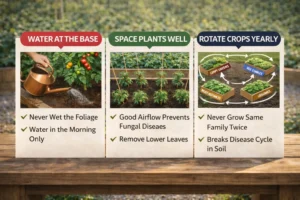
Water at the base. Space plants well. Rotate crops each year.
These habits stop most vegetable garden diseases before they ever start.
Plant experts at UMass Amherst Extension confirm that fungicides protect healthy plant tissue.
They do not cure sick plants. Act early — or even before symptoms appear — for the best result.
If you know a disease has been a problem in past years, plan for it. Do not wait for it to show up again.
WORTH KNOWING
University of Georgia CAES Extension says that seed catalogues list the disease resistance of each variety. Check the label before you buy.
Choosing a resistant variety is the easiest best step you can take.
How to Spot Vegetable Garden Disease Early

Check your plants at least twice a week. Look at the top and the underside of every leaf.
Check the stems at soil level too.
You are looking for change. Holes that were not there. Colour that is spreading.
Wilting that does not get better with water.
| What You See | Disease to Check For |
| White powder on leaf surface | Powdery mildew — common on courgette and cucumber |
| Brown black patches on leaves spreading fast | Blight — check tomatoes and potatoes first |
| Yellow patches on top of leaf, grey fuzz beneath | Downy mildew — check brassicas and lettuce |
| Fluffy grey mould on fruit or stems | Grey mould — most common in cool damp weather |
| Seedling falls over at soil level after sprouting | Damping off — caused by cold wet compost |
| Plant wilts even when soil is wet — leaves go yellow | Fusarium wilt — a soil disease with no cure |
| Brassica leaves yellow and wilt, roots look swollen | Clubroot — dig up root to confirm |
Always check the underside of leaves too. Many diseases start there and stay hidden until they are well set in.
Vegetable Garden Disease 1: Powdery Mildew
Powdery mildew is the most common disease in a vegetable garden.
Most growers see it first on courgette, pumpkin, or cucumber leaves in midsummer.
It looks like a white or grey dusty powder on the top of the leaf. It does not need wet conditions to spread.
It thrives at warm temperatures around 60 to 80 degrees, with damp air at night and drier air in the day.
The good news is that powdery mildew on one type of plant does not spread to others.
The type that hits your courgette is different to the type that might affect your tomatoes.
How to Stop Powdery Mildew in a Vegetable Garden
- Choose resistant varieties. Many modern courgette and cucumber types have resistance built in.
- Give plants space. Good airflow between plants keeps the air drier and slows the spread.
- Never water over the top of leaves in the evening. Wet foliage overnight makes things much worse.
- Remove badly affected leaves at once. Bin them — do not compost.
- For mild cases, spray with a mix of 1 teaspoon of baking soda per 1 quart of water and a few drops of liquid soap. This slows the spread by changing the surface of the leaf.
- Neem oil spray in the evening also works well on early cases.
| Good to Know
Powdery mildew is host-specific. The type on your courgette will not move to your tomatoes or roses. Each plant family has its own strain. |
Vegetable Garden Disease 2: Blight
Blight is the most feared disease for tomato and potato growers.
There are two types — early blight and late blight.
Both can destroy a crop fast if you do not act.
Early Blight in a Vegetable Garden
Early blight shows as dark brown spots on the lower leaves of tomatoes and potatoes.
The spots often have rings inside them — like a target.
It spreads up the plant over time.
It is caused by a fungus that does best when it is warm and humid.
It spreads by rain splash and spores on the wind.
Late Blight in a Vegetable Garden
Late blight is far worse. It causes large dark wet-looking patches that spread across leaves and stems very fast.
Late blight is the disease that caused the Irish potato famine in the 1840s.
Today it strikes most often when temperatures sit between 65 and 75 degrees and the air stays damp for long spells.
How to Prevent and Deal With Blight in a Vegetable Garden
- Only water at the base. Wet leaves are the main trigger for blight.
- Stake tomatoes and tie them in often. Keep leaves off the soil where spores collect.
- Cut off the lower leaves of tomato plants in midsummer. This helps air move through the base.
- At the very first sign of blight — even one leaf — remove it and bin it at once.
- If late blight takes hold, pull out the whole plant and destroy it. This protects the plants nearby.
- Pick blight-resistant tomato varieties such as Crimson Crush, Fantasio, or Ferline if blight is a problem in your area.
WORTH KNOWING
Penn State Extension confirms that late blight can fully strip a tomato plant of its leaves within 14 days of the first symptoms when humidity is high and temperatures are between 65 and 75 degrees.
The first affected leaf must be removed the same day you find it.
Vegetable Garden Disease 3: Damping Off
Damping off hits seedlings just after they sprout.
The stem pinches off at soil level and the seedling falls over and dies.
It is caused by soil fungi that thrive in cold, wet, poorly drained compost. It spreads fast when trays are overcrowded and air does not move.
How to Stop Damping Off in a Vegetable Garden
- Always use fresh seed compost. Never reuse old compost — it may carry the fungi that cause this disease.
- Do not overwater seedling trays. Keep compost damp but not wet. Water from below by sitting the tray in water briefly.
- Make sure air moves around your trays. Still, stagnant air makes things much worse.
- Sow seeds thinly. Packed seedlings create a damp damp pocket of air right at soil level.
- Wash pots and trays with diluted bleach before reuse each season.
- If it strikes, remove sick seedlings at once. Improve drainage and airflow for the rest. There is no treatment.
Vegetable Garden Disease 4: Fusarium Wilt
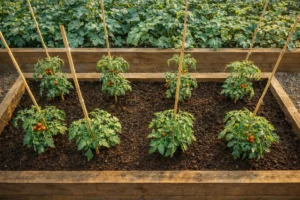
Fusarium wilt is a soil disease. It attacks the inside of the plant stem.
It blocks the channels that move water from the roots to the leaves.
The plant wilts even though the soil is wet. Leaves go yellow from the base up.
If you cut the stem near the base you will often see brown staining inside. There is no cure.
How to Prevent Fusarium Wilt in a Vegetable Garden
- Rotate crops every season. Fusarium spores stay in soil for many years. Never grow the same crop family in the same bed two years in a row.
- Choose resistant varieties. Look for the letter F on seed packet codes — this means Fusarium it is built in.
- Improve drainage. Fusarium thrives in wet, poorly drained soil. Raised beds with rich compost help a lot.
- Remove sick plants at once — roots and all. Do not compost them. Keep that bed free from the same crop family for at least 5 years.
- Keep tools clean. Muddy boots and dirty tools spread Fusarium spores from bed to bed.
Vegetable Garden Disease 5: Downy Mildew
Downy mildew affects many crops — brassicas, lettuce, spinach, onions, and cucumbers are all at risk.
Look at the top of the leaf and you will see yellow patches.
Look at the underside directly below and you will find grey or purple fluffy growth.
That fuzzy coating is how the disease spreads its spores.
How to Stop Downy Mildew in a Vegetable Garden
- Water at the base in the morning only. Wet leaves help downy mildew spread fast.
- Space plants well. Good airflow keeps leaves drier for longer after rain.
- Remove badly infected leaves right away. Bin them — do not compost.
- A copper fungicide spray every 7 to 10 days can slow the spread if caught early. This works best on brassicas and cucumbers.
- Rotate crops each season. Spores survive in soil and on old plant debris over winter.
Vegetable Garden Disease 6: Grey Mould
Grey mould is caused by a fungus called Botrytis cinerea.
It can affect almost every plant in your vegetable garden.
It does best in cool, damp, still air.
It looks like a fluffy grey or brown coating on fruit, flowers, stems, or leaves.
It usually enters through a wound or through tissue that is already dying.
How to Stop Grey Mould in a Vegetable Garden
- Remove dead and dying plant material at once. Grey mould needs a way in — clean plants with no dead leaves at the base are much safer.
- Pick fruit as soon as it is ripe. Overripe fruit left in damp weather is a common entry point.
- Improve airflow. Cut lower leaves and stake plants to keep the canopy open and airy.
- Do not water overhead in cool, wet weather. Every drop on the leaves or fruit raises the risk.
- Remove any mouldy fruit, stems, or leaves the same day you find them. Bin them at once.
Vegetable Garden Disease 7: Clubroot
Clubroot affects all brassica crops — cabbage, broccoli, kale, cauliflower, Brussels sprouts, turnips, and radishes.
It is caused by a tiny living thing in the soil that can live in the ground for more than 10 years — and in some soils up to 20 years, according to University of Maryland Extension.
Plants wilt in the heat of the day.
They do not fully recover even after watering.
Leaves go yellow.
Growth slows and stops.
Dig up the roots and you will find them swollen and twisted — that is the key sign.
How to Prevent and Manage Clubroot in a Vegetable Garden
- Raise the soil pH to 7.0 or above by adding garden lime. Clubroot does not do well in soil above pH 7.0.
- Rotate brassicas to a new bed every single year. Never grow them in the same spot more than once every 4 years.
- Check the pH of bought-in compost before adding it to brassica beds. Acidic compost can lower your pH and raise clubroot risk.
- Remove all sick plants — roots and all — at once. Bin everything. Do not leave root fragments in the soil. They carry spores that infect future crops.
- Do not replant brassicas in an infected bed for a minimum of 5 to 7 years. UMass Amherst Extension and University of Minnesota Extension both confirm that 3 years is not enough — the disease stays active far longer than most growers expect.
- If clubroot keeps coming back, grow brassicas in large pots of fresh compost. This sidesteps the soil completely.
Plant experts at University of Georgia CAES Extension confirm that crop rotation and choosing resistant varieties are the two most effective ways to manage disease that has been a problem in your garden before.
How to Keep Vegetable Garden Diseases Away
Most vegetable garden diseases share the same set of triggers — wet leaves, poor airflow, and the same crops in the same soil year after year.
Fix those three things and most disease stays out of your garden.
| Habit | Why It Reduces Disease in a Vegetable Garden |
| Water at the base in the morning | Keeps leaves dry all day. Wet leaves cause most fungal disease. |
| Space plants well | Good airflow keeps humidity low and leaves drier after rain. |
| Rotate crops every year | Stops soil diseases from building up around the same crops. |
| Pick resistant varieties | The easiest best step — built in before the seed goes in the ground. |
| Remove plant debris after harvest | Old stems and leaves hold spores that infect next year’s crops. |
| Use fresh compost for seedlings | Stops damping off fungi from reaching young seedlings. |
| Never compost diseased material | Compost heaps rarely get hot enough to kill disease spores. |
| Check plants twice a week | Early action stops small problems from becoming big ones. |
WORTH KNOWING
UMass Amherst Extension confirms that if a disease has struck before, it will likely come back.
Plan for it early. Apply a spray to prevent disease before you see symptoms — not after. Acting before disease appears is always more effective than reacting to it.
| Key Takeaways — Common Vegetable Garden Diseases and How to Prevent Them
1. Prevention is the only real strategy. Most diseases cannot be cured once they take hold — only stopped from spreading. 2. Water at the base in the morning. Never wet the leaves. Wet foliage causes most fungal disease. 3. Space plants well and remove lower leaves from tomatoes. Good airflow is your best free tool. 4. Rotate crops every year. Never grow the same family in the same bed two years running. 5. Choose disease-resistant varieties when you can. Check the seed packet before you buy. 6. Remove and bin diseased material at once. Never compost it. 7. Use fresh compost for seedlings every season. Clean pots. Sow thinly. This stops damping off. |
Protect Your Vegetable Garden From Disease
You now know the seven most common vegetable garden diseases.
You know how to spot each one and what steps keep them out.
The core habits are simple. Water at the base. Give plants space. Rotate crops.
Remove sick plants fast. Check your garden twice a week.
Do those things and most disease will never become a serious problem in your vegetable garden.
Your action this week: Walk your vegetable garden and check every plant today.
Look at the top and underside of leaves.
Check stems at soil level.
Remove anything that looks off and bin it.
Then check again in three days.
Frequently Asked Questions
| Q: What are the most common vegetable garden diseases?
A: The seven most common are powdery mildew, blight, damping off, fusarium wilt, downy mildew, grey mould, and clubroot. Most are caused by fungi and all are far easier to prevent than to cure. |
| Q: How do I prevent vegetable garden diseases without chemicals?
A: Water at the base in the morning, space plants well, rotate crops each year, and remove all plant debris after harvest. These four habits alone will stop most disease from ever taking hold. |
| Q: Can I save a tomato plant that has blight?
A: Late blight moves too fast to save — pull the plant out and bin it straight away to protect nearby plants. Early blight can be slowed by removing affected lower leaves quickly and improving airflow around the plant. |
| Q: Why do my seedlings keep falling over after sprouting?
A: This is damping off — a soil fungus that thrives in cold wet compost. Use fresh compost every season, water from below, sow thinly, and keep air moving around your trays. Remove any fallen seedlings at once. |
| Q: How long does clubroot stay in the soil?
A: Clubroot spores can live in soil for more than 10 years — up to 20 in some soils. Never grow brassicas in an infected bed for at least 5 to 7 years. Add garden lime to raise pH above 7.0. This makes the soil far less friendly to the disease. |